Unit: Theorems
Chapter: Closed Figures in the Coordinate Plane
Reference: – Definition of Closed Figures, Coordinate Geometry of Polygons, Distance Formula for Side Lengths, Midpoint of a Line Segment, Slope and Parallelism in Figures, Equations of Lines and Sides of Figures, Area of Polygons in the Coordinate Plane, Perimeter and Boundary Lengths, Symmetry and Reflection in the Coordinate Plane, Classification of Quadrilaterals and Other Figures
After studying this chapter, you should be able to understand:
- Definition of Closed Figures & Coordinate Geometry of Polygons
- Distance Formula for Side Lengths & Midpoint of a Line Segment
- Equations of Lines and Sides of Figures & Area of Polygons in the Coordinate Plane
- Classification of Quadrilaterals and Other Figures
Definition of Closed Figures
A closed figure is a geometric shape in which all line segments or curves are connected, enclosing a finite space. In the coordinate plane, closed figures can be classified based on the number of sides, angles, and symmetry. These figures include polygons such as triangles, quadrilaterals, pentagons, and curved figures like circles and ellipses.
Coordinate Geometry of Polygons
Polygons are formed by a sequence of points in the coordinate plane, each defined by two numerical values corresponding to horizontal and vertical positions. These points are connected by straight-line segments to create a fully enclosed shape. The arrangement of these points determines the geometric properties of the polygon, such as its size, orientation, and angles.
Distance Between Two Points
The concept of distance is essential for understanding the dimensions of closed figures. The separation between two points in the coordinate plane can be determined using a mathematical relationship that considers both horizontal and vertical changes. This is crucial in determining side lengths, diagonals, and overall proportions of geometric figures.
Midpoint of a Line Segment
The midpoint of a segment is the point that lies exactly halfway between two endpoints. It serves as a reference for understanding balance, division, and symmetry within a closed figure. Midpoints are particularly important in bisecting lines, constructing geometric centers, and analyzing relationships between different parts of a shape.
Slope and Parallelism in Figures
The concept of slope describes the inclination or steepness of a line in relation to the coordinate plane. Lines with equal slopes are classified as parallel, indicating that they will never intersect. This property is significant in identifying parallel sides in quadrilaterals, understanding proportional relationships, and proving specific geometric theorems.
Equations of Lines and Sides of Figures
Every straight-line segment in a closed figure can be represented as a mathematical relationship that defines its behavior within the coordinate plane. These equations help in identifying intersections, determining orientations, and proving geometric properties such as collinearity and perpendicularity.
Area of Polygons in the Coordinate Plane
The area of a closed figure represents the total amount of space enclosed within its boundaries. It is a fundamental property that provides insights into spatial relationships, comparisons between different figures, and applications in real-world problem-solving. In coordinate geometry, the area of irregular polygons is determined by systematically analyzing the placement of vertices and their contributions to the enclosed region.
Perimeter and Boundary Lengths
The perimeter of a closed figure is the total measure of its boundary, obtained by adding up the lengths of all sides. It is used to determine the extent of a shape and is a key property in measuring enclosures, designing structures, and evaluating geometric constraints in various applications.
Symmetry and Reflection in the Coordinate Plane
Symmetry is the property that allows a shape to maintain its form when mirrored or rotated in a specific manner. In the coordinate plane, symmetry is analyzed by observing how a figure aligns with axes or other reference lines. Reflection across an axis or a specific line provides insight into how shapes transform while preserving their fundamental properties.
Classification of Quadrilaterals and Other Figures
The classification of geometric figures is based on their sides, angles, and relative properties. Quadrilaterals, for example, are categorized as rectangles, squares, parallelograms, or rhombuses based on their internal relationships. The coordinate plane provides a systematic approach to defining and distinguishing these shapes based on slope, side lengths, and angle measures.
Closed Figures in the Coordinate Plane
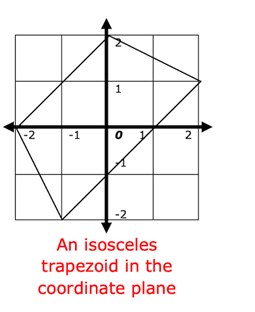
Much of our work with closed figures and their respective theorems has been either theoretical work or with measurements already given to us. We haven’t given many opportunities to test those theories by making our own measurements on figures because these documents cannot provide the opportunity to offer things to be measured.
The coordinate plane helps us find the relationships of various elements on closed figures and gives us the opportunity to test our theorems in a more interactive way. In this lesson, we will deal with classification of quadrilaterals using the theorems we know and measurements taken from the coordinate plane. Then, we will do some more circle work.
The Midpoint Formula
Our work in this lesson will require the knowledge of slopes we gained in the last lesson, the distance formula, and the midpoint formula. While the midpoint formula is fairly intuitive and easy, we haven’t had reason to use it until now.
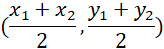
The midpoint between two points is exactly what it sounds like it is; the point in the middle, or equidistant, between two points. You could think of it like an average position between the two points. To take the average of two data points, you take their sum and divide that sum by two. The midpoint is similar in that you do this for each coordinate dimension, so the midpoint between (x1, y1) and (x2, y2) is:
Quadrilaterals and Their Sides
The most basic way we know how to classify quadrilaterals is by their side lengths and the sides’ relationships to each other. Here is a quick review of what we know about the sides in each type of special quadrilateral we have learned about:
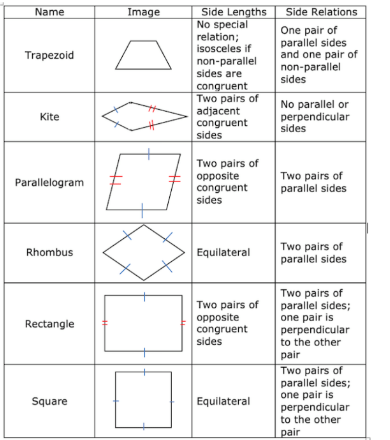
In the coordinate plane, we can use slopes to determine whether sides are parallel or perpendicular, and we can use the distance formula to determine the relationship between the side lengths.
Quadrilaterals and Their Diagonals
After a while, it becomes quite tedious performing the calculations for every single pair of sides. Doing so requires finding the distance and slope between every single pair of corners except for the two pairs of opposite corners. The line segments formed by those two corners, however, are also important; they are the quadrilateral’s diagonals, and we can classify nearly all the same quadrilaterals with diagonals that we can with sides.
Any quadrilateral has four sides and two diagonals. Analyzing the properties of the diagonals definitely saves time, but if you realize after this part of the lesson that you prefer analyzing the sides, that is perfectly fine.
Let’s look through the characteristics of the perpendicular bisectors for each of the six quadrilaterals we analyzed earlier.
|
Name |
Image |
Diagonals’ Properties |
|
Isosceles Trapezoid |
|
Diagonals are congruent. |
|
Kite |
|
Diagonals are perpendicular, one is bisected. |
|
Parallelogram |
|
Diagonals bisect each other. |
|
Rhombus |
|
Diagonals are perpendicular bisectors of each other. |
|
Rectangle |
|
Diagonals are congruent and bisect each other. |
|
Square |
|
Diagonals are congruent and perpendicularly bisect each other. |


Notice we switched “trapezoid” to “isosceles trapezoid”. That is because the diagonals of a trapezoid only have special properties if the two non-parallel sides are congruent. If you find no special properties in the diagonals, first check if any of the sides are parallel before concluding that the quadrilateral is simply a generic quadrilateral.
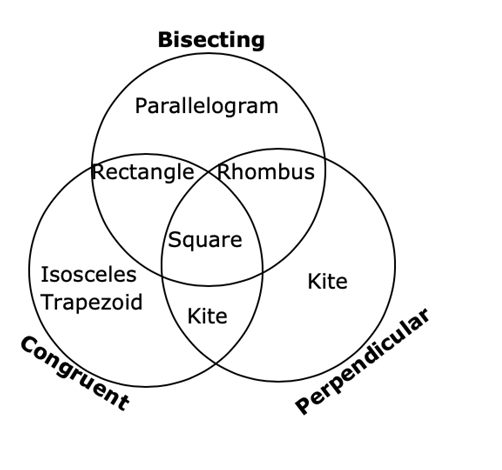
We have three criteria for our diagonals; perpendicular, bisecting, or congruent. We will thus need the slope, midpoint formula, and distance formula for each diagonal to determine each criterion respectively.
With the side method we had four sides and two calculations each for a total of eight calculations. With the diagonal method we have two diagonals and three calculations each for a total of six calculations. Once again, this method is more efficient.
You may find this Venn diagram helpful for remembering the diagonals’ criteria for each shape.
Closed Figures Enclose Finite Space
Every closed figure in the coordinate plane consists of connected line segments or curves that completely enclose a region, making them fundamental in spatial reasoning and geometric analysis.
Coordinate Geometry Provides Precision
By using coordinates, closed figures can be precisely defined, measured, and analyzed in terms of distance, slope, midpoint, and equations, allowing for accurate mathematical representations.
Properties of Figures Depend on Points and Relationships
The classification and properties of closed figures, such as polygons and circles, are determined by their vertices, side lengths, angles, and relative positioning in the coordinate plane.
Symmetry and Transformations Aid in Understanding Shapes
The study of symmetry, reflections, and parallelism in closed figures helps in understanding transformations and congruence, which are essential in proving geometric relationships.
Applications Extend to Real-World Problem Solving
Understanding closed figures in the coordinate plane has practical applications in architecture, engineering, physics, and design, where precision and spatial reasoning play a crucial role in planning and construction.