Unit: Dimensions and Properties
Chapter: Ratio Partitions
Reference: – Basic Geometric Dimensions, Length, Area, and Volume, Properties of Geometric Shapes, Perimeter and Circumference, Surface Area and Lateral Area, Relationships Between Dimensions, Parallelism and Perpendicularity, Symmetry and Transformations, Coordinate Geometry and Distance, Properties of Special Figures
After studying this chapter, you should be able to understand:
- Basic Geometric Dimensions & Length, Area, and Volume
- Properties of Geometric Shapes & Perimeter and Circumference
- Relationships Between Dimensions & Parallelism and Perpendicularity
- Coordinate Geometry and Distance & Properties of Special Figures
Basic Geometric Dimensions
Geometry classifies figures based on dimensions: one-dimensional figures consist of only length (such as lines), two-dimensional figures include length and width (such as polygons), and three-dimensional figures also have depth (such as solids). These dimensions help define the nature and properties of different geometric objects.
Length, Area, and Volume
Length refers to the extent of a line segment or curve. Area measures the amount of space enclosed within a two-dimensional shape, while volume quantifies the amount of space occupied by a three-dimensional object. These fundamental concepts are essential for analyzing and comparing geometric figures.
Properties of Geometric Shapes
Every geometric shape has specific properties that define its structure, such as the number of sides, types of angles, relationships between sides, and symmetry. These properties determine how figures relate to one another and how they can be categorized in geometry.
Perimeter and Circumference
The perimeter is the total length of the boundary of a polygon, while the circumference is the boundary length of a circle. Both concepts are crucial for understanding the extent of a shape and are widely used in practical applications, such as construction and design.
Surface Area and Lateral Area
Surface area represents the total area covered by the outer surfaces of a three-dimensional figure, while lateral area considers only the sides, excluding bases. These measurements help in determining material usage and understanding the external exposure of a shape.
Relationships Between Dimensions
The properties of geometric figures change based on their dimensions. For instance, when a shape is scaled, its perimeter, area, and volume change at different rates. This relationship is key to understanding transformations and the impact of size adjustments in real-world applications.
Parallelism and Perpendicularity
Parallelism occurs when two or more lines or planes never intersect, maintaining a constant distance apart. Perpendicularity refers to two lines or surfaces meeting at a right angle. These concepts are crucial in designing structures and analyzing spatial relationships in geometry.
Symmetry and Transformations
A figure has symmetry if it can be divided into identical parts by a line, point, or plane. Transformations involve changing a figure’s position or size through operations like reflection, rotation, translation, and dilation while preserving key properties. These principles are fundamental in geometry and artistic design.
Coordinate Geometry and Distance
The coordinate plane provides a system for analyzing geometric figures using numerical values. Distances between points, slopes of lines, and relative positions of shapes can be determined using coordinates. This approach allows for precise geometric reasoning and problem-solving.
Properties of Special Figures
Different geometric figures, such as triangles, quadrilaterals, circles, and polyhedra, have unique sets of properties. For example, triangles have specific angle relationships, quadrilaterals exhibit parallel and perpendicular sides, and circles have constant curvature. Understanding these properties helps in classifying and analyzing shapes in geometry.
Geometry, Figures & Properties: Construction
Introduction:
The construction refers to the constructing or making of an angle. By far, we have learned how to construct an angle with the help of a compass and ruler. Construction is a scoring chapter as it is based on the method and steps. In this chapter we will learn how to divide a given line segment into a given ration.
Division of a Line Segment
The line segment can be divided into a fixed ratio. There could be many different ways to do so. One method could be to take a ruler, measure the total length, and put markings on the line into an equal number of intervals depending on the ratio that is given to divide the line segment.
The above method above, however, may not work if the line is too small. And also, we always need to be prepared to use an easy and alternate method. In this one, we are going to use the principles of coordinate geometry.
Divide a line segment in a given ratio.
Given a line segment PQ, we want to divide it in the ratio m: n, where both m and n are positive integers. To help you to understand it, we shall take m = 3 and n = 2.
- Consider a line PR, as shown below. Line PR is a line segment of the ray PS.
- The objective is to divide the line PR in a ratio of 3:2.
- Next, we will drop two lines from point P and point R so that they both intersect at point Q and make an angle of 90 degrees with each other.
- The above step will give us a triangle QPR.
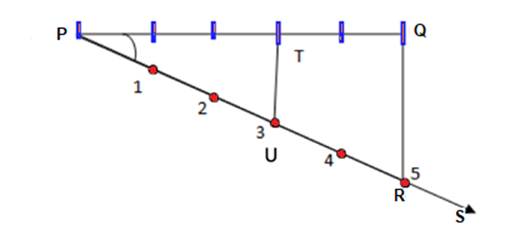
- Let us now divide the line PQ (the horizontal line) into five equal parts. And then drop a perpendicular from a point T.
- The reason we chose to divide the line PQ into five parts is that the required ratio is 3:2 (in which 3+2 = 5). Hence we divide the entire length of PQ into 5 sections.
- Point T is 3 units away from the Point P and 2 units away from the point Q
- T divides the line PQ into the ratio 3:2.
- And the perpendicular on the line PQ from Point T will intersect the line PR at point # 3.
- The line TU so obtained divided the line PR into ratio 3:2.
- This can also be proven by an axiom in triangle properties that any line drawn parallel to one of the sides of a triangle divides the remaining two lines into equal ratio. Here, in this case, the line TU is dividing PQ and PR into a ratio of 3:2.
The methods given above work for dividing the line segment in any ratio.
Fundamental Role of Dimensions
Understanding dimensions is crucial in geometry, as they define the structure and characteristics of all geometric figures. The distinction between one-dimensional, two-dimensional, and three-dimensional figures forms the basis for further geometric analysis.
Interrelationship of Measurements
Perimeter, area, surface area, and volume are interconnected properties that help quantify geometric shapes. These measurements are essential for practical applications such as engineering, architecture, and design.
Importance of Symmetry and Transformations
The study of symmetry and transformations allows for a deeper understanding of geometric relationships. Transformations like reflection, rotation, and dilation help in visualizing how figures can be altered while retaining their fundamental properties.
Coordinate Geometry as a Tool for Analysis
Using a coordinate system enhances the study of geometry by providing a numerical framework to calculate distances, slopes, and relationships between shapes. This approach is essential in problem-solving and real-world applications.
Application of Properties in Problem-Solving
Recognizing the properties of different geometric figures aids in solving complex problems. From understanding the characteristics of special figures to applying principles of parallelism and perpendicularity, these properties form the foundation for advanced studies in geometry and related fields.