Unit: Three-Dimensional Solids
Chapter: Cavalieri's Principle
Reference: – Fundamental Concept of Cavalieri’s Principle, Historical Background of Cavalieri’s Principle, Application to Prisms and Cylinders, Application to Pyramids and Cones, Cavalieri’s Principle in Spheres and Hemispheres, Generalization to Higher Dimensions, Comparison of Solids with Different Shapes, Use in Integral Calculus, Verification of Volume Formulas
After studying this chapter, you should be able to understand:
- Fundamental Concept of Cavalieri’s Principle & Historical Background of Cavalieri’s Principle
- Application to Prisms and Cylinders & Application to Pyramids and Cones
- Generalization to Higher Dimensions & Comparison of Solids with Different Shapes
- Use in Integral Calculus & Verification of Volume Formulas
Fundamental Concept of Cavalieri’s Principle
Cavalieri’s Principle states that if two three-dimensional solids have the same height and corresponding cross-sectional areas at every level, then their volumes are equal. It provides a method to compare volumes of objects without requiring direct measurement.
Historical Background of Cavalieri’s Principle
This principle was developed by Bonaventura Cavalieri, an Italian mathematician, as an early approach to understanding volume before the development of calculus. It provided a way to analyze geometric figures using an infinite number of slices.
Application to Prisms and Cylinders
When comparing prisms and cylinders, Cavalieri’s Principle allows one to establish volume relationships between different three-dimensional shapes with identical heights and equal cross-sections at every level, even if their bases have different shapes.
Application to Pyramids and Cones
The principle helps in understanding the volume of pyramids and cones by comparing them to prisms and cylinders with the same height. It shows that as long as the cross-sectional areas match at every level, their total volumes remain the same.
Cavalieri’s Principle in Spheres and Hemispheres
A sphere can be analyzed using Cavalieri’s Principle by comparing it with a different solid that has identical cross-sectional areas at every level. This principle is key in proving volume relationships for curved surfaces.
Generalization to Higher Dimensions
The idea behind Cavalieri’s Principle can be extended to higher dimensions beyond three-dimensional solids. It applies to four-dimensional figures and other abstract mathematical spaces, demonstrating its broader applications in advanced geometry.
Comparison of Solids with Different Shapes
Cavalieri’s Principle allows the evaluation of two solids with different external appearances but identical internal cross-sections. It helps confirm that these solids have equal volumes without requiring physical measurement.
Use in Integral Calculus
The principle serves as a foundation for integral calculus, which calculates the volume of irregular shapes by summing an infinite number of infinitely thin cross-sections. It plays a crucial role in mathematical analysis and problem-solving.
Verification of Volume Formulas
Traditional volume formulas for geometric solids can be verified using Cavalieri’s Principle. By slicing shapes into smaller sections, one can demonstrate that classic formulas remain valid without relying on experimental methods.
Real-World Applications
Cavalieri’s Principle is used in practical fields like architecture, engineering, and physics, where volume calculations are necessary. It helps determine the capacities of irregularly shaped objects and optimize space utilization in design.
Cavalieri’s Principle
We can use what we have learned about cross sections to get a deeper understanding of the volume of three-dimensional solids. Any three-dimensional solid can simply be thought of as a stack of countless individual cross-sections. Thinking of solids and cross-sections in this way will help lead us to Cavalieri’s Principle.
In this lesson we will learn about Cavalieri’s Principle and how it can lead us to the formulas of various solids.
Defining Cavalieri’s Principle
Observe the two solids below:
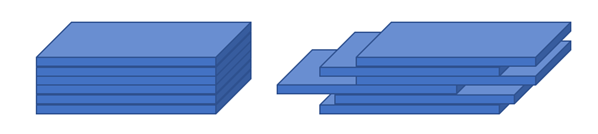
If you received a problem that told you to find the volume of a solid that looked like the one on the right, it would seem like quite a daunting task. Even once you realize that it’s simply created by a set of six rectangular prisms, it would be quite a hassle to find the volume of each individual rectangular prism and then add them up.
Meanwhile, the one on the left seems easy. Simply multiply length by width by height and you have the volume!
However, if you look closely, they are both made up of six identical rectangular cross sections. If you were to neatly stack the cross-sections of the figure on the right, it would be identical to the figure on the left. Therefore, the two figures have the exact same volume.
This brings us to Cavalieri’s Principle: If two solids have the same height, and cross-sections of the solid created by parallel planes at the same distance from the base consistently have the same area, then the two solids have the same volume. In more basic terms, no matter how you stack the cross-sections of a given solid, the solid will have the same volume.
Prisms
Cavalieri’s principle most directly applies to prisms. Any plane parallel to the base of a prism intersects a cross section with the exact same shape and area as the base, all the way up to the top.
The part of Cavalieri’s principle that specifies that parallel planes creating cross sections of the same area the same distance away from the base does not apply to prisms because every cross-section from parallel planes has the same area.
Thus, a prism only depends on two factors; the height of the prism and the area of the base. Thus, the volume for any prism is V = Bh, in which B is the area of the base and h is the height.
In a rectangular prism, the area of the base is length times width, giving us the formula we already know as V = l × w × h.
For a triangular prism, the area of the base is ½ × b × h, with b being the base length and h being the height of the triangle. This gives us the formula we learned in grade 7, V = ½ × b × h1 × h2, with h1 being the height of the triangular base and h2 being the height of the prism as a whole.
For a cylinder, the area of the base is πr2, with r being the radius, giving us the formula V = πr2h.
Spheres
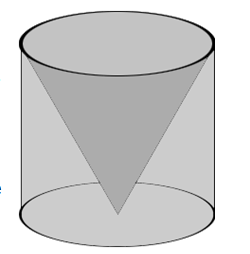
It is unfortunately not within the scope of this lesson to prove this, but a cone with the same height of a cylinder is 13 the volume of the cylinder. In algebraic terms, the relationship looks like this:
Suppose you carved out a cone from the inside of a cylinder the same height as the cylinder, like the diagram at the right, with the darker gray being empty space.
It turns out that the cross sections of the figure have the exact same area as the cross sections of a hemisphere with its flat edge parallel to the empty top of the cylinder! The diagram below displays a rough illustration of this (not to scale):
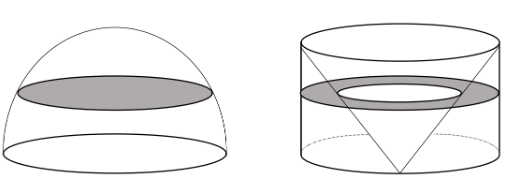
The two gray areas above have the exact same value, and they do at every other height as well. Since the carved-out cylinder and the hemisphere have the same area cross section at every height and the same area base, they are the same volume. Using the relationship Vcylinder = 3Vcone, the formula for the area of the carved-out cylinder, and thus also the hemisphere, is figured out below:
Vhemisphere = Vcylinder − Vcone
Vhemisphere = Vcylinder −  Vcylinder
Vhemisphere =  Vcylinder
Vhemisphere =  πr2h
πr2h
Since the height of a hemisphere is also its radius, it’s better to write it as:
Vhemisphere =  πr3
πr3
A hemisphere is half of a sphere, so the volume of a full sphere is:
Vsphere =  πr3
πr3
We don’t expect you to memorize any full proofs in this part of the lesson. What you should remember is the sphere formula and the fact that finding it is one of the things that Cavalieri’s Principle can do.
Universal Volume Comparison Method – Cavalieri’s Principle provides a powerful method to compare the volumes of different three-dimensional solids without requiring complex calculations, making it a fundamental tool in geometry.
Broad Applicability Across Shapes – This principle applies not only to standard geometric solids like prisms, cylinders, cones, and spheres but also extends to irregular and abstract shapes, demonstrating its versatility.
Foundation for Advanced Mathematics – Cavalieri’s Principle serves as an essential precursor to integral calculus, offering insights into how volume can be determined using infinite cross-sections.
Validation of Traditional Formulas – The principle helps in verifying established volume formulas by breaking solids into simpler slices, reinforcing mathematical understanding without direct measurement.
Real-World Significance – Beyond theoretical mathematics, Cavalieri’s Principle plays a crucial role in fields like engineering, architecture, and physics, where precise volume calculations are essential for design and functionality.