Unit: Three-Dimensional Solids
Chapter: Surface Area, Volume of Solids – Cube & Cuboid
Reference: – Fundamental Properties of Cube and Cuboid, Comparison Between Cube and Cuboid, Faces, Edges, and Vertices Relationship, Surface Area Concept, Lateral and Total Surface Area, Volume Interpretation, Effect of Scaling on Surface Area and Volume, Applications in Real-Life Scenarios, Decomposition of Composite Solids, Optimization Problems
After studying this chapter, you should be able to understand:
- Fundamental Properties of Cube and Cuboid & Comparison Between Cube and Cuboid
- Faces, Edges and Vertices Relationship & Surface Area Concept
- Lateral and Total Surface Area & Volume Interpretation
- Decomposition of Composite Solids, Optimization Problems
Fundamental Properties of Cube and Cuboid – A cube is a three-dimensional solid where all faces are equal squares, while a cuboid has rectangular faces with different dimensions. Both are six-faced polyhedral with opposite faces being parallel and congruent. Understanding their basic properties helps in visualizing their geometric structure.
Comparison Between Cube and Cuboid – While both shapes have six faces, eight vertices, and twelve edges, a cube is a special case of a cuboid where all edges are equal. Cuboids, on the other hand, have varied edge lengths, allowing for different proportions and shapes in practical applications.
Faces, Edges, and Vertices Relationship – The structure of these solids follows a fixed relationship between the number of faces, edges, and vertices. Each solid’s three-dimensional framework is formed by connecting edges at vertices, making it essential for spatial understanding.
Surface Area Concept – The surface area of a solid is the total area covered by its external faces. It determines the amount of material needed to cover the shape and is used in applications such as wrapping, painting, or designing external surfaces of objects.
Lateral and Total Surface Area – The lateral surface area considers only the vertical faces, excluding the top and bottom, while the total surface area includes all six faces. This distinction is crucial for applications where only certain faces are exposed or utilized, such as walls of a room or labels on a box.
Volume Interpretation – Volume represents the amount of three-dimensional space a solid occupies. It is a crucial concept in determining the storage capacity of objects, including water tanks, shipping containers, and packaging materials.
Effect of Scaling on Surface Area and Volume – When a cube or cuboid undergoes proportional enlargement or reduction, its surface area and volume change at different rates. This property is significant in scaling models, resizing objects, and analysing the impact of dimensional changes in real-world applications.
Applications in Real-Life Scenarios – Cubes and cuboids are frequently found in construction, packaging, and everyday objects. Their surface area helps in determining costs of materials like paint or fabric, while their volume is useful in storage and transportation industries.
Decomposition of Composite Solids – Many complex three-dimensional figures can be broken down into cubes and cuboids. This method simplifies calculations in architecture, engineering, and industrial design, allowing for the efficient use of materials and space.
Optimization Problems – Surface area and volume play a key role in optimizing designs to maximize efficiency and minimize waste. For instance, understanding these properties helps in designing storage units with minimal material usage while maximizing capacity.
Surface Area & Volume:
Anything with three dimensions (width, depth, and height) is a solid object. We use the term solids to define 3-D shapes. The 3-D objects may be hollow inside but we reserve the term solids to indicate that the object in discussion requires 3-dimensions in space to build them
In mathematics, in geometry and in measurements we will come across many solid figures, like Cuboids, Cubes, Cone, Cylinders, and Sphere etc.
Volume, as we have learned in past grades, is the amount of material that can fill a given 3-D object or the amount of space that a given object encloses in a three-dimensional space.
The surface area , put it simply, is the area of the two-dimensional boundary that encloses the three-dimensional space of a three-dimensional shape in the same way that the perimeter is the one-dimensional length of the boundary that encloses the two-dimensional space of a two-dimensional shape.
If you are ever in a situation where you do not know the formula for the surface area of a shape, simply find the area of each polygon (or of the surfaces) that are used to create a 3-D object. And then sum up all of the individual areas to obtain the total surface area.
Units of Measurements
1 cm = 10 mm
1 m = 100 cm = 1000 mm
1 km = 1000 m
1  = 1 ml =1000
1 litre = 1000 ml
Surface Area and Volume
Let us now study about the surface area and volume of Cuboids.
Cuboids
Cuboids are solids that have has six rectangular faces at right angles to each other.
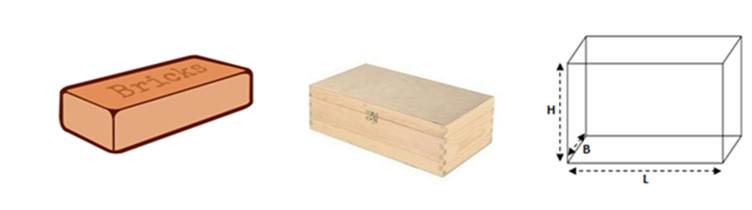
Surface area: It is the measure of the total area that the surface of the object occupies.
As cuboids are formed by 6 rectangular sheets and we know the area of rectangle is the product of both its sides, the area of all 6 sheets is mentioned in the diagram.
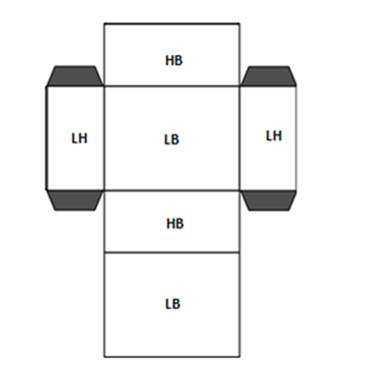
So, with this we can say that
Total Surface Area of Cuboids = 
= 
Lateral Surface Area = Total Surface area – (Area of Base + Top)=  – 2LB
– 2LB
=2 ( )
)
=2(L + B) H
Volume of Cuboid
Volume is the quantity of three-dimensional space enclosed by closed surface or the space that a shape occupies.
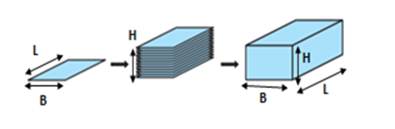
For volume of cuboids, let’s assume we have a rectangular sheet of dimensions L and B.
So, area of one sheet = L×B
Let’s pile H numbers of similar sheets over the first one, just like in the diagram.
Now, this means the total space covered by these number of sheets = L×B×H
Therefore, Volume of Cuboids= L×B×H
Cubes
Cube can be defined as a symmetrical three-dimensional shape, either solid or hollow, contained by six equal squares.
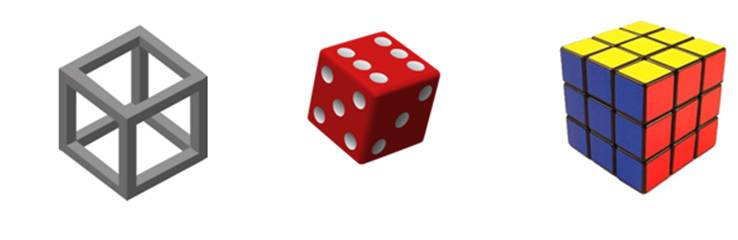
As cube are formed by 6 square sheets and we know the area of square is the product of both its sides, the area of all 6 sheets = 6  Therefore, Surface Area of a Cube = 6
Lateral Surface Area = Total Surface area – (Area of Base + Top)
= 6 
= 
Volume of Cube
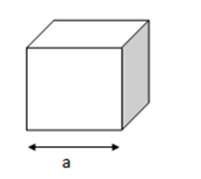
Using the similar concept of cuboids, the volume of cube can also be deriving.
Volume of Cube = 
Fundamental Geometric Understanding – The cube and cuboid are essential three-dimensional shapes in geometry, forming the basis for understanding spatial structures, volume, and surface area calculations.
Distinct Yet Related Properties – While cubes have equal edges, cuboids allow for varied dimensions, making them more versatile in real-life applications. Both shapes share common geometric relationships between faces, edges, and vertices.
Significance of Surface Area and Volume – Surface area determines the external coverage of an object, while volume measures its internal capacity. These concepts are widely used in construction, packaging, and industrial design.
Scaling and Proportional Changes – Changes in the dimensions of cubes and cuboids affect surface area and volume differently, which is crucial in fields like architecture and material optimization to enhance efficiency and reduce waste.
Real-World Applications – Understanding these properties helps in designing storage units, optimizing space, and determining material costs, making them indispensable in engineering, logistics, and manufacturing industries.