Unit: Three-Dimensional Solids
Chapter: Surface Area, Volume of Solids – Cylinder
Reference: – Definition and Properties of a Cylinder, Elements of a Cylinder, Types of Cylinders, Surface Area Concept, Lateral Surface Area, Volume of a Cylinder, Relationship Between Cylinder and Prism, Scaling Effects on Cylinders, Applications in Real Life
After studying this chapter, you should be able to understand:
- Definition and Properties of a Cylinder
- Elements of a Cylinder & Types of Cylinders
- Surface Area Concept & Lateral Surface Area
- Volume of a Cylinder & Relationship Between Cylinder and Prism
Definition and Properties of a Cylinder – A cylinder is a three-dimensional geometric figure that consists of two identical circular bases connected by a continuous curved surface. It has a uniform cross-section, meaning that any slice parallel to its bases will produce an identical shape.
Elements of a Cylinder – A cylinder consists of a base radius, a height, and a curved surface that wraps around it. The bases are parallel to each other, and the perpendicular distance between them is known as the height. The boundary of the circular base determines the overall structure of the solid.
Types of Cylinders – Cylinders can be classified into right cylinders, where the axis is perpendicular to the base, and oblique cylinders, where the axis is tilted. These distinctions affect how their dimensions interact and their applications in geometric analysis.
Surface Area Concept – The surface area of a cylinder refers to the total amount of space occupied by its outer surfaces. It includes contributions from the two circular bases as well as the curved surface that connects them. This concept is crucial in determining how much material is needed to construct or cover a cylindrical object.
Lateral Surface Area – The lateral surface of a cylinder refers to the curved portion that connects the two circular bases. When unrolled into a flat plane, it takes the shape of a rectangle. This area is especially important when considering the external exposure of the solid.
Volume of a Cylinder – The volume of a cylinder represents the total three-dimensional space enclosed within its boundaries. It is determined by the extent of its base and how far that base extends along the height. Understanding volume is essential in fields like engineering, where it helps estimate the capacity of cylindrical containers.
Relationship Between Cylinder and Prism – A cylinder can be compared to a prism since both have uniform cross-sections throughout their heights. While a prism has polygonal bases, a cylinder has circular bases. This similarity allows for the application of prism-related geometric principles to cylinders.
Scaling Effects on Cylinders – When the dimensions of a cylinder are increased or decreased proportionally, its surface area and volume also change in predictable ways. Understanding these effects is useful in designing scaled models, optimizing material use, and analyzing structural properties in architecture.
Applications in Real Life – Cylinders are commonly found in both natural and man-made structures, including storage tanks, pipelines, beverage cans, and engine components. Their geometric properties make them ideal for applications involving fluid containment and structural integrity.
Comparisons with Other Solids – Cylinders share similarities with cones and spheres but also exhibit distinct differences. Unlike a cone, which tapers to a point, a cylinder maintains a constant cross-section. These comparisons help in understanding the diverse range of three-dimensional solids and their mathematical properties.
Surface Area and Volume
Cylinder
A cylinder is a closed solid, 3-D object that has two parallel (usually circular) bases connected by a curved surface.
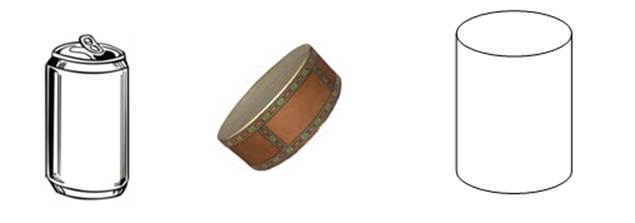
Here, we will be dealing with only right circular cylinders. So, unless stated otherwise, the word cylinder would mean a right circular cylinder.
Curved Surface Area of Cylinder
If we roll a rectangular sheet, a hollow cylinder is formed, as we can see from the figure.
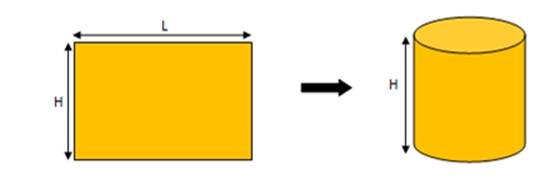
So the area of rectangular sheet will equal to the curved surface area of cylinder.
The length of rectangular sheet is equal to the circumference of the cylinder of radius R.
So, L= 2πR, B= H
Area of sheet = Curved Surface area of Cylinder = 2𝛑RH
Total Surface Area of Cylinder = Curved Surface Area of Cylinder + Area of Bases
= 2πRH + π
= 
Volume of Cylinder
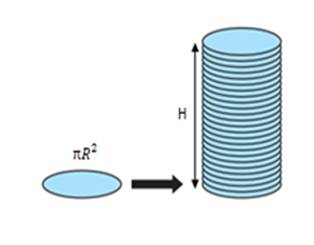
Let us assume a cylinder, which is formed by piling up circular plates to ‘H’ height.
Volume = Space covered by the cylinder= Area of 1 plate × Height
=  H
H
Fundamental Role in Geometry – Cylinders are essential three-dimensional solids with circular bases and a curved surface, making them a key subject in geometric studies and real-world applications.
Interplay of Surface Area and Volume – Understanding the surface area and volume of a cylinder is crucial for practical applications, such as calculating material requirements, optimizing space, and designing efficient containers.
Comparison with Other Solids – Cylinders share similarities with prisms and cones, but their distinct properties, such as a uniform cross-section, make them unique in mathematical modeling and structural design.
Scaling and Proportionality – Changes in a cylinder’s dimensions affect its surface area and volume in predictable ways, demonstrating the importance of proportional reasoning in mathematical and engineering applications.
Practical Applications – Cylinders are widely used in industries like construction, manufacturing, and fluid storage, emphasizing their significance in engineering, architecture, and everyday life.