Unit: Three-Dimensional Solids
Chapter: Surface Area, Volume of Solids – Cone
Reference: – Definition & Elements of a Cone, Comparison with Other Solids, Surface Area of a Cone, Volume of a Cone, Relationship Between Cone and Cylinder, Cross-Sections of a Cone, Scaling and Proportionality in Cones, Real-World Applications of Cones
After studying this chapter, you should be able to understand:
- Definition & Elements of a Cone
- Comparison with Other Solids & Surface Area of a Cone
- Relationship Between Cone and Cylinder & Cross-Sections of a Cone
- Scaling and Proportionality in Cones & Real-World Applications of Cones
Definition of a Cone – A cone is a three-dimensional geometric shape with a circular base and a curved surface that extends from the boundary of the base to a single fixed point called the vertex. The smooth transition from the base to the vertex differentiates it from other solids.
Elements of a Cone – A cone consists of several key elements, including its base, height, slant height, and lateral surface. The base is a flat circular region, the height is the perpendicular distance from the base to the vertex, and the slant height represents the shortest distance along the curved surface from the base to the vertex.
Comparison with Other Solids – The cone shares similarities with both cylinders and pyramids. While a cylinder has two parallel circular bases, a cone has only one, making it a tapered solid. A cone is also similar to a pyramid in that it converges to a single point, but unlike pyramids, its base is always circular rather than polygonal.
Surface Area of a Cone – The total external area of a cone is determined by its base and its lateral curved surface. The lateral surface extends from the circular boundary of the base to the vertex and forms a smooth, continuous curve that wraps around the structure.
Volume of a Cone – The volume of a cone represents the three-dimensional space it encloses. It depends on the dimensions of the base and height, and it is conceptually related to the volume of a cylinder, highlighting the proportional relationship between the two solids.
Relationship Between Cone and Cylinder – A cone can be visualized as a section of a cylinder where all the points on the circular base gradually converge toward the vertex. This relationship is significant in understanding volume and proportionality, as a cone can be derived from a cylinder by reducing its top surface to a single point.
Cross-Sections of a Cone – The shape of a cross-section obtained by slicing a cone depends on the orientation of the cutting plane. A horizontal cut results in a circular cross-section, while a vertical or inclined cut can produce an elliptical, parabolic, or hyperbolic cross-section, forming the basis of conic sections.
Scaling and Proportionality in Cones – When the dimensions of a cone are increased or decreased, its surface area and volume change according to specific geometric proportions. This concept is important in transformations, allowing for predictions of how a cone's size will change under uniform scaling.
Real-World Applications of Cones – Cones appear in various practical scenarios, including architecture, engineering, and everyday objects. They are used in designing structures such as towers, funnels, and traffic cones, where their tapered shape plays a functional role in stability and aerodynamics.
Mathematical Modeling with Cones – The geometric properties of cones make them essential in fields such as physics, design, and fluid mechanics. They are used in calculations related to motion, energy distribution, and optimization problems where curved surfaces play a role in efficiency and structural design.
Surface Area & Volume
Cone
A cone is a three-dimensional figure with a single curved base that tapers to a single point called an apex. The base of a cone can be a circle or an oval of some type.
In this chapter, we will only use circular cones, particularly a right circular cone. This is a cone with a circle on a flat surface that tapers to a point that is 90 degrees from the centre of the circle.
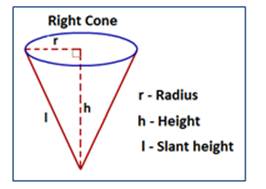
So, the term cone in this chapter, we shall mean a right circular cone.
Important Terms
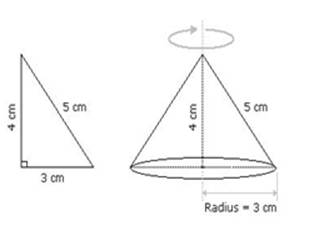
Radius – The radius is the distance from the centre to the edge of the circle at the base of cone.
Height – The height is the distance from the centre of the base to the tip of the cone.
Slant – The slant is the length from the edge of the circle to the tip of the cone.
You can also think of a cone as a triangle which is being rotated about one of its right-angled side.
Here we can see that if we rotate the triangle around the 4 cm side, we get a cone whose radius is 3 cm and height is 4 cm.
Surface Area & Volume of Cone
Curved Surface Area of Cone
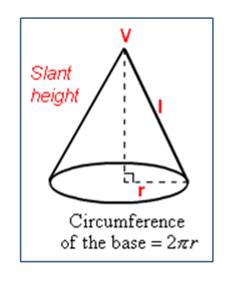
Curved Surface Area = 
= 
= 
Also,

Total Surface Area of Cone
Total Surface Area = Curved Surface Area + Area of base of cone
= 
Volume of Cone
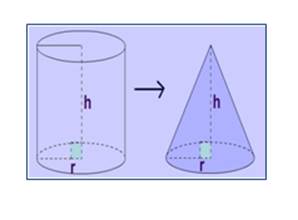
Volume of Cone = 
=
Understanding Three-Dimensional Structure – A cone is a fundamental three-dimensional shape with unique properties that distinguish it from other solids, such as cylinders and pyramids. Its tapered design and curved surface make it an important geometric figure in mathematical and practical applications.
Interdependence of Dimensions – The surface area and volume of a cone are determined by its radius, height, and slant height. Changes in any of these dimensions proportionally affect the overall measurements of the cone, making it essential to understand their relationships.
Comparative Study with Other Solids – The cone shares key relationships with cylinders and pyramids, particularly in terms of volume and proportionality. Understanding these relationships helps in comprehending the spatial characteristics of various three-dimensional solids.
Significance in Real-Life Applications – Cones play an essential role in diverse fields, including architecture, engineering, physics, and manufacturing. Their shape is widely utilized in the design of structures, aerodynamics, and fluid flow systems, making them an integral part of practical problem-solving.
Foundation for Advanced Geometric Concepts – Mastering the properties of cones provides a strong foundation for further studies in geometry, calculus, and physics. The principles learned here extend to more complex concepts such as conic sections, optimization problems, and volume integration in higher mathematics.