Unit: Three-Dimensional Solids
Chapter: Surface Area, Volume of Solids – Sphere
Reference: – Definition of a Sphere, Properties of a Sphere, Radius and Diameter of a Sphere, Surface Area of a Sphere, Volume of a Sphere, Hemispheres, Great Circles and Small Circles, Relationship Between Sphere and Other Solids, Applications of Spherical Geometry
After studying this chapter, you should be able to understand:
- Definition of a Sphere & Properties of a Sphere
- Radius and Diameter of a Sphere & Surface Area of a Sphere
- Great Circles and Small Circles & Applications
- Relationship Between Sphere and Other Solids
Definition of a Sphere
A sphere is a perfectly round three-dimensional object where every point on its surface is equidistant from a central point. It has no edges, corners, or flat surfaces, making it unique among geometric solids. The sphere is symmetrical in all directions, meaning its shape does not change regardless of how it is rotated.
Properties of a Sphere
The sphere exhibits properties such as uniform curvature, meaning its surface bends equally in all directions. It also has rotational symmetry, so it looks the same no matter how it is turned around its center. Additionally, it encloses the maximum volume for a given surface area compared to any other three-dimensional shape.
Radius and Diameter of a Sphere
The radius of a sphere is a straight line extending from its center to any point on its surface. The diameter is a straight line passing through the center, connecting two opposite points on the sphere. The diameter is always twice the radius and serves as a fundamental measurement for determining the sphere’s size.
Surface Area of a Sphere
The surface area of a sphere represents the total extent of its curved outer boundary. It depends on the radius, as an increase in radius results in a larger surface. Since the sphere has no flat faces, its surface is continuously curved without distinct edges.
Volume of a Sphere
The volume of a sphere represents the total amount of three-dimensional space it occupies. A sphere can enclose more volume than other solids of similar surface area, which makes it highly efficient in applications requiring minimal surface exposure while maximizing internal capacity.
Hemispheres
A hemisphere is formed when a sphere is divided into two equal halves by a flat plane passing through its center. Each hemisphere retains the properties of the sphere but has a flat circular base along the division. Hemispheres are commonly found in natural and engineered structures, such as domes and planetary hemispheres.
Great Circles and Small Circles
A great circle is the largest possible circular section that can be made on a sphere, always passing through its center. It divides the sphere into two equal halves. Small circles, in contrast, do not pass through the center and are formed by slicing the sphere at different heights parallel to a great circle. These concepts are crucial in navigation, astronomy, and mapping.
Relationship Between Sphere and Other Solids
The sphere is often compared with cylinders, cones, and cubes in geometry. For instance, a sphere can be inscribed within a cube or fit within a cylinder. Additionally, spheres and cones share proportional relationships when considering their volumes, demonstrating how different three-dimensional solids are interconnected.
Applications of Spherical Geometry
Spheres are widely used in real-world applications, including planetary bodies, sports equipment like balls, water droplets, soap bubbles, and engineering designs such as pressure vessels and domes. Their shape minimizes surface resistance and maximizes strength, making them ideal for fluid dynamics and aerodynamics.
Limitations of Traditional Geometry in Spheres
Unlike polyhedral shapes, spheres lack edges and vertices, making it difficult to apply traditional geometric principles such as angle measurements and flat surfaces. Specialized methods, such as calculus and spherical trigonometry, are used to analyse their properties in more advanced mathematical studies.
Surface Area and Volume
Sphere
A sphere is a three dimensional figure (solid figure), such that any point taken on the surface of this 3-D object, is at a constant distance from the centre. This is called the radius, from a fixed point called the centre of the sphere.
Total/ Curved Surface Area of Sphere
Surface Area of Sphere = 
As there is only one face in a sphere, it has only curved surface, so its
Curved Surface Area = Total Surface Area
Let us take a solid sphere, and slice it exactly ‘through the middle’ with a plane that passes through its centre what we get is called a hemisphere.
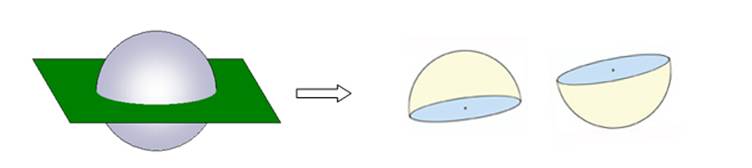
Curved Surface Area of a hemisphere = 2πR2
In case of hemisphere, there is one curved surface area and one plane base.
Therefore,
Total Surface area of hemisphere = 2 +
+  =
= 
Volume of Sphere and Hemisphere
Volume of Sphere = 

As hemisphere is half of Sphere,
Volume of Hemisphere = 

Spheres Are Unique Three-Dimensional Shapes
A sphere is a perfectly round solid with uniform curvature and symmetry in all directions. Unlike polyhedral, it has no edges, vertices, or flat surfaces, making its properties distinct in geometry.
Surface Area and Volume Depend on the Radius
The size of a sphere’s surface and the space it occupies are directly related to its radius. As the radius increases, both the surface area and volume grow, showing how scaling affects three-dimensional solids.
Hemispheres and Great Circles Expand Applications
When a sphere is divided into two equal halves, it forms hemispheres, which have practical applications in various fields. Great circles play an important role in navigation, geography, and astronomy, illustrating the significance of spherical geometry.
Spheres Are Widely Used in Real-World Applications
From planets and sports balls to engineering structures and fluid mechanics, spheres are found in numerous areas. Their shape minimizes surface area for a given volume, making them efficient in both natural and artificial designs.
Spheres Extend Beyond Basic Geometry
Traditional geometric methods are often insufficient to analyse spheres due to their continuous curvature. Advanced mathematical techniques, such as calculus and spherical trigonometry, are used to explore their properties in greater depth.