Unit: Construction
Chapter: Constructing Tangents to Circles
Reference: – Definition of Tangent to a Circle, Point of Tangency, Constructing a Tangent from an External Point, Constructing Two Tangents from an External Point, Constructing a Tangent at a Given Point on the Circle, Tangent Properties in Right Triangles, Using Compass and Straightedge for Tangent Construction, Tangent Segments from an External Point, Real-World Applications of Tangents, Tangents in Problem-Solving
After studying this chapter, you should be able to understand:
- Definition of Tangent to a Circle & Point of Tangency
- Constructing one or two Tangent from an External Point
- Tangent Properties in Right Triangles & Using Compass and Straightedge for Tangent Construction
- Real-World Applications of Tangents & Tangents in Problem-Solving
Definition of Tangent to a Circle
A tangent to a circle is a straight line that touches the circle at exactly one point. Unlike secants, which intersect the circle at two points, tangents maintain only a single contact with the boundary of the circle. This unique interaction plays a crucial role in geometric constructions.
Point of Tangency
The point where the tangent touches the circle is known as the point of tangency. At this point, a fundamental property states that the tangent is always perpendicular to the radius of the circle. This property serves as the basis for constructing accurate tangents in geometric problems.
Constructing a Tangent from an External Point
When given a point outside a circle, a tangent can be drawn by first identifying the center of the circle. A segment connecting the external point to the center is drawn, and a perpendicular line is constructed at the appropriate position to ensure it only touches the circle at one point. This process ensures precision in tangent construction.
Constructing Two Tangents from an External Point
From any point outside a circle, exactly two distinct tangents can be drawn. These tangents are equidistant from the external point, creating a symmetrical structure. The equal lengths of these tangents form an essential geometric property, which can be applied in various proofs and problem-solving scenarios.
Constructing a Tangent at a Given Point on the Circle
If the tangency point is already specified, a tangent can be drawn by constructing a perpendicular line to the radius passing through that point. Since a tangent only touches the circle at one location, this construction ensures that the resulting line does not extend into the circle’s interior.
Tangent Properties in Right Triangles
The relationship between tangents and right triangles is a fundamental concept in geometry. Since the radius to the point of tangency is always perpendicular to the tangent, right triangles often emerge in geometric constructions and proofs involving circles. This property is widely used in trigonometry and coordinate geometry.
Using Compass and Straightedge for Tangent Construction
Traditional geometric constructions rely on a compass and straightedge to achieve accuracy without measuring angles. Using these tools, tangents can be constructed by carefully ensuring that only one point of contact exists between the circle and the tangent line. This method maintains precision in classical geometric problems.
Tangent Segments from an External Point
When two tangents are drawn from the same external point to a circle, the segments from the external point to each tangency point are always equal in length. This fundamental property of tangents is used in geometric proofs and constructions, particularly in symmetrical designs and optimization problems.
Real-World Applications of Tangents
Tangents are widely applied in real-life scenarios, including engineering, architecture, and physics. Roads, bridges, and optical devices often incorporate tangents for structural stability and efficiency. The ability to construct tangents precisely ensures that these practical applications function correctly and safely.
Tangents in Problem-Solving
Geometric problems frequently involve tangents, requiring an understanding of their properties and relationships with circles. Whether solving for distances, constructing bisectors, or analyzing angular relationships, tangents serve as a crucial element in diverse problem-solving situations.
Geometry, Figures & Properties: Circle
Introduction:
Circle is a collection of all points in a plane such that all of those points are at a constant distance (radius) from a fixed point (centre). We have also studied various terms related to a circle like a chord, segment, sector, arc, etc. Let us now examine the different situations that can arise when a circle and a line are given in a plane.
So, let us consider a circle and a line PQ. There can be three possibilities as you can see from the figure below:
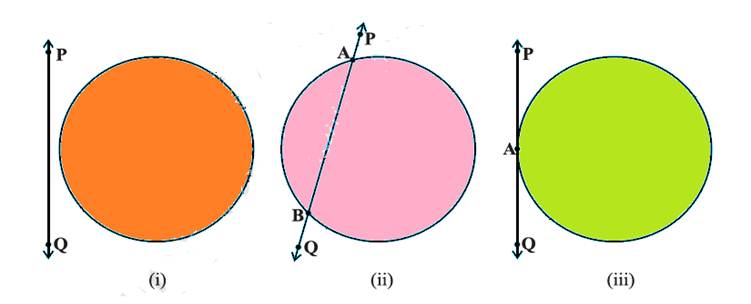
In Fig. (i), the line PQ and the circle do not touch each and hence have no common point. In this case, PQ is called a non-intersecting line with respect to the circle. In Fig. (ii), there are two common points A and B that the line PQ and the circle have. In this case, we call the line PQ a secant of the circle. In Fig. (iii), there is only one point A at which the line PQ is touching the circle; in this case, the line PQ is called a tangent to the circle.
A discus thrower spins around in a circle one and a half times then releases the discus. The discus forms a path tangent to the circle.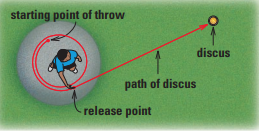
Tangent to a Circle:
Tangent to a circle is a line that intersects the circle at only one point.
To understand the existence of a tangent to a circle, let us perform the following activities:
Activity1:
On a drawing board or a wood table, put a plain paper and fix two pins A and B. Now keeping normal stress, tie up a black colour thread on these two points and draw a circle on the other side of another paper. See figure (i) below.
Now move the paper on which you have drawn in such a way that the thread appears like it is intersecting with the circle and dividing it into two parts. Name these points as P and Q. keeping the paper on which circle is drawn stable and fix a pin on point P. in this way, the paper can move with respect to point P. See figure (ii) below. Now move the paper on which circle is drawn and observe this process. We observe the following:
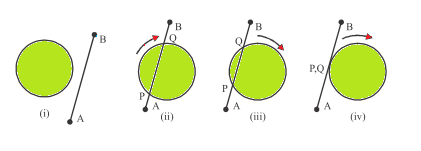 The distance between P and Q is reducing with moving means in every situation the chord length decreases from its initial length. See figure (iii) below.
- When point Q approaches to point P or when both coincide, then the length of the chord becomes zero. The line looks like intersecting at one point. See figure (iv) in this situation line AB touches the circle at P.
- If a circle is moved more in the same direction, then we observe that the length of the chord increases up to a specific limit, and after that, it decrease, and again we get the results as described in (i) and (ii).
Repeat the same process in the opposite direction; you will get the same result. After this activity, we can say that at any point on the circumference of a circle, only one tangent can exist.
Fundamental Role of Tangents – Tangents play a significant role in geometry by defining a unique relationship with circles, where they touch the circle at exactly one point while remaining perpendicular to the radius.
Precision in Construction – The construction of tangents using a compass and straightedge ensures accuracy without the need for direct angle measurement, making it a fundamental skill in geometric problem-solving.
Symmetry and Properties – Tangents from an external point to a circle are always equal in length, providing a useful property that helps in proofs, constructions, and symmetry-based problems.
Wide Applications – Tangents are not just theoretical; they are used in real-world applications such as engineering, physics, and architecture, especially in designing curves, roads, and reflective surfaces.
Foundation for Advanced Concepts – Mastering the construction and properties of tangents lays a strong foundation for more advanced geometric studies, including trigonometry, coordinate geometry, and calculus.