Unit: Real Numbers
Chapter: Inverse & Reciprocals of Rationals
Reference: – Understanding the Concept of Inverses in Mathematics, Additive Inverse of Rational Numbers, Multiplicative Inverse (Reciprocal) of Rational Numbers, Reciprocal of Different Forms of Rational Numbers, Properties of Inverses in Mathematical Operations, Connection Between Inverses and Identity Elements, Real-World Applications of Inverses and Reciprocals
After studying this chapter, you should be able to understand:
- Understanding the Concept of Inverses in Mathematics
- Additive & Multiplicative Inverse of Rational Numbers
- Reciprocal of Different Forms of Rational Numbers
- Real-World Applications of Inverses and Reciprocals
1. Understanding the Concept of Inverses in Mathematics
An inverse in mathematics refers to an operation or value that, when applied to a given number or function, results in an identity value. In the context of rational numbers, there are two main types of inverses:
- Additive Inverse: A number that, when added to the original number, results in zero.
- For example, +2 (or just 2) is an additive invers to “-2”, or in other words “2” and “-2” are additive inverse to each other.
- Multiplicative Inverse (Reciprocal): A number that, when multiplied by the original number, results in one.
- For example, ¾ multiplied by 4/3 results in 1. Hence “3/4” is a multiplicative inverse to “4/3”.
Inverses play a fundamental role in algebra, as they help simplify expressions, solve equations, and establish the fundamental relationships between numbers and operations.
2. Additive Inverse of Rational Numbers
The additive inverse of a rational number is the value that, when added to the original number, produces a sum of zero. This concept is based on the principle that every number has an opposite, which balances it out in addition.
- The additive inverse always has the same absolute value as the original number but is opposite in sign.
- This property is essential in solving algebraic equations where balancing expressions is required.
- The concept of additive inverses also extends to vectors and functions, making it an important mathematical tool.
Understanding additive inverses is crucial in algebraic operations, as it helps isolate variables and simplify expressions.
3. Multiplicative Inverse (Reciprocal) of Rational Numbers
The multiplicative inverse, commonly known as the reciprocal, is the value that, when multiplied by the original number, results in a product of one. This property ensures that every nonzero rational number has a unique reciprocal.
- The reciprocal of a rational number is based on the principle that multiplication is the inverse operation of division.
- Reciprocals are particularly useful in solving equations where division is required.
- The concept of multiplicative inverses is essential in understanding proportional relationships and scaling.
This inverse is widely used in algebra and higher mathematics, including calculus and probability theory.
4. Reciprocal of Different Forms of Rational Numbers
The reciprocal of a rational number depends on its representation, whether as a fraction, decimal, or mixed number:
- Fractions: The reciprocal is obtained by interchanging the numerator and denominator.
- Decimals: Reciprocals of decimals require converting them into fractions first, ensuring proper computation.
- Mixed Numbers: To find the reciprocal, they must first be converted into improper fractions before inverting the values.
There are also cases where reciprocals are undefined, such as when attempting to find the reciprocal of zero. This highlights the fact that division by zero is not possible, reinforcing the importance of mathematical rules and constraints.
5. Properties of Inverses in Mathematical Operations
Inverses follow specific mathematical properties that govern their behavior in operations:
- Additive Inverse Property: A number added to its inverse results in zero, making it essential for solving algebraic equations.
- Multiplicative Inverse Property: A number multiplied by its reciprocal results in one, showing its utility in division and simplification.
- Inverse Relationship in Equations: Inverses are used to simplify expressions and isolate variables in equations.
These properties help build a structured approach to solving mathematical problems, ensuring logical consistency in algebraic reasoning.
6. Connection Between Inverses and Identity Elements
Identity elements in mathematics are special numbers that, when used in an operation, do not change the original value:
- Zero as the Additive Identity: Any number added to zero remains unchanged, reinforcing the concept of additive inverses.
- One as the Multiplicative Identity: Any number multiplied by one remains the same, emphasizing the role of reciprocals in returning a product to its base value.
- Undefined Nature of Zero’s Reciprocal: Since division by zero is undefined, zero does not have a multiplicative inverse.
Understanding identity elements strengthens the concept of inverses, making their applications more intuitive in algebraic problem-solving.
7. Real-World Applications of Inverses and Reciprocals
Inverses and reciprocals are not just theoretical concepts; they have practical applications in various fields:
- Financial Calculations: Reciprocals are used in determining exchange rates, interest calculations, and proportional budgeting.
- Physics and Engineering: Many formulas involve inverses, such as in speed-time relationships and electrical resistance calculations.
- Scaling and Proportions: Reciprocals are used in resizing objects, adjusting recipes, and working with scale models.
- Probability and Statistics: Inverse relationships appear in probability distributions, where reciprocals help determine odds and likelihoods.
Example: –
A machine part needs to complete a full cycle of movement exactly 1 time in a given time interval. However, it can function at two different speed settings:
1. At Speed A, the machine completes 5/7 of a cycle in 4 minutes.
2. At Speed B, the machine completes 3/5 of a cycle in 6 minutes.
Solution: –
Step 1: Determine Work Rate for Each Speed
The rate of work is the fraction of the cycle completed per minute.
For Speed A:
- The machine completes 5/7 of a cycle in 4 minutes.
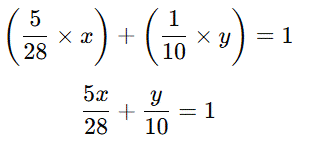
- Work done per minute 5/28 cycles per minute.
For Speed B:
- The machine completes 3/5 of a cycle in 6 minutes.
- Work done per minute 1/10 cycles per minute.
Step 2: Form the Equation for Full Cycle Completion
Let:
- x be the time in minutes the machine runs at Speed A.
- y be the time in minutes the machine runs at Speed B.
Since the machine must complete exactly one full cycle, we get:
Step 3: Express One Variable in Terms of the Other
If the total available time is not given, we assume the machine can run for as long as necessary.
Thus, we solve for one variable in terms of the other.
Multiplying everything by 280 (LCM of 28 and 10) to eliminate fractions:
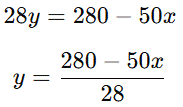
50x+28y=280
Rearranging for y:
Step 4: Find a Realistic Value for x and y
To ensure valid positive values for x and y, we set:
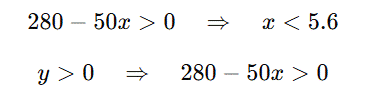
From both conditions, we find that x must be less than 5.6 minutes for valid solutions.
Step 5: Example Calculation
Let’s assume x=5 minutes at Speed A:
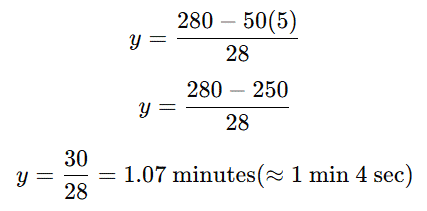
Thus, the machine should run for:
- 5 minutes at Speed A
- 1 minute and 4 seconds at Speed
Final Answer:
To complete exactly one full cycle, the machine should run:
- 5 minutes at Speed A (Rate: 5/28 cycles per minute)
- 1 minute and 4 seconds at Speed B (Rate: 1/10 cycles per minute)
This ensures the machine completes exactly one full cycle. ✅
Here are five conclusive points summarizing the chapter "Inverse & Reciprocals of Rationals"
- Inverses Are Fundamental to Mathematical Operations – Both additive and multiplicative inverses are essential in algebra, as they help simplify expressions, balance equations, and provide a structured approach to mathematical problem-solving.
- Every Nonzero Rational Number Has a Reciprocal – The multiplicative inverse, or reciprocal, of a rational number always exists except for zero. This property ensures that division by a nonzero rational number is always possible and meaningful.
- Identity Elements Help Define Inverses – The additive inverse of a number returns the sum to zero, while the multiplicative inverse returns the product to one. These properties demonstrate the relationship between inverses and identity elements in mathematics.
- Undefined Nature of Zero’s Reciprocal Reinforces Mathematical Rules – Since division by zero is undefined, zero has no multiplicative inverse. This fundamental property ensures logical consistency in algebra and prevents computational errors.
- Inverses and Reciprocals Have Practical Applications – These concepts are widely used in real-world scenarios such as financial calculations, physics, engineering, probability, and proportional reasoning, making them essential for both theoretical and applied mathematics.