Unit: Real Numbers
Chapter: Properties of Rational Numbers
Reference: – Definition and Characteristics of Rational Numbers, Closure Property of Rational Numbers, Commutative Property of Addition and Multiplication, Associative Property of Addition and Multiplication, Distributive Property of Multiplication Over Addition, Identity Properties of Rational Numbers, Inverse Properties of Rational Numbers, Density Property of Rational Numbers, Applications of Rational Number Properties in Algebra
After studying this chapter, you should be able to understand:
- Definition and Characteristics of Rational Numbers
- Commutative & Associative Property of Addition and Multiplication
- Identity Properties of Rational Numbers
- Applications of Rational Number Properties in Algebra
1. Definition and Characteristics of Rational Numbers
Rational numbers are a fundamental category of real numbers that can be expressed in the form of a ratio between two integers, where the denominator is not zero. They can be represented in different forms, including fractions, terminating decimals, and repeating decimals. Rational numbers contrast with irrational numbers, which cannot be written as exact fractions and have non-repeating, non-terminating decimal expansions. Understanding rational numbers is essential in algebra, as they form the basis for arithmetic and algebraic operations.
2. Closure Property of Rational Numbers
The closure property states that a set of numbers is closed under an operation if performing that operation on any two numbers in the set results in another number that also belongs to the same set. Rational numbers exhibit closure under addition, subtraction, and multiplication, meaning that combining any two rational numbers using these operations will always yield a rational number. However, division is closed only when the divisor is not zero, as division by zero is undefined. This property ensures consistency in mathematical operations and is fundamental in algebraic computations.
3. Commutative Property of Addition and Multiplication
The commutative property refers to the ability to change the order of numbers in an operation without affecting the outcome. Rational numbers follow the commutative property under addition and multiplication, meaning that swapping the order of two numbers does not alter the sum or product. This property is significant in simplifying expressions, rearranging terms in equations, and performing mental calculations efficiently. However, subtraction and division do not follow this property, as changing the order of numbers in these operations can lead to different results.
4. Associative Property of Addition and Multiplication
The associative property states that the grouping of numbers in an operation does not change the result. For rational numbers, addition and multiplication are associative, meaning that regardless of how numbers are grouped within parentheses, the outcome remains unchanged. This property is useful in algebraic manipulations, as it allows for reordering and regrouping of terms to simplify expressions and solve equations more efficiently. However, subtraction and division do not adhere to this property, as changing the grouping in these operations can yield different results.
5. Distributive Property of Multiplication Over Addition
The distributive property establishes a relationship between multiplication and addition, allowing a number to be multiplied separately by each term inside parentheses before performing addition or subtraction. This property is fundamental in algebra, as it facilitates expansion, factorization, and simplification of expressions. It also plays a crucial role in solving equations by distributing terms across sums or differences, making it easier to manipulate complex algebraic expressions systematically.
6. Identity Properties of Rational Numbers
Identity properties define specific elements that, when used in an operation, do not alter the original value of a number. Rational numbers exhibit two identity properties:
- The additive identity states that adding zero to any rational number results in the same number, as zero does not affect the sum.
- The multiplicative identity states that multiplying any rational number by one retains its original value, as one does not change the product.
These properties are fundamental in algebraic problem-solving, ensuring consistency in operations and simplifying equations.
7. Inverse Properties of Rational Numbers
Inverse properties describe how a number interacts with its opposite or reciprocal to yield identity values.
- The additive inverse of a rational number is a value that, when added to the original number, results in zero. This concept is essential for balancing equations and solving for unknown values.
- The multiplicative inverse, also known as the reciprocal, is a value that, when multiplied by the original number, results in one. This property is crucial in division, as dividing by a number is equivalent to multiplying by its reciprocal.
Inverse properties are widely applied in algebraic simplifications and equation solving.
8. Density Property of Rational Numbers
The density property states that between any two rational numbers, there exists an infinite number of other rational numbers. This characteristic ensures that rational numbers are densely packed on the number line, meaning that they can always be subdivided into smaller rational values. This property is essential in various mathematical fields, such as calculus, where limits and continuity rely on the infinite divisibility of numbers. The density property also plays a crucial role in real-world applications, such as measurements and financial calculations, where precision is required.
9. Applications of Rational Number Properties in Algebra
The properties of rational numbers are essential in algebra, as they help simplify expressions, solve equations, and establish logical relationships between numbers. These properties allow for efficient computation, provide a systematic approach to problem-solving, and ensure accuracy in mathematical reasoning. Additionally, rational number properties extend beyond theoretical mathematics into real-world applications, including engineering, economics, and scientific analysis, where calculations must adhere to structured rules for consistency and precision.
Example: –
Let x, y and z be three distinct rational numbers such that:
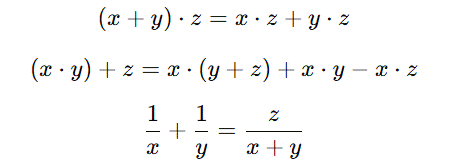
Find the values of x, y & z satisfying the above equations, ensuring that no denominator becomes zero.
Solution: –
We are given three equations involving rational numbers x, y & z:
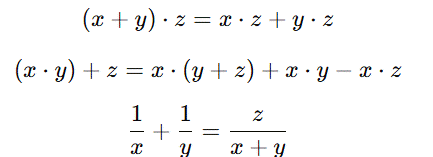
Step 1: Analysing the First Equation
(x+y)⋅z=x⋅z+y⋅z
This is simply the distributive property of multiplication over addition:
z(x+y)=zx+zy
Since this property holds for all rational numbers, it is always true and does not provide any new information about the values of x, y & z
Step 2: Simplifying the Second Equation
(x⋅y)+z=x⋅(y+z)+x⋅y−x⋅z
Expanding the terms:
xy+z=xy+xz+xy−xz
Cancel out xz:
xy+z= 2xy
Rearrange:
z=2xy−xy
So, we establish that z=xy.
Step 3: Solving the Third Equation
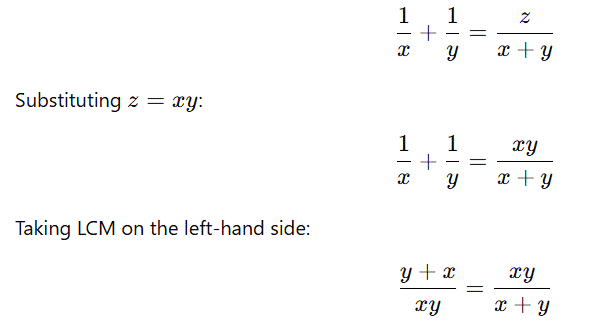
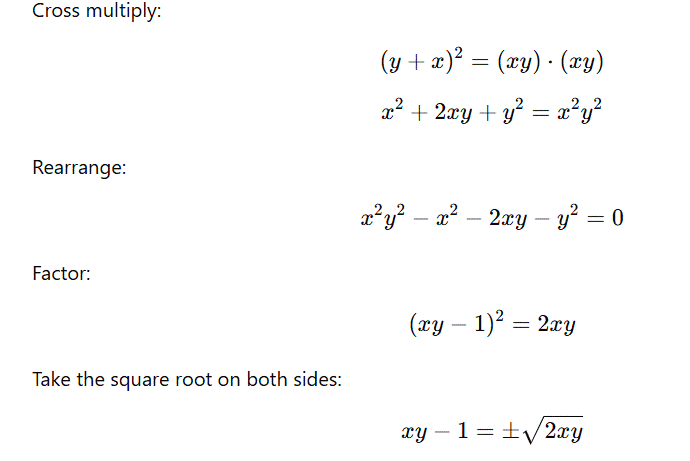
Step 4: Special Case with Rational Solutions
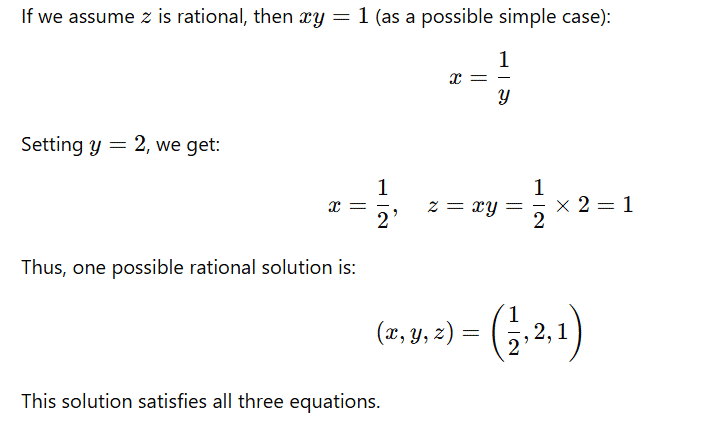
Final Answer:
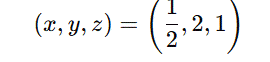
A valid rational solution to the problem is:
Here are five conclusive points summarizing the chapter "Properties of Rational Numbers"
- Rational Numbers Follow Fundamental Mathematical Properties – Rational numbers obey key mathematical properties, including closure, commutativity, associativity, and distributivity, ensuring consistency in arithmetic and algebraic operations.
- Identity and Inverse Elements Maintain Mathematical Structure – The existence of identity elements (zero for addition and one for multiplication) and inverse elements (additive and multiplicative inverses) ensures that equations can be balanced and solved systematically.
- Rational Numbers Are Densely Packed on the Number Line – Between any two rational numbers, an infinite number of other rational numbers exist, demonstrating their density and allowing for precision in measurements and calculations.
- Operations on Rational Numbers Are Predictable and Reliable – The defined properties of rational numbers guarantee that arithmetic operations will always yield consistent results, making them essential for algebraic problem-solving and logical reasoning.
- Rational Number Properties Have Practical Applications – These properties are crucial not only in theoretical mathematics but also in real-world applications such as finance, engineering, and science, where structured and accurate calculations are required.