Unit: Comparing Quantities
Chapter: Profit, Loss & tax – 1
Reference: – Concept of Profit Change, Formula and Interpretation of Profit Increase & Decrease, Successive Profit Changes, Introduction to Discounting, Cumulative Discounting and Its Effects, Comparison of Discounted Prices and Original Values, Real-World Applications of Profit Change and Discounting, Effect of Profit Change on Different Quantities
After studying this chapter, you should be able to understand:
- Concept of Profit Change
- Formula and Interpretation of Profit Increase & Decrease
- Cumulative Discounting and Its Effects
- Effect of Profit Change on Different Quantities
- Concept of Profit Change
- Profit change represents the relative difference between an initial and final value in proportion to the original amount.
- It is widely used to measure growth or decline in various domains such as finance, population studies, and business trends.
- Formula and Interpretation of Profit Increase & Decrease
- Profit increase signifies growth in value, while Profit decrease indicates reduction.
- It helps in understanding how values change over time, such as inflation, depreciation, or salary increments.
- Successive Profit Changes
- When multiple Profit increases or decreases occur one after another, they impact the value cumulatively rather than independently.
- This concept is applicable in financial sectors, especially in cases like compound interest, multi-stage taxation, and changing market prices.
- Introduction to Discounting
- Discounting refers to the reduction applied to an original price to make it more attractive for buyers.
- It is commonly observed in commercial transactions, seasonal sales, and promotional offers to influence consumer behavior.
- Cumulative Discounting and Its Effects
- When multiple discounts are applied successively, the reduction is not based on the original price but on the progressively reduced amount.
- This plays a crucial role in determining final prices in retail businesses and structured pricing strategies.
- Comparison of Discounted Prices and Original Values
- Analysing discounted values allows individuals to understand how much they save compared to the original cost.
- This concept is significant in financial planning, purchasing decisions, and marketing strategies.
- Real-World Applications of Profit Change and Discounting
- Profit-based calculations are extensively used in stock market analysis, economic forecasting, taxation, and salary structuring.
- Discounting principles are implemented in e-commerce, wholesale pricing, and business negotiations.
- Effect of Profit Change on Different Quantities
- Profit change can affect different types of quantities, influencing variables such as interest rates, demographic changes, and pricing adjustments.
- Understanding these effects is crucial for making informed decisions in business, education, and personal finance.
- Reverse Calculation of Original Price from Discounted Value
- Determining the original value from a discounted price involves understanding the inverse process of Profit reduction.
- This is particularly useful for businesses when adjusting product prices and for consumers evaluating pre-discount costs.
Example: –
A high-end luxury watch is initially priced at $50,000. Due to various business decisions and market factors, the price undergoes multiple changes:
- The company first increases the price by 30% due to rising production costs.
- A month later, a 10% discount is offered during a special sale.
- After the sale, another 20% discount is applied as part of a clearance offer.
- A 15% luxury tax is then added to the final price.
Using the concepts of Profit increase, successive Profit changes, and cumulative discounting, determine:
- The price after the 30% increase.
- The price after the first 10% discount.
- The price after the second 20% discount.
- The final price after applying the 15% luxury tax.
- The overall Profit change from the original price.
Solution: –
(1) Price After 30% Increase
A 30% increase means the new price is:
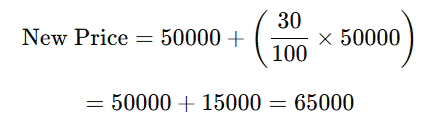
So, after the price increase, the new price is $65,000.
(2) Price After 10% Discount
A 10% discount means reducing the price by 10% of $65,000:
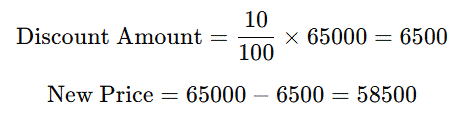
So, after the first discount, the price is $58,500.
(3) Price After 20% Discount
A 20% discount is applied to $58,500:
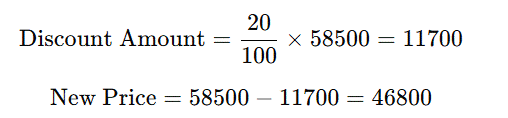
So, after the second discount, the price is $46,800.
(4) Final Price After 15% Luxury Tax
A 15% tax is applied on $46,800:
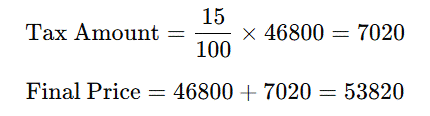
So, after applying the luxury tax, the final price is $53,820.
(5) Overall Profit Change from Original Price
The original price was $50,000, and the final price is $53,820.
The overall increase is:
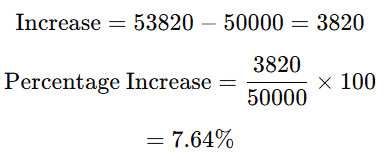
Thus, the overall Profit change in price from the original cost is 7.64% increase.
Conclusive Points for "Profit Change and Cumulative Discounting"
- Profit change is a fundamental concept for analysing variations in values across different fields such as finance, economics, and daily transactions. It helps in understanding how an amount increases or decreases relative to its original value.
- Successive Profit changes do not simply add up but affect values in a compounded manner. This principle is widely applied in taxation, interest calculations, and multi-level discounting strategies.
- Cumulative discounting significantly impacts pricing strategies and consumer decisions. Multiple discounts applied successively result in a different final price than a single equivalent discount, influencing purchasing behavior in retail and e-commerce.
- Understanding the relationship between discounted and original values is crucial for financial planning. It allows businesses to set competitive prices and helps consumers make informed purchasing decisions by evaluating true cost savings.
- The application of Profit change and discounting extends beyond shopping and business into broader areas such as economic policy, salary adjustments, and investment growth. Mastering these concepts enables better financial literacy and decision-making in both personal and professional contexts.