Unit: Linear Equation with two Variable
Chapter: Solving Linear Equations, Algebraic Methods
Reference: – Understanding Systems of Linear Equations, Substitution Method, Elimination Method, Comparison Method, Checking Solutions, Application of Algebraic Methods, Advantages and Limitations of Different Methods, Transforming Equations for Simplicity, Connecting Algebraic and Graphical Methods
After studying this chapter, you should be able to understand:
- Understanding Systems of Linear Equations
- Substitution Method, Elimination Method & Comparison Method
- Advantages and Limitations of Different Methods
- Connecting Algebraic and Graphical Methods
- Substitution Method
- This method involves expressing one variable in terms of another using one equation and then replacing it in the second equation. This reduces the system to a single-variable equation, which can then be solved. After finding one variable, it is substituted back into the original equation to determine the other variable.
- Elimination Method
- This technique involves manipulating equations by adding or subtracting them to eliminate one variable. If necessary, both equations may be multiplied by specific values to align coefficients, making elimination possible. After reducing to a single-variable equation, the solution is found and substituted into one of the original equations to determine the second variable.
- Transforming Equations for Simplicity
- Before applying algebraic methods, equations may be rewritten to simplify their structure. This can involve clearing fractions, rearranging terms, or multiplying by constants to make solving more efficient. A well-structured equation set helps in systematically solving for unknowns.
- Application of Algebraic Methods in Real-World Scenarios
- These algebraic techniques are widely used in real-life problem-solving, including financial planning, physics, and engineering. By forming equations based on relationships between variables, practical problems can be analysed and solved efficiently.
- Solving Special Cases
- Certain systems of equations lead to special outcomes. If solving results in a contradiction, it implies no solution, meaning the equations represent parallel lines. If both equations simplify to the same expression, infinitely many solutions exist, meaning the lines overlap completely. Recognizing these cases enhances mathematical reasoning.
- Comparing Different Algebraic Methods
- The substitution and elimination methods are compared based on efficiency and ease of solving. While substitution is useful when one equation is easily expressible in terms of a single variable, elimination is preferred when coefficients align conveniently for direct elimination. The choice of method depends on the complexity and structure of the given equations.
- Connecting Algebraic and Graphical Methods
- Each algebraic solution corresponds to a graphical representation, where solving equations algebraically can be verified by plotting their graphs. The intersection point of the two lines represents the solution, demonstrating the visual aspect of linear equations alongside the algebraic approach.
Example: –
A company manufactures and sells two types of laptops: Model X and Model Y.
- Model X costs $800 to produce and Model Y costs $1,200 to produce.
- The company has a daily production budget of $48,000.
- It also has a total production capacity of 50 laptops per day.
How many units of Model X and Model Y should be produced daily to use the full budget and capacity?
Use substitution, elimination, transformation of equations, special cases, and graphical connection to solve this problem.
Solution: –
Step 1: Define Variables
Let:
- x = Number of Model X laptops produced per day
- y = Number of Model Y laptops produced per day
Two conditions must be satisfied:
- Production Capacity Constraint:
x+ y=50
- Budget Constraint:
800x+1200y=48000
Step 2: Solve Using Substitution Method
From the first equation:
y=50−x
Substituting into the second equation:
800x+1200(50−x) =48000
Expanding:
800x+60000−1200x=48000
Combine like terms:
−400x+60000=48000
Transposing:
−400x=48000−60000
−400x=−12000
Dividing by -400:
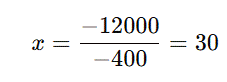
Now, solve for y:
y=50−30=20
Step 3: Solve Using Elimination Method
Multiply the first equation by 800 to align coefficients:
800x+800y=40000
Now, subtract from the budget equation:

Solving for y:
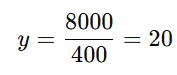
Step 4: Verify Special Cases
- The system has one unique solution (x=30, y=20), meaning the lines intersect at a single point.
- If the equations resulted in a false statement (e.g., 0=5), there would be no solution (parallel lines).
- If they reduced to the same equation, there would be infinite solutions (overlapping lines).
Step 5: Graphical Connection
- Equation 1: x+ y=50 is a straight line passing through (50,0) and (0,50).
- Equation 2: 800x+1200y=48000 is a straight line passing through (60,0) and (0,40).
- Their intersection point (30,20) verifies the solution algebraically and graphically.
Conclusive Points for "Solving Linear Equations, Algebraic Methods"
- Algebraic Methods Provide Systematic Solutions
- The substitution and elimination methods are structured approaches that simplify solving systems of linear equations, ensuring accurate results. They help in efficiently determining unknown values without relying on graphical estimations.
- Different Methods Are Suitable for Different Scenarios
- The substitution method is effective when an equation is already solved for one variable, while the elimination method is preferable when variables can be eliminated easily through addition or subtraction. The choice of method depends on the given equations and their structure.
- Equations Can Have Unique, Infinite, or No Solutions
- Depending on the relationship between two equations, a system can have a single unique solution (intersecting lines), infinitely many solutions (overlapping lines), or no solution (parallel lines). Recognizing these possibilities helps in interpreting real-world applications.
- Algebraic Solutions Are Verifiable Graphically
- The intersection of two lines on a coordinate plane corresponds to the algebraic solution of a system. This connection between algebraic and graphical approaches provides an additional way to confirm solutions.
- Real-World Applications Strengthen Conceptual Understanding
- The algebraic methods for solving linear equations are widely used in finance, physics, economics, and engineering. Applying these methods to real-life problems, such as budgeting, motion analysis, and market trends, reinforces their importance beyond theoretical learning.