Unit: Linear Equation with two Variable
Chapter: Solving Linear Equations, Graphical Methods
Reference: – Understanding the Cartesian Coordinate System, Graphing Linear Equations, Finding Intercepts and Slope, Graphical Representation of Linear Equations, Intersection of Two Lines, Types of Solutions in Graphical Method, Real-World Applications of Graphical Solutions
After studying this chapter, you should be able to understand:
- Understanding the Cartesian Coordinate System
- Finding Intercepts and Slope & Graphical Representation of Linear Equations
- Intersection of Two Lines
- Real-World Applications of Graphical Solutions
- Understanding the Cartesian Coordinate System
- The Cartesian plane consists of two perpendicular lines, called axes, that divide the plane into four regions. These axes provide a structured way to represent algebraic equations graphically.
- Every point on the plane is defined by an ordered pair, which corresponds to a specific location in relation to the axes.
- Understanding the coordinate system helps in visualizing mathematical relationships and analysing solutions to equations in a graphical manner.
- Graphing Linear Equations
- A linear equation represents a straight-line relationship between two variables. The equation defines how one variable changes in response to the other.
- Graphing a linear equation requires translating the equation into a visual representation on the coordinate plane.
- By plotting specific points that satisfy the equation, a straight line can be drawn to represent all possible solutions of the equation.
- Finding Intercepts and Slope
- The intercepts of a linear equation are the points where the line crosses the coordinate axes. These points provide an easy way to graph the equation.
- The slope of a line defines its steepness and direction. It indicates how one variable changes with respect to the other.
- Understanding intercepts and slope is essential for constructing accurate graphs and interpreting their meaning in real-world contexts.
- Graphical Representation of Linear Equations
- Each linear equation corresponds to a unique straight line on the graph. The position and orientation of this line depend on the equation’s parameters.
- The visual representation allows for quick analysis of the relationship between variables and helps in identifying patterns and trends.
- By comparing different graphs, one can determine whether equations have common solutions or distinct behaviours.
- Intersection of Two Lines
- When two linear equations are plotted on the same coordinate plane, their intersection represents the common solution to both equations.
- If the lines intersect at a single point, it indicates a unique solution where both equations hold true simultaneously.
- The concept of intersection is fundamental in solving systems of equations graphically, allowing for intuitive problem-solving approaches.
- Types of Solutions in Graphical Method
- The graphical approach reveals different types of solutions based on how lines relate to each other.
- If two lines meet at a single point, there is a unique solution. If they are parallel, no solution exists. If they overlap completely, infinitely many solutions exist.
- Recognizing these different cases helps in understanding how equations behave and whether they lead to meaningful outcomes.
- Real-World Applications of Graphical Solutions
- Graphical methods are widely used in real-life scenarios such as economics, physics, and engineering.
- By representing relationships visually, one can easily interpret trends, make predictions, and solve optimization problems.
- The ability to graph and analyse linear equations enhances decision-making in various fields, including business, transportation, and scientific research.
Example: –
A company produces and sells two types of fitness bands: Basic Model and Advanced Model.
- The total number of bands produced daily is 200.
- The total revenue generated by selling the fitness bands is $18,000, where the Basic Model sells for $50 per unit and the Advanced Model sells for $120 per unit.
Find the number of Basic and Advanced models produced daily using the graphical method.
Solution: –
Step 1: Define Variables
Let:
- x = Number of Basic Model fitness bands produced per day
- y = Number of Advanced Model fitness bands produced per day
We have two conditions:
- Production Capacity Constraint:
x+ y=200
- Revenue Constraint:
50x+120y=18000
Step 2: Convert Equations to Graphable Form
For Equation (1):
y=200−x
For Equation (2), express y in terms of x:
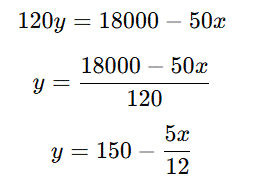
Step 3: Find Intercepts
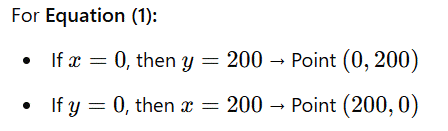
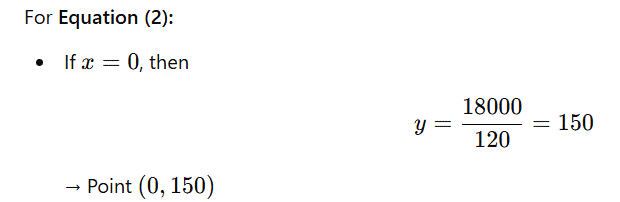
Step 4: Graphical Representation
- Plot (0, 200) and (200, 0) to draw the first line.
- Plot (0, 150) and (360, 0) to draw the second line.
- Identify the intersection point, which represents the solution.
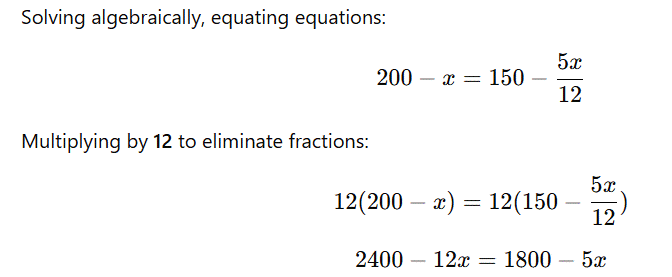
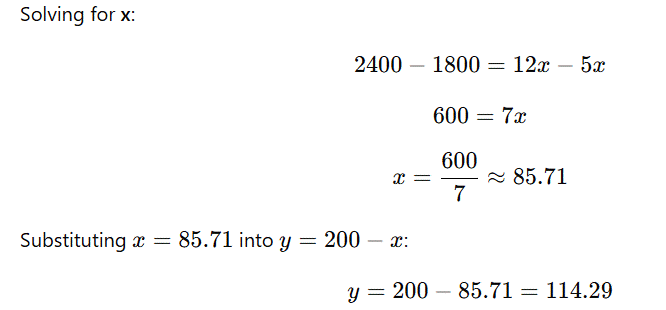
Step 5: Solution Interpretation
- The company should produce approximately 86 Basic Models and 114 Advanced Models daily.
- The intersection confirms the solution graphically.
Conclusive Points for "Solving Linear Equations, Graphical Methods"
- Graphical Representation Simplifies Understanding
- Visualizing equations as graphs provides an intuitive way to understand the relationship between variables and their solutions. It helps in analysing mathematical relationships without relying solely on algebraic manipulation.
- Intersection of Lines Determines Solutions
- The graphical method effectively identifies the solution of a system of linear equations by locating the intersection of their respective lines. The nature of this intersection determines whether a unique, infinite, or no solution exists.
- Different Types of Solutions are Easily Identified
- Graphs reveal three possible cases: intersecting lines indicate a single solution, parallel lines indicate no solution, and overlapping lines indicate infinitely many solutions. This classification helps in distinguishing different equation behaviours.
- Graphing Provides Real-World Insights
- The graphical approach is widely used in real-life scenarios, such as financial analysis, physics, and engineering, to model relationships between variables and predict outcomes based on visual trends.
- Enhances Problem-Solving in Algebra
- Learning to solve equations graphically strengthens problem-solving skills by integrating algebraic and geometric reasoning. It allows students to cross-verify algebraic solutions and develop a deeper conceptual understanding of linear equations.