Unit: Factorization of Expressions
Chapter: Factorization Using Standard Identities
Reference: – Understanding Algebraic Identities, Factorization Using the Square of a Binomial, Using the Difference of Squares Identity, Factorization Using the Sum and Difference of Cubes, Application of Mixed Identities, Decomposing Higher-Order Polynomials, Practical Applications of Factorization
After studying this chapter, you should be able to understand:
- Understanding Algebraic Identities
- Factorization Using the Square of a Binomial
- Factorization Using the Sum and Difference of Cubes
- Decomposing Higher-Order Polynomials
- Understanding Algebraic Identities
Algebraic identities serve as foundational rules that define relationships between algebraic expressions. These identities help in rewriting complex expressions in simplified forms, making calculations easier. Understanding these identities is essential as they allow mathematical transformations that facilitate factorization, equation solving, and expansion of polynomials. - Factorization Using the Square of a Binomial
Expressions that involve the square of a binomial follow specific patterns that can be rewritten in factorized forms. Recognizing these patterns helps in simplifying algebraic expressions. This method is particularly useful in solving quadratic equations, expanding expressions, and breaking down polynomials into manageable components. - Using the Difference of Squares Identity
The difference of squares is a fundamental identity that enables factorization by splitting an expression into two binomial factors. This technique is widely used to simplify algebraic expressions, solve equations, and analyse geometric relationships. It is particularly effective for polynomials that do not have a middle term and can be expressed as the difference between two perfect squares. - Factorization Using the Sum and Difference of Cubes
Certain algebraic expressions can be rewritten using identities related to the sum or difference of cubes. These identities allow polynomials to be factored into binomial and trinomial components, which simplifies their manipulation. The application of these identities is crucial in higher mathematics and problem-solving scenarios where polynomials of higher degrees need to be broken down into simpler expressions. - Application of Mixed Identities
In some cases, factorization requires the use of multiple identities simultaneously. By recognizing patterns within an expression, different identities can be applied in a step-by-step manner to simplify and factorize polynomials. This approach is particularly useful when working with complex algebraic expressions that cannot be directly factored using a single identity. - Decomposing Higher-Order Polynomials
Higher-degree polynomials often require strategic decomposition using algebraic identities. By breaking down an expression into simpler components, it becomes easier to analyse and solve. This method is widely used in advanced algebra to simplify polynomial equations and make calculations more manageable. - Practical Applications of Factorization
Factorization is not just a theoretical concept but has real-world applications in various fields, including physics, engineering, economics, and computer science. By simplifying expressions, it helps in solving problems related to motion, finance, and structural analysis. Understanding factorization allows for a deeper comprehension of mathematical models used in scientific and business-related computations.
Example: –
Factorize the following expression using appropriate identities:
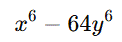
Solution: –
Step 1: Recognizing the Difference of Squares
The given expression is a difference of squares:
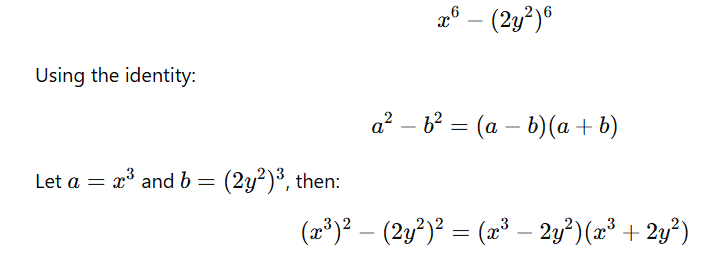
Step 2: Recognizing the Sum and Difference of Cubes
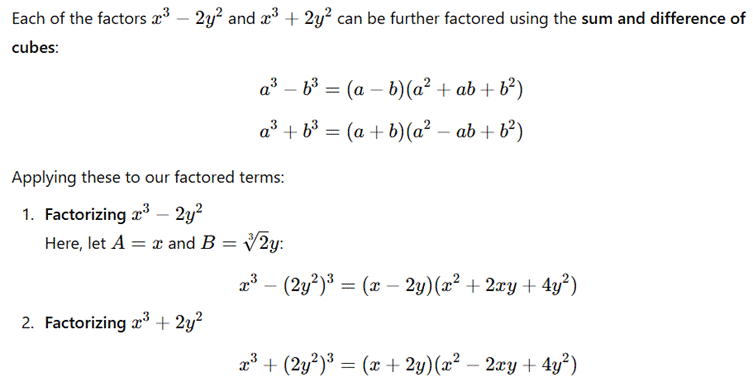
Step 3: Final Factorized Form

Here are five conclusive points for the topic Factorization Using Standard Identities:
- Enhances Algebraic Manipulation Skills
Mastering the use of standard identities in factorization allows for a deeper understanding of algebraic expressions. It provides a systematic approach to breaking down complex expressions into simpler forms, which is essential in advanced mathematical problem-solving. - Simplifies Polynomial Expressions
Factorization using identities helps in simplifying polynomial expressions, making them easier to work with. This simplification is useful in solving equations, performing mathematical proofs, and understanding the structure of algebraic expressions. - Speeds Up Equation Solving
Recognizing standard identities and applying them correctly can significantly reduce the time required to solve algebraic equations. This method eliminates the need for lengthy calculations and provides a structured approach to finding solutions efficiently. - Facilitates Real-World Applications
The principles of factorization extend beyond theoretical mathematics and are widely used in various real-world applications, including physics, engineering, economics, and data analysis. Understanding these concepts enables problem-solving in practical scenarios that require mathematical modeling. - Strengthens Mathematical Foundation for Higher Studies
A strong grasp of algebraic factorization using standard identities serves as a foundation for more advanced mathematical concepts. It prepares students for higher-level studies in algebra, calculus, and beyond, where these techniques are frequently applied.