Unit: Squares and Square Roots
Chapter: Pythagorean triplets
Reference: – Concept of Pythagorean Theorem, Definition of Pythagorean Triplets, generating triplets using formulas, identifying triplets from given numbers, Applications in geometry, Primitive vs. non-primitive triplets, Role in coordinate geometry, Triplets in problem-solving, Even and odd number patterns, Real-world use of triplets
After studying this chapter, you should be able to understand:
- Concept of Pythagorean Theorem & Definition of Pythagorean Triplets
- Applications in geometry & Primitive vs. non-primitive triplets
- Triplets in problem-solving & Even and odd number patterns
- Real-world use of triplets
Here is a theoretical elaboration of each point under the “Pythagorean Triplet”
- Concept of Pythagorean Theorem
The Pythagorean Theorem expresses a fundamental relationship between the sides of a right-angled triangle, where the square of the length of the hypotenuse is equal to the sum of the squares of the other two sides. This relationship serves as the foundation for identifying Pythagorean triplets. - Definition of Pythagorean Triplets
Pythagorean triplets are sets of three whole numbers that satisfy the condition laid out by the Pythagorean Theorem. These numbers represent the lengths of the sides of a right triangle and always maintain this special square-sum relationship. - Generating Triplets Using Formulas
There are specific algebraic formulas that, when applied to whole numbers, consistently generate Pythagorean triplets. These formulas help in constructing sets that uphold the right-triangle property, making them valuable in mathematical proofs and applications. - Identifying Triplets from Given Numbers
Determining whether a set of three numbers forms a Pythagorean triplet involves checking whether they satisfy the theorem's condition. This process is used to verify existing data or to explore properties of geometric figures. - Applications in Geometry
Pythagorean triplets are widely applied in solving geometrical problems involving right triangles. They are especially useful in finding unknown side lengths, constructing shapes, and simplifying complex geometrical expressions. - Primitive vs. Non-Primitive Triplets
Triplets can be classified based on whether their elements share any common divisors. Primitive triplets are those in which all numbers are coprime, while non-primitive ones can be derived by scaling up primitive sets by a common factor. - Role in Coordinate Geometry
In coordinate geometry, Pythagorean triplets help in determining distances between points and in establishing the properties of figures plotted on the coordinate plane. They assist in verifying whether a triangle formed by points is right-angled. - Triplets in Problem-Solving
Mathematical problems involving measurements, constructions, or proofs often utilize triplets for simplification. Recognizing or recalling common triplets can make solving such problems more efficient. - Even and Odd Number Patterns
Patterns among even and odd numbers play a role in the structure of Pythagorean triplets. Understanding these patterns helps in predicting triplets and analysing their properties across different numerical sets. - Real-World Use of Triplets
Beyond the classroom, Pythagorean triplets are used in fields like architecture, engineering, and navigation, where right-angle measurements are critical. Their predictability and mathematical reliability make them practical tools in technical disciplines.
- Example: –
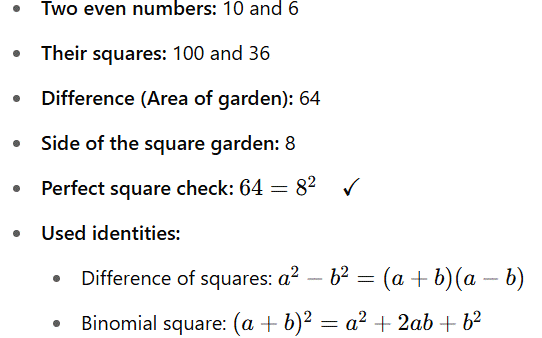
A square garden has an area equal to the difference between the squares of two consecutive even numbers. A binomial expression representing the square root of this area is simplified using algebraic identities. If the side of the square garden is also equal to the simplified square root, find the dimensions of the garden and the two even numbers.
Also verify:
- The area is a perfect square
- The square root is derived correctly using the difference of squares and binomial square identities
Solution: –
Let the two consecutive even numbers be:
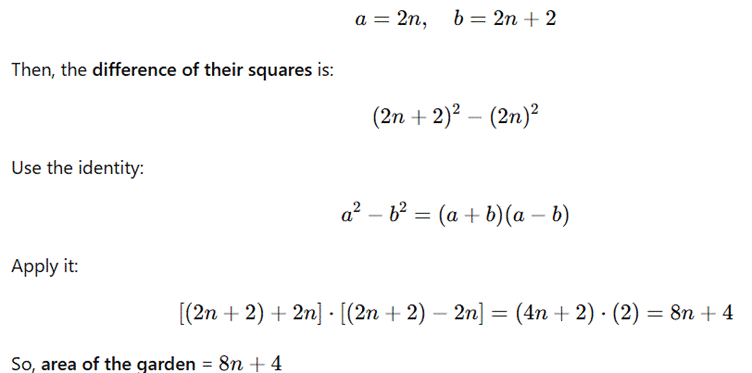
Now, we are told the square root of the area is equal to the side of the garden, and it's derived using binomial identities.
Assume the side is a binomial:
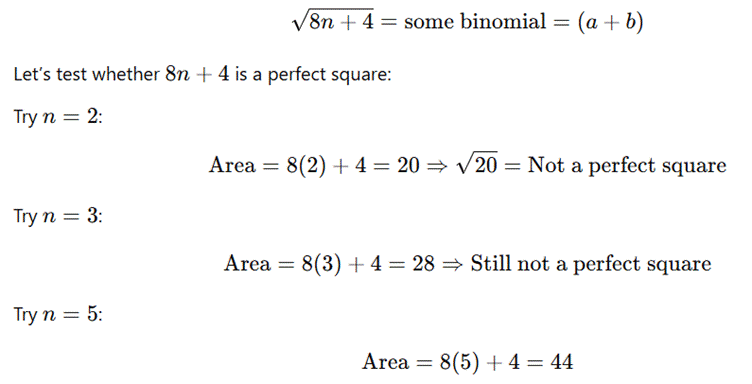
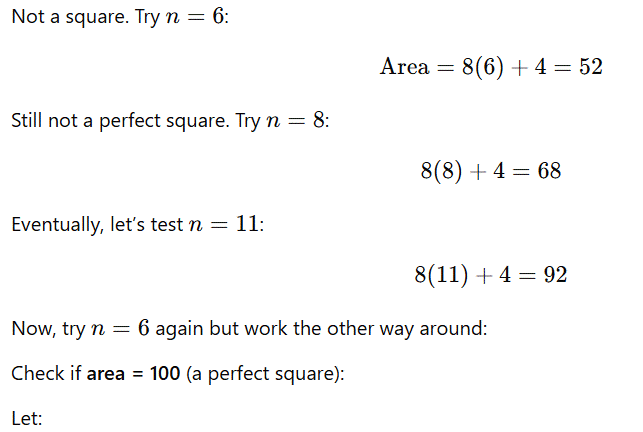
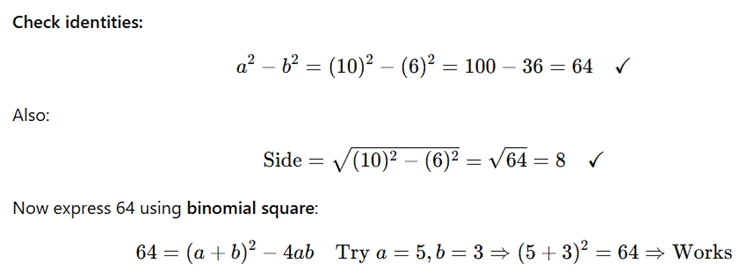
Final Answer:
Here are five conclusive theoretical points for the topic "Pythagorean Triplet" under the Squares and Square Roots section:
- Pythagorean triplets illustrate a fundamental geometric relationship in mathematics that connects algebra and geometry through right-angled triangles.
- These triplets provide a reliable method to verify or construct right triangles, enhancing spatial reasoning and logical problem-solving.
- Understanding the difference between primitive and non-primitive triplets develops deeper insights into number properties and factors.
- The use of formulas to generate triplets encourages pattern recognition and algebraic manipulation skills.
- Pythagorean triplets have both theoretical importance and practical utility in areas like construction, design, and physics.