Unit: Squares and Square Roots
Chapter: Square Roots -1
Reference: – Concept of square roots, Perfect square numbers, square roots of perfect squares, Properties of square roots, square root of a product, square root of a quotient, Estimating non-perfect square roots, Simplifying square roots, square roots and real numbers, Application-based word problems
After studying this chapter, you should be able to understand:
- Concept of square roots & Perfect square numbers
- Square roots of perfect squares & Properties of square roots
- Estimating non-perfect square roots
- Application-based word problems
Here’s a theoretical elaboration of each topic under the “Square Roots – Basics”: –
- Concept of square roots
The square root of a quantity refers to a value that, when multiplied by itself, yields the original quantity. It is a fundamental operation that serves as the inverse of squaring and is essential in solving quadratic equations and understanding geometric relationships. - Perfect square numbers
Perfect squares are outcomes of squaring whole numbers. These values hold a distinct place in mathematics as their square roots result in exact whole numbers, making them especially useful in algebraic simplification and geometric calculations. - Square roots of perfect squares
When the original value is a perfect square, its square root is easily determinable and does not require approximation. This forms the basis for simplifying expressions and solving equations involving roots. - Properties of square roots
The operation of taking square roots follows specific mathematical properties, including distributive behavior over multiplication and division, but not over addition or subtraction. These properties assist in manipulating expressions in algebra. - Square root of a product
The square root of a product of two terms is equivalent to the product of their individual square roots. This property simplifies expressions and is especially useful when factoring or working with radical expressions. - Square root of a quotient
Similar to products, the square root of a quotient is equal to the quotient of the square roots of the numerator and the denominator. This allows for the simplification of fractional radical expressions. - Estimating non-perfect square roots
When the number under the root is not a perfect square, estimation techniques, including number line reasoning or calculator-based approximations, are used to find a close value. This is important for applications in measurement and real-life problem-solving. - Simplifying square roots
Simplification involves expressing a square root in its simplest radical form, often by factoring out perfect square components. This helps in achieving a more manageable or interpretable form in equations. - Square roots and real numbers
Square roots are closely related to the real number system. While the square root of a positive number is real, the square root of a negative number is not a real number, introducing the need for imaginary numbers in higher mathematics. - Application-based word problems
Problems involving square roots frequently appear in real-world contexts such as geometry, physics, and engineering, where lengths, areas, and other measurements need to be calculated or estimated.
- Example: –
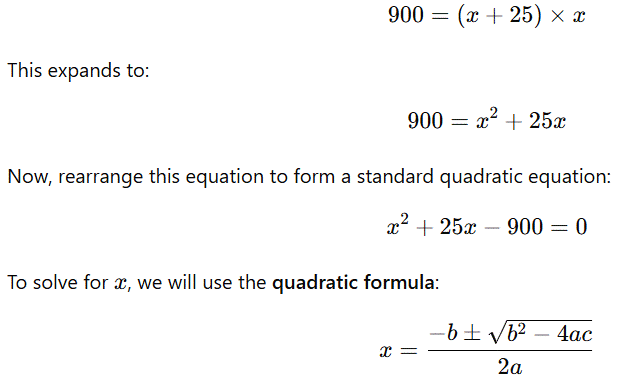
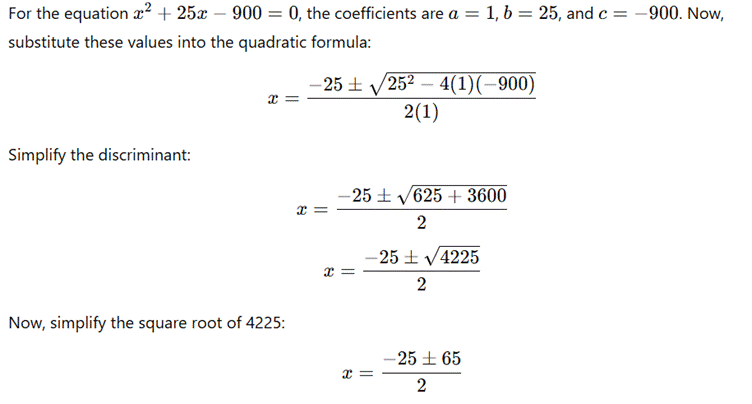
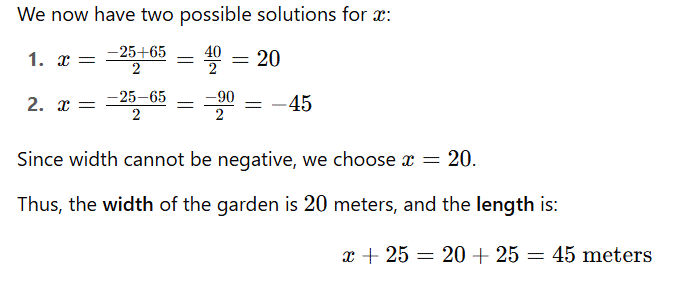
A rectangular garden has a length that is 25 meters longer than its width. The area of the garden is 900 square meters. Find the length and width of the garden using square roots, simplifying square roots, and applying properties of square roots.
Solution: –
We are given the following information:
- Area of the rectangular garden = 900 square meters
- Length = Width + 25 meters
Let’s denote the width of the garden as x, so the length will be 25x+25.
The formula for the area of a rectangle is:
Area = Length x Width
Substitute the given information: –
Here are five conclusive points for the topic of Square Roots:
- Square roots are the inverse operation of squaring, essential for solving quadratic equations and simplifying expressions.
- Perfect square numbers have square roots that are whole numbers, making them easy to compute.
- The square root operation follows specific properties, such as the distributive property over multiplication and division.
- Non-perfect square roots are estimated through approximation methods for practical applications.
- Square roots are fundamental in geometry and real-world problem-solving, especially in areas like measurement and design.