Unit: Exponents & Powers
Chapter: Expressing Large Number in Standard Form
Reference: – Understanding Standard Form, Scientific Notation Basics, converting to and from Standard Form, Use of Positive and Negative Exponents, Real-Life Applications, Comparing and Ordering Numbers in Standard Form, Multiplying and Dividing Numbers in Standard Form, Word Problems Using Standard Form, Common Errors and Misinterpretations
After studying this chapter, you should be able to understand:
- Understanding Standard Form & Scientific Notation Basics
- Use of Positive and Negative Exponents
- Comparing and Ordering Numbers in Standard Form
- Common Errors and Misinterpretations
- Understanding Standard Form
Standard form is a method of writing extremely large or small numbers in a simplified, consistent structure using powers of ten. It is designed to make it easier to read, interpret, and compute values across scientific, academic, and practical contexts. - Scientific Notation Basics
Scientific notation is a type of standard form that expresses a number as the product of a decimal and a power of ten. This notation helps manage complexity when working with very large or minuscule quantities, commonly used in sciences and engineering. - Converting to and from Standard Form
This concept involves learning how to rewrite ordinary numbers into standard form by identifying how many places the decimal must move to position the leading digit correctly, and vice versa for standard-to-decimal form conversion. - Use of Positive and Negative Exponents
Positive exponents are used when the number is large, indicating repeated multiplication of ten. Negative exponents are used for small decimal numbers, representing repeated division by ten. Understanding both is essential to accurately express any size of number. - Real-Life Applications
In various disciplines like astronomy, biology, or economics, standard form enables professionals to communicate large data sets clearly and concisely. It is especially useful when dealing with populations, distances, measurements, or budgets. - Comparing and Ordering Numbers in Standard Form
When comparing numbers in standard form, students assess the powers of ten and the coefficient to determine relative magnitude. This process is efficient because it avoids the need to expand the full values. - Multiplying and Dividing Numbers in Standard Form
Applying exponent rules allows multiplication and division of numbers in standard form to be performed by operating on the decimal parts and manipulating exponents using algebraic principles. - Word Problems Using Standard Form
These problems incorporate real-world scenarios, requiring the application of standard form to model and solve problems logically, reinforcing understanding through contextual use. - Common Errors and Misinterpretations
Students learn to identify frequent mistakes such as incorrect decimal placement or misapplication of exponent rules. Emphasis is placed on checking conversions and ensuring scientific notation maintains its correct structure.
Example: –
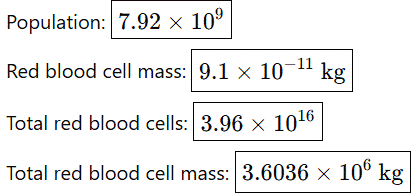
The population of Earth is approximately 7,920,000,000, and the estimated mass of a red blood cell is about 0.000000000091 kg.
- Express both numbers in standard form.
- Estimate how many red blood cells make up the total population's weight if each person has 5 million red blood cells. Give the answer in standard form.
- Multiply the number of red blood cells by the mass of one red blood cell. Express your final result in standard form, and interpret the answer.
Solution: –
Step 1: Convert to Standard Form
Population:

Mass of one red blood cell:

Step 2: Total Red Blood Cells in Population
Each person has 5,000,000 = 5×10⁶ red blood cells.
Total red blood cells:

Adjust to scientific notation:

Step 3: Total Mass of All Red Blood Cells

Final Answer:
Here are five conclusive points for the topic "Expressing Large Numbers in Standard Form" under the Exponents & Powers model:
- Standard form allows representation of very large or very small numbers using powers of ten, simplifying complex numerical expressions.
- It enhances clarity in scientific and technical fields by reducing the length of numerical data.
- Mastery of positive and negative exponents is essential for converting between standard form and decimal notation.
- Standard form facilitates comparison and operations like multiplication or division of large numbers.
- This concept is widely applicable in fields such as astronomy, physics, and finance for data efficiency.