Unit: Exponents & Powers
Chapter: Exponents and Small numbers
Reference: – Scientific Notation, Small Numbers in Exponential Form, Understanding Powers of Ten, converting between Standard and Scientific Notation, Simplifying Expressions with Exponents, Application in Real-World Scenarios, Comparing Magnitudes Using Exponents, Exponent Rules Applied to Small Numbers, Estimating Large and Small Values, Practical Examples of Exponents in Real Life
After studying this chapter, you should be able to understand:
- Scientific Notation & Small Numbers in Exponential Form
- Understanding Powers of Ten, converting between Standard and Scientific Notation
- Simplifying Expressions with Exponents
- Estimating Large and Small Values & Practical Examples of Exponents in Real Life
Here’s a theoretical elaboration on the topics mentioned in the "Exponents and Small Numbers" chapter:
- Scientific Notation: This method allows us to express extremely large or small numbers in a concise form, using a base between one and ten multiplied by a power of ten. It is particularly useful in disciplines like science, where such values are common.
- Small Numbers in Exponential Form: Small numbers are represented with negative exponents, which show how small the number is in relation to one. This allows easy manipulation of values smaller than one.
- Understanding Powers of Ten: Powers of ten are essential for expressing the size of numbers. They help in conveying values like vast distances or tiny measurements in a manageable format.
- Converting between Standard and Scientific Notation: To convert a number into scientific notation, the number is written as a decimal between one and ten and multiplied by a power of ten. The reverse process involves shifting the decimal point based on the exponent to return it to standard form.
- Simplifying Expressions with Exponents: Exponent rules simplify algebraic expressions. By applying these rules, we can combine or reduce powers of numbers efficiently, making the calculation process quicker.
- Application in Real-World Scenarios: Exponents and small numbers are commonly used in various fields such as astronomy, economics, and biology to simplify complex calculations and represent data more clearly.
- Comparing Magnitudes Using Exponents: Exponents are useful for comparing the relative size of numbers, whether large or small. They help clarify relationships between values that are otherwise difficult to compare directly.
- Exponent Rules Applied to Small Numbers: Knowing exponent rules allows one to simplify small number expressions, making calculations easier and more understandable.
- Estimating Large and Small Values: Exponents help estimate numbers that span a wide range, especially in situations where full precision is unnecessary. They allow for quick approximations in scientific or financial contexts.
- Practical Examples of Exponents in Real Life: Exponents are widely used in areas such as physics, economics, and chemistry to deal with both large-scale and microscopic measurements, enabling more efficient calculations.
- Example: –
Simplify the following expression and express the result in scientific notation:
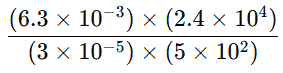
Then, convert the result into standard form.
Solution: –
Step 1: Simplify the Coefficients and Exponents Separately
We have two parts to deal with: the coefficients (the numbers in front of the powers of ten) and the powers of ten. Start by simplifying each part separately.
Simplifying the Coefficients:
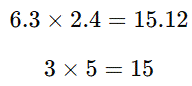
Simplifying the Powers of Ten:
For the powers of ten, use the rules of exponents:

Step 2: Combine the Coefficients and Powers of Ten
Now, put the simplified coefficients and exponents together:

Simplify the fraction:
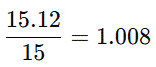
Thus, we get:
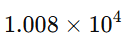
Step 3: Convert the Result into Scientific Notation
Since the coefficient 1.0081.0081.008 is already between 1 and 10, the expression is in scientific notation.
Step 4: Convert to Standard Form
Now, convert the scientific notation back to standard form by shifting the decimal point

Final Answer:
The expression simplifies to:
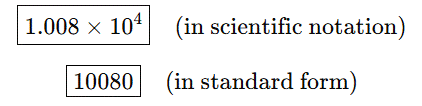
Interpretation and Explanation:
- Scientific Notation was used to express large or small numbers concisely, which is essential in handling values that span a wide range, especially in fields like physics or chemistry.
- Negative Exponents indicated the presence of very small numbers, allowing us to manage fractional values efficiently.
- Exponent Rules were applied to simplify the expression involving powers of ten, using the laws of exponents such as the product and quotient rules.
- Converting Between Forms (scientific notation and standard form) enables easier comparison and understanding of the magnitude of numbers.
Here are five conclusive points for the topic of Exponents and Small Numbers:
- Exponents help simplify large and small numbers by using powers of ten, making complex calculations more manageable.
- Scientific notation is crucial for expressing extremely large or small values in a concise format.
- Negative exponents represent very small numbers, allowing for efficient handling of fractional values.
- Converting between scientific notation and standard form helps in accurately comparing numbers of varying sizes.
- Exponent rules are vital for simplifying expressions and solving algebraic problems involving powers of numbers.