Unit: Algebraic Expressions and Identities
Chapter: Multiplication of Algebraic Expressions -1
Reference: – Understanding multiplication of monomials, multiplying a monomial with a binomial, multiplying a monomial with a polynomial, applying distributive property in multiplication, multiplying two binomials using FOIL method, multiplying binomials and trinomials, multiplying two polynomials, Identifying and simplifying like terms post-multiplication, Application of multiplication in word problems
After studying this chapter, you should be able to understand:
- Understanding multiplication of monomials
- Multiplying a monomial with a binomial & multiplying a monomial with a polynomial
- Identifying and simplifying like terms post-multiplication
- Application of multiplication in word problems
Here is a theoretical elaboration of the key topics covered under “Multiplication of Algebraic Expressions”: –
- Multiplication of Monomials
This concept involves combining single-term expressions by using the rules of exponents and understanding how variables behave when multiplied together. It emphasizes simplifying the product by grouping like bases and adding their powers. - Monomial and Binomial Multiplication
This topic deals with distributing the monomial across each term in the binomial. The aim is to ensure students understand how to apply the distributive law of multiplication over addition and organize terms based on variable components. - Monomial and Polynomial Multiplication
Extending the idea of distribution, this concept teaches how to multiply a single-term expression with multiple terms, requiring repeated application of the distributive property across all terms while maintaining attention to like terms and proper sign handling. - Multiplication of Two Binomials
This area introduces the method of pairing each term of one binomial with every term of the second. Students explore structured strategies like the First, Outer, Inner, Last (FOIL) method and how resulting terms may need simplification. - Multiplying Binomials and Trinomials
This concept expands the distributive property across expressions with differing term counts. It encourages logical structuring, multiplication of every term pair, and organization of the resulting expressions by combining like terms where possible. - Multiplication of Polynomials
This topic generalizes all previous concepts and focuses on ensuring each term in one polynomial is multiplied with each term in the other. It stresses organizing resulting expressions and using standard algebraic form for clarity. - Use of Algebraic Identities in Multiplication
Students are introduced to standard algebraic patterns such as the square of a binomial or the product of sum and difference. Recognizing and applying these identities helps simplify and verify expressions more efficiently. - Simplification After Multiplication
Once multiplication is complete, expressions often require simplification. This includes combining like terms, arranging terms in standard form, and ensuring clarity in final expression layout. - Visual Models in Multiplication
The use of area models or algebra tiles aids in visually demonstrating the multiplication of polynomials, particularly for learners who benefit from conceptual and spatial understanding of algebraic operations. - Real-Life Contextual Applications
Multiplication of algebraic expressions is linked to real-world scenarios such as calculating area, profit margins, or rates of change, helping learners see the practical relevance of symbolic manipulation.
Example: –
Simplify the following expression:

Then, identify and simplify all like terms in the result.
Solution: –
Step 1: Expand each part individually
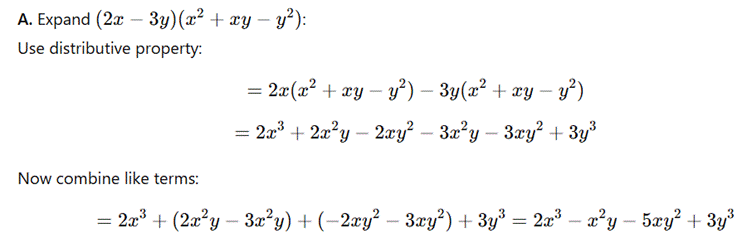
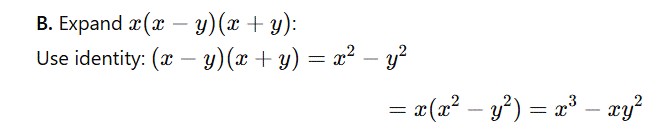

Step 2: Plug back and combine all three expressions
Now combine:

Step 3: Combine like terms
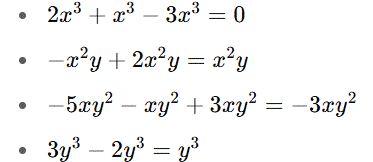
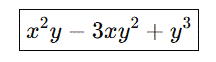
Final Simplified Expression:
Concluding Highlights:
- This example combines monomial × polynomial, binomial × trinomial, and identity-based multiplication.
- It requires attention to signs, distribution, and like-term simplification.
- Such complexity mirrors real-world algebraic modeling scenarios in physics, economics, or geometry.
Here are five conclusive points for the topic "Multiplication of Algebraic Expressions" under the AP Algebra / High School Algebra US curriculum:
- Mastery of multiplying algebraic expressions builds a foundation for more advanced topics such as factoring, solving equations, and simplifying rational expressions.
- Understanding and applying distributive properties strengthens algebraic reasoning and helps students manipulate expressions efficiently.
- Recognition and use of algebraic identities streamline multiplication processes and deepen conceptual understanding.
- Simplification and organization of polynomial products enhance clarity in mathematical communication.
- Real-world application of algebraic multiplication demonstrates its importance in modeling and solving practical problems.