Unit: Expressions and System of Equations
Chapter: Understanding Expressions, Structure, Properties, Simplifying
Reference: – Structure of expressions, Variables and constants, combining like terms, Use of properties (distributive, associative, commutative), Factoring techniques, expanding expressions, Simplifying complex expressions, Translating word problems to expressions, Identifying equivalent expressions, Patterns in algebraic forms
After studying this chapter, you should be able to understand:
- Structure of expressions & Variables and constants
- Use of properties (distributive, associative, commutative)
- Translating word problems to expressions
- Patterns in algebraic forms
Here’s an elaborated theoretical explanation for each topic under the chapter Understanding Expressions, Structure, Properties, Simplifying:
- Structure of expressions
Expressions are composed of variables, constants, and operations. Understanding how these elements are arranged helps in recognizing patterns and manipulating expressions efficiently. - Variables and constants
Variables represent unknown quantities that can change, while constants remain fixed. Recognizing the role of each in an expression is foundational to algebraic reasoning. - Combining like terms
Terms that have the same variable raised to the same power can be combined by applying arithmetic operations, helping to simplify and condense expressions. - Use of properties (distributive, associative, commutative)
Algebraic properties guide how expressions can be restructured. The distributive property spreads multiplication over addition; the associative and commutative properties allow regrouping and reordering of terms. - Factoring techniques
Factoring involves breaking down expressions into products of simpler factors, which is key to solving equations and analyzing algebraic forms. - Expanding expressions
Expansion involves removing parentheses and applying operations, typically by distributing and multiplying terms, to express an equation in a more detailed form. - Simplifying complex expressions
Simplifying means reducing expressions to their most basic form using operations, properties, and combination of terms to improve clarity and usability. - Translating word problems to expressions
Real-world situations are represented with algebraic expressions to model relationships and solve problems symbolically. - Identifying equivalent expressions
Expressions that produce the same value for all variable inputs are considered equivalent. Recognizing these aids in transformation and simplification. - Patterns in algebraic forms
Identifying recurring patterns in expressions helps in generalizing solutions and forming mathematical rules or identities. - Operations on polynomials
Operations such as addition, subtraction, and multiplication are applied to polynomial expressions while maintaining their algebraic structure. - Application of identities
Standard algebraic identities simplify expressions and solve equations efficiently by recognizing and applying known formulas.
Example: –
A rectangular field is 20 meters longer than it is wide. A path of uniform width is built around the field, increasing the total area to 432 square meters.
If the original width of the field is represented by the variable x,
- write an expression for the area of the field with the path,
- expand and simplify it,
- solve for the dimensions of the field,
using structure of expressions, algebraic properties, and simplification techniques.
Solution: –
Step 1: Define the expressions
Let the width of the field = x
Then the length = x+20
Let the width of the path = y
So, with the path added,
- The new width becomes x+2y
- The new length becomes x+20+2y

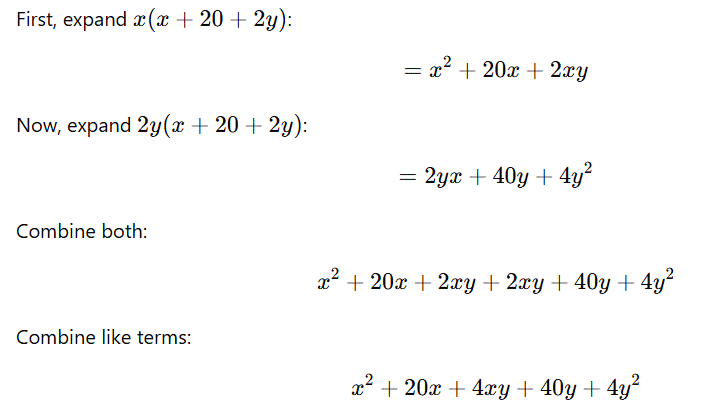
Step 2: Expand the expression (using distributive property)
We expand:

Step 3: Use the given total area to create an equation
We are told:

So, the equation becomes:

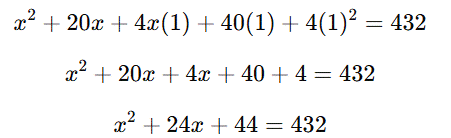
Step 4: Solve the equation using values
Let’s suppose the path is 1 meter wide, i.e., y=1
Substitute y=1 into the expression:
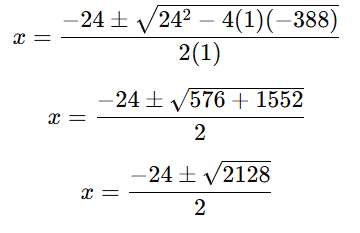
Step 5: Solve the quadratic equation
Use the quadratic formula:

Final Dimensions
- Width of field: 11.06 meters
- Length of field: 11.06+20=31.06 meters
- With path:
- Width = 11.06+2(1) =13.06 meters
- Length = 31.06+2(1) =33.06 meters
Here are five conclusive points for the topic Understanding Expressions, Structure, Properties, Simplifying:
- Mastery of algebraic structure enhances the ability to interpret, manipulate, and simplify expressions logically and efficiently.
- Recognizing and applying algebraic properties allows for strategic rearrangement and simplification of expressions.
- Simplification and factoring techniques are foundational tools for solving equations and understanding mathematical relationships.
- Translating real-life problems into algebraic expressions bridges abstract concepts with practical application.
- Identifying patterns and equivalent forms nurtures a deeper conceptual grasp of algebra and promotes advanced problem-solving skills.