Unit: Exponents and Roots
Chapter: Exponents and Equivalent Expressions
Reference: – Understanding exponential notation, simplifying exponential expressions, using properties of exponents, Rewriting expressions with rational exponents, converting between radical and exponential forms, identifying equivalent exponential expressions, multiplying expressions with exponents, dividing exponential expressions, Negative and zero exponents, Simplifying nested exponents, Applying exponent rules in algebraic equations
After studying this chapter, you should be able to understand:
- Understanding exponential notation
- simplifying exponential expressions & using properties of exponents
- multiplying expressions with exponents & dividing exponential expressions
- Applying exponent rules in algebraic equations
Here is a theoretical elaboration of each point under the chapter “Exponents and Equivalent Expressions”: –
- Understanding exponential notation
Exponential notation represents repeated multiplication of a base by itself. This symbolic form simplifies the expression of large or small quantities and introduces a structured language for exponential relationships. - Simplifying exponential expressions
Simplification involves using the foundational rules of exponents to write expressions in a more compact or understandable form. This process helps in reducing complexity and finding equivalent representations. - Using properties of exponents
The laws governing exponent operations allow for systematic manipulation. These include rules for multiplication, division, and powers of powers, ensuring consistency across different types of expressions. - Rewriting expressions with rational exponents
Expressions involving roots can be rewritten using fractional exponents. This transition allows for a unified approach to handle roots and powers within the same algebraic framework. - Converting between radical and exponential forms
Radical expressions, commonly used to denote roots, can be equivalently expressed in exponential form. This conversion aids in applying exponent rules uniformly to both types of expressions. - Identifying equivalent exponential expressions
Recognizing when two expressions are algebraically the same despite different appearances is key. This involves understanding the underlying structure and applying exponent rules to verify equivalency. - Multiplying expressions with exponents
When exponential expressions with the same base are multiplied, the exponents combine according to established rules. This allows expressions to be consolidated into a single exponential form. - Dividing exponential expressions
Division of expressions with exponents and common bases follows a specific pattern that simplifies the result by subtracting exponents, reducing complexity in comparison and computation. - Negative and zero exponents
Exponents that are negative or zero have unique interpretations. A zero exponent typically indicates unity, while a negative exponent reflects the reciprocal relationship of powers. - Simplifying nested exponents
In expressions where an exponent is raised to another exponent, the powers combine multiplicatively. This helps streamline complex exponential forms into simpler structures. - Applying exponent rules in algebraic equations
Solving algebraic equations involving exponents requires the consistent use of rules. Understanding how to isolate and evaluate exponential terms is crucial in problem-solving. - Comparing and evaluating exponential forms
Exponential expressions can be assessed for relative size or simplified through structure analysis. This helps in making logical judgments about their values or properties.
Example: –
Simplify the expression:
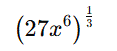
Solution: –
Break it into separate parts:
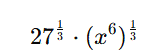
Simplify each part:
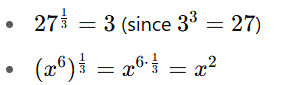
Final Answer: 3x2
Here are five conclusive points for the topic "Exponents and Equivalent Expressions" under Exponents and Roots:
- Exponent rules provide a consistent structure for simplifying and transforming expressions across various algebraic contexts.
- Recognizing equivalent expressions strengthens problem-solving skills and improves algebraic fluency.
- Rational and negative exponents expand the concept of powers beyond whole numbers, offering deeper mathematical versatility.
- Mastery in converting between exponential and radical forms builds confidence in manipulating diverse algebraic formats.
- Understanding the behavior of exponential expressions under operations is foundational for advanced mathematical thinking and real-world applications.