Unit: Non-linear functions
Chapter: Rational, Radical and Other Nonlinear Functions
Reference: – Introduction to Rational Functions, Graphing Rational Functions, Identifying Asymptotes (Vertical and Horizontal), Simplifying Rational Expressions, Understanding Radical Functions, Operations with Rational Functions, Graphing Square Root and Cube Root Functions, Solving Equations Involving Rational and Radical Expressions, Domain and Range of Rational and Radical Functions
After studying this chapter, you should be able to understand:
- Introduction to Rational Functions & Graphing Rational Functions
- Identifying Asymptotes (Vertical and Horizontal)
- Graphing Square Root and Cube Root Functions
- Domain and Range of Rational and Radical Functions
Here’s a theoretical elaboration for each of the topics related to Rational, Radical, and Other Nonlinear Functions:
- Introduction to Rational Functions: Rational functions are expressions that involve the ratio of two polynomials. They are characterized by having a numerator and a denominator, both of which are polynomial functions. Understanding these functions requires knowledge of how polynomials behave and how their ratios affect the overall function's graph.
- Graphing Rational Functions: Graphing rational functions involves plotting the function's behavior by considering key points such as intercepts, asymptotes, and the general shape of the curve. The function’s graph typically includes vertical and horizontal asymptotes, which represent the boundaries that the graph approaches but does not necessarily cross.
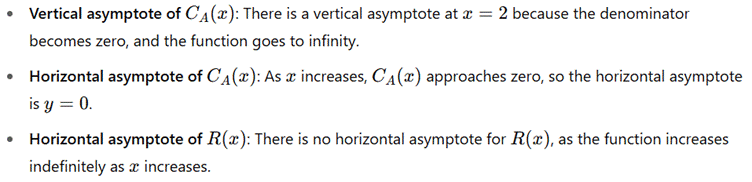
- Identifying Asymptotes (Vertical and Horizontal): Asymptotes are lines that a function approaches but never touches. Vertical asymptotes occur where the denominator of a rational function equals zero, while horizontal asymptotes reflect the behavior of the function as the input grows large. Understanding asymptotes helps in predicting the graph's long-term behavior.
- Simplifying Rational Expressions: Simplification of rational expressions involves reducing fractions by factoring both the numerator and the denominator and cancelling out common factors. This helps make the function easier to work with and understand, especially when solving equations or performing operations on rational expressions.
- Operations with Rational Functions (Addition, Subtraction, Multiplication, Division): Like polynomials, rational functions can be added, subtracted, multiplied, and divided. However, these operations require a clear understanding of how to handle the denominators and ensure that the resulting expression is simplified.
- Understanding Radical Functions: Radical functions involve roots, such as square roots or cube roots. These functions have unique properties and graphs compared to polynomial functions. For example, square root functions have a restricted domain, as the radicand (the expression under the root) must be non-negative for real numbers.
- Graphing Square Root and Cube Root Functions: Graphing radical functions involves understanding how the root affects the shape of the graph. Square root functions have a distinctive curve that starts from the origin and moves upwards, while cube root functions can take both positive and negative values and have a more symmetric shape around the origin.
- Operations with Radical Functions: Just like with rational functions, radical functions can be added, subtracted, multiplied, and divided. However, the operations require careful handling of the radical expressions, including simplifying the radicand and applying the properties of exponents to manipulate roots effectively.
- Solving Equations Involving Rational and Radical Expressions: Solving equations with rational and radical expressions involves isolating the variable by manipulating the expression. For rational expressions, this often involves clearing the denominators, while for radical equations, squaring both sides or rationalizing may be necessary to eliminate the roots.
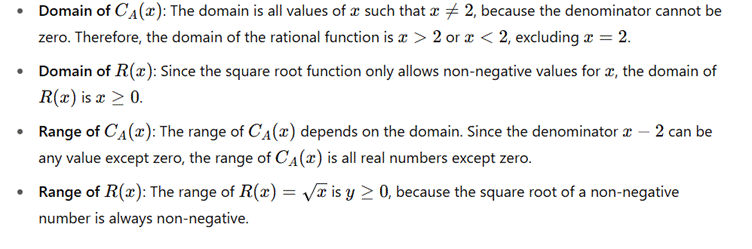
- Domain and Range of Rational and Radical Functions: The domain of a rational function includes all real numbers except those that make the denominator zero. The range of a rational function depends on the behavior of the asymptotes. For radical functions, the domain is restricted based on the radicand, and the range depends on the type of root (even or odd).
- Applications of Rational Functions (e.g., rates, proportions): Rational functions are often used to model real-world situations where one quantity is proportional to the inverse of another, such as speed, rates, or financial models. These applications demonstrate how rational functions model real-life scenarios where relationships are expressed as ratios.
- Applications of Radical Functions (e.g., distance, velocity problems): Radical functions are useful in scenarios where relationships involve square roots, such as in physics for calculating distance under constant acceleration or determining velocity. These types of applications highlight how radical functions are used to model real-world phenomena involving growth or decay.
Example: –
A chemical company is producing a special solution using two types of ingredients: Ingredient A and Ingredient B. The cost of Ingredient A is given by a rational function, and the production rate of the solution is determined by a radical function.
- The cost per unit of Ingredient A is modelled by the rational function:
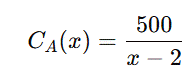
where x is the number of units produced, and the cost increases as the production units increase beyond 2 units.
- The production rate of the solution (in liters per hour) is modelled by the square root function:
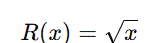
where x is the number of units produced, and the rate of production increases as the number of units increases.
The company needs to determine the following:
- The total cost for producing 10 units of Ingredient A.
- The production rate for 10 units of the solution.
- The time required to produce 10 units if the production rate is constant.
Solution: –
Step 1: Find the total cost for producing 10 units of Ingredient A.
The cost function is given by:
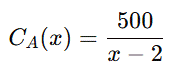
Substitute x=10 into the function:

Thus, the total cost for producing 10 units of Ingredient A is $62.50.
Step 2: Find the production rate for 10 units of the solution.
The production rate function is given by:
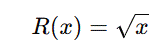
Substitute x=10 into the function:

Thus, the production rate for 10 units of the solution is approximately 3.16 liters per hour.
Step 3: Find the time required to produce 10 units of the solution.
The time required to produce 10 units of the solution can be calculated by dividing the total number of units by the production rate:

Step 4: Identify domain and range restrictions for the functions.
Step 5: Identify any asymptotes.
Step 6: Operations with Rational and Radical Functions.
Let's perform a combination of the functions by adding them together:

This combined function represents the total cost plus the production rate, which can be used to analyse the efficiency and cost-effectiveness of the production process.
Here are five conclusive points for Rational, Radical, and Other Nonlinear Functions:
- Rational and radical functions involve key algebraic principles and the understanding of polynomials, roots, and their behavior.
- Graphing rational and radical functions requires recognizing asymptotes, roots, and domain restrictions, which influence how the function behaves in different regions.
- Operations such as addition, subtraction, multiplication, and division for both rational and radical functions require careful manipulation of terms, focusing on common denominators and simplifying radicals.
- The domain and range of these functions are central to understanding their behavior in real-world contexts.
- Real-life applications, such as rates or physical problems, often use these functions to model relationships involving inverse or root-based dependencies.