Unit: Zeros, Parabolas, And Polynomial Graphing
Chapter: Zeros of Function
Reference: – Definition of zeros of a function, finding zeros of polynomial functions, Relationship between factors and zeros, solving for zeros of quadratic functions, Identifying the multiplicity of zeros, Using the Factor Theorem, using synthetic division to find zeros, Graphical interpretation of zeros, The Rational Root Theorem
After studying this chapter, you should be able to understand:
- Definition of zeros of a function & finding zeros of polynomial functions
- Relationship between factors and zeros
- Using the Factor Theorem
- The Rational Root Theorem
Here are theoretical elaborations for the topics covered under Zeros of a Function:
- Definition of zeros of a function: Zeros of a function are the values of the input (x) that make the function's output (f(x)) equal to zero. Essentially, these are the points where the graph of the function intersects the x-axis.
- Finding zeros of polynomial functions: This involves solving for x in polynomial equations where f(x) = 0. Techniques such as factoring, synthetic division, and using the quadratic formula are common methods for finding these zeros.
- Relationship between factors and zeros: If a polynomial has a factor (x – a), then x = a is a zero of the polynomials. This relationship helps in factoring polynomials and finding their roots.
- Solving for zeros of quadratic functions: For a quadratic function, zeros can be found using methods like factoring, completing the square, or applying the quadratic formula. These methods determine where the parabola crosses the x-axis.
- Identifying the multiplicity of zeros: The multiplicity of a zero refers to the number of times a particular root occurs. For example, if (x – a)2 is a factor of a polynomial, then x = a is a zero with multiplicity 2. The multiplicity affects the shape of the graph.
- Using the Factor Theorem: The Factor Theorem states that if (x – a) is a factor of a polynomial, then x = a is a zero of the polynomials. This theorem is useful in factoring polynomials and finding their zeros.
- Using synthetic division to find zeros: Synthetic division is a shortcut method for dividing polynomials, often used when finding zeros of polynomials. It simplifies the division process, especially when the potential zero is a simple value.
- Graphical interpretation of zeros: Zeros of a function correspond to the points where the graph intersects the x-axis. These are critical for understanding the function's behavior and identifying solutions graphically.
- Connection between zeros and the x-intercepts of a graph: Zeros represent the x-intercepts of the function's graph, where the function’s value is zero. These intercepts provide valuable insights into the function's roots.
- The Rational Root Theorem: The Rational Root Theorem helps identify possible rational roots of a polynomial equation. It states that any potential rational root of the polynomial must be a factor of the constant term divided by a factor of the leading coefficient.
- Descartes' Rule of Signs for determining possible zeros: Descartes’ Rule of Signs provides a way to predict the number of positive and negative real roots of a polynomial. It involves analysing the number of sign changes in the polynomial’s terms.
- Real-world applications of finding zeros in functions: Zeros are essential in many practical applications, such as finding the point of equilibrium in economics, determining the trajectory of objects in physics, and solving problems involving optimization
Example: –
Consider the polynomial function:

You are tasked with finding all the real zeros of the function and analysing the multiplicity of the zeros. Additionally, use synthetic division to divide the polynomial by x−1, determine the remaining factor, and verify the Rational Root Theorem for potential rational roots.
Solution: –
Step 1: Apply the Rational Root Theorem
The Rational Root Theorem suggests that any rational root of the polynomial is of the form p/q, where:
- p is a factor of the constant term (6), and
- q is a factor of the leading coefficient (2).
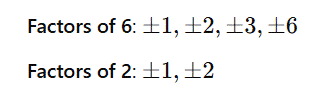
Therefore, the possible rational roots are:
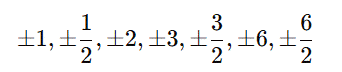
Thus, the list of potential rational roots is:
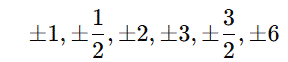
Step 2: Use Synthetic Division to Check for Rational Roots
Let’s test x=1 using synthetic division:
The polynomial is:

Set up the synthetic division:
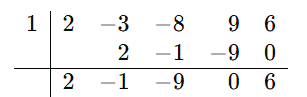
Since the remainder is 6 (not 0), x=1 is not a root.
Now, let’s try x=−1 using synthetic division:
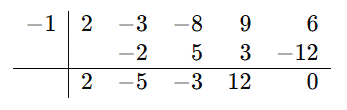
The remainder is 0, so x=−1 is a zero of the polynomial.
Step 3: Factor the Polynomial by Dividing by x+1
Now that we know x=−1 is a zero, we divide the original polynomial by x+1 using synthetic division.
After dividing, we get the quotient:

Thus, the polynomial becomes:

Step 4: Solve the Quadratic
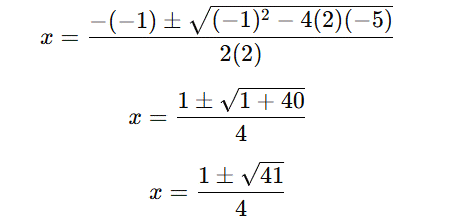
Thus, the zeros of the quadratic are:

Step 6: Compile All Zeros
So, the full set of zeros for the polynomial function is:

Here are five conclusive points for the topic Zeros of a Function:
- Zeros of a function represent the x-values where the function intersects the x-axis, meaning the output equals zero.
- Polynomial equations are solved to find zeros using methods like factoring, synthetic division, and the quadratic formula.
- The Factor Theorem links factors of a polynomial to its zeros, helping to simplify solving equations.
- The multiplicity of a zero indicates how many times a root occurs, influencing the graph’s behavior at that zero.
- Graphical and algebraic methods work together to identify and verify zeros, which are crucial in understanding a function’s solutions.