Unit: Revisiting real numbers
Chapter: Operations on Real Numbers
Reference: – Addition of Real Numbers, Subtraction of Real Numbers, Multiplication of Real Numbers, Division of Real Numbers, Commutative Property, Associative Property, Distributive Property, Additive Identity, Multiplicative Identity, Additive Inverse, Multiplicative Inverse (Reciprocal), Closure Property, Rules of Signs in Operations, Combining Like Terms (Algebraic Operations with Real Numbers)
After studying this chapter, you should be able to understand:
- Addition of Real Numbers & Subtraction of Real Numbers
- Multiplication of Real Numbers & Division of Real Numbers
- Associative Property & Distributive Property
- Closure Property & Rules of Signs in Operations, Combining Like Terms
- Addition of Real Numbers
The process of combining two or more real numbers to obtain a single real number called the sum. It follows specific rules depending on the signs and values of the numbers involved.
- Subtraction of Real Numbers
The operation of finding the difference between two real numbers, interpreted as adding the opposite of a number. It is the inverse of addition.
- Multiplication of Real Numbers
A repeated addition operation where one real number is taken a number of times specified by another real number. It follows rules for signs and distributive laws.
- Division of Real Numbers
The process of determining how many times one real number is contained within another, except when dividing by zero, which is undefined. It is the inverse of multiplication.
- Commutative Property
A property of real numbers stating that the order in which two numbers are added or multiplied does not affect the result of the operation.
- Associative Property
This property states that when performing addition or multiplication with three or more real numbers, the way the numbers are grouped does not change the result.
- Distributive Property
A property that connects multiplication and addition (or subtraction), stating that a number multiplied by a sum is equal to the sum of the individual products of that number with each added.
- Additive Identity
The unique real number that, when added to any other real number, results in the same number. This identity element preserves the original number in addition.
- Multiplicative Identity
The unique real number that, when multiplied by any other real number, leaves it unchanged. It is the identity element for multiplication.
- Additive Inverse
For every real number, there exists another real number such that their sum is the additive identity. This inverse effectively "cancels" the original number in addition.
- Multiplicative Inverse (Reciprocal)
For every non-zero real number, there exists another real number such that their product is the multiplicative identity. This concept is fundamental in solving equations involving division.
- Closure Property
This property states that the result of an operation (addition, subtraction, multiplication, or division excluding zero in the denominator) on any two real numbers is also a real number.
- Rules of Signs in Operations
A set of consistent rules that determine the sign of the result when performing operations with positive and negative real numbers.
- Order of Operations (BODMAS/PEMDAS)
A standardized hierarchy that dictates the sequence in which multiple operations in an expression should be performed to ensure a consistent result.
- Combining Like Terms (Algebraic Operations with Real Numbers)
The process of simplifying algebraic expressions by grouping terms that have identical variable parts and combining their real number coefficients using addition or subtraction.
Example: –
Simplify and evaluate the expression:

Solution: –
Step 1: Simplify innermost parentheses
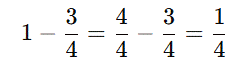
Now the expression becomes:

Step 2: Perform multiplication inside first square bracket
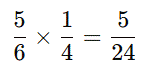

Step 3: Subtract inside the square bracket
Convert to same denominator:
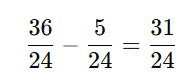

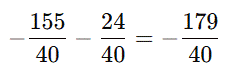
Final addition
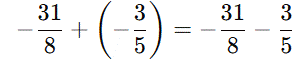
✅ Five Conclusive Points
- Real Numbers Are Closed Under Basic Operations
Addition, subtraction, multiplication, and (except for division by zero) division of real numbers always result in another real number, preserving closure within the set.
- Fundamental Properties Ensure Consistent Results
The commutative, associative, and distributive properties govern how real numbers interact in operations, allowing for predictable and consistent simplification and calculation.
- Identity and Inverse Elements Play a Key Role
Every real number has an additive inverse and every non-zero real number has a multiplicative inverse, which are essential for solving equations and maintaining balance in expressions.
- Order of Operations Maintains Expression Clarity
Applying a standard order (such as BODMAS or PEMDAS) ensures that complex expressions involving multiple operations yield unambiguous and correct results.
- Operations on Real Numbers Extend to Algebraic Expressions
The same rules used for real numbers apply to algebraic expressions with variables, forming the foundation of algebraic manipulation and simplification.