Unit: Graphing: Create Functions
Chapter: Depict Real-World Situations using Graphing of Functions
Reference: – Understanding Real-World Variables in Functions, Translating Real-World Problems into Algebraic Functions, Linear Functions in Real-World Situations, Quadratic Functions in Real-World Situations, Exponential Functions in Growth and Decay Models, Piecewise Functions for Real-World Cost Structures, Absolute Value Functions in Error or Deviation Models, Identifying Domain and Range in Context, Using Graphs to Interpret Real-World Behavior, Modeling Constraints with Inequalities, Understanding the Impact of Function Transformations
After studying this chapter, you should be able to understand:
- Understanding Real-World Variables in Functions & Translating Real-World Problems into Algebraic Functions
- Quadratic Functions in Real-World Situations & Exponential Functions in Growth and Decay Models
- Absolute Value Functions in Error or Deviation Models & Identifying Domain and Range in Context
- Understanding the Impact of Function Transformations
- Understanding Real-World Variables in Functions:
This involves identifying and defining variables that represent quantities in real-world situations, distinguishing between input (independent) variables and output (dependent) variables.
- Translating Real-World Problems into Algebraic Functions:
It refers to converting word problems or real-life scenarios into mathematical functions that express the relationship between the variables involved.
- Linear Functions in Real-World Situations:
Linear functions represent situations where there is a constant rate of change between variables. Graphically, they are depicted as straight lines showing direct proportionality or steady increase/decrease.
- Quadratic Functions in Real-World Situations:
Quadratic functions model situations involving changing rates, such as objects in motion following parabolic paths or calculations of area. Their graphs are U-shaped curves called parabolas.
- Exponential Functions in Growth and Decay Models:
Exponential functions represent processes where quantities increase or decrease at rates proportional to their current value, commonly seen in population growth, radioactive decay, or financial investments.
- Piecewise Functions for Real-World Cost Structures:
Piecewise functions represent scenarios where different rules or rates apply over different intervals. Each piece applies to a specific section of the domain, modeling changing behaviours in a system.
- Absolute Value Functions in Error or Deviation Models:
Absolute value functions model situations involving deviations from a central value, tolerance ranges, or distance-based calculations, where the magnitude matters regardless of direction.
- Identifying Domain and Range in Context:
Domain and range are used to define the set of possible inputs and outputs that make sense in the context of a real-world problem, ensuring that models remain meaningful and applicable.
- Using Graphs to Interpret Real-World Behavior:
This involves analysing the shape, direction, and features of a graph to draw conclusions about the real-world situation it represents, such as identifying trends, peaks, or steady-state behavior.
- Modeling Constraints with Inequalities:
Real-world constraints such as budget limits, capacity restrictions, or time frames are often modelled using inequalities that limit the possible solutions to a specific range or region.
- Understanding the Impact of Function Transformations:
Transformations include shifting, stretching, compressing, or reflecting a function’s graph. Understanding these helps to adjust models to better fit real-world scenarios or data patterns.
- Using Graphs to Predict Future Outcomes:
This involves extrapolating data points from the existing graph of a function to make informed predictions about future behavior or unknown values.
- Analysing Intersections of Graphs for Decision-Making:
Intersections represent points where two different functions have the same output for a given input. This is used to model points of equilibrium, break-even points, or where two conditions meet.
- Determining Rates of Change from Graphs:
The rate of change shows how quickly one variable changes in relation to another. This is often represented by the slope of the graph, indicating speed, cost change, or other rates in real-life situations.
- Evaluating Reasonableness of Graph Models:
After constructing a function and its graph, it’s important to check whether the graph accurately represents the real-world scenario, making adjustments if the function type does not fit the data.
Example: –
A water tank is being filled and drained over time. The height of water (in meters) in the tank at time t minutes is given by the following function:

Graph the function for t from 0 to 10 minutes.
Identify the time when the tank has the maximum water level.
Interpret the real-world meaning of the graph in terms of the water tank process.
Solution: –
Analyse Each Piece of the Function
- First Part (0 ≤ t ≤ 5):
h(t)=2t
This is a linear function showing the water level rising at a constant rate (2 meters per minute) for the first 5 minutes.

Sketch the Graph (Conceptual Description)
- From t=0 to t=5:
A straight line rising from height 0 to 10 meters (since h (5) =10). - From t=5 to t=10:
A downward-opening parabola starting at height 20 meters at t=5 and dropping as t increases up to t=10.
Note: There is a discontinuity between the first and second parts at t=5 because at t=5, h jumps from 10 meters (from linear part) to 20 meters (from quadratic part).
Finding Maximum Water Level
The second part of the function represents the height for t>5.
For the quadratic part:
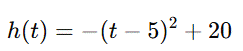
This is maximized at t=5, where:
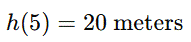
So, maximum water level = 20 meters at t=5 minutes.
Summary Answer:
- Maximum water height: 20 meters
- Time of maximum height: Exactly at t=5 minutes
- Graph behavior:
Linear rise → Sudden jump → Parabolic fall. - Real-world meaning:
The graph models a two-phase process: steady filling, sudden event, then draining with increasing speed.
Here are five conclusive points for "Linear Functions in a Coordinate Plane":
- Graphing functions is essential for visually representing real-world relationships:
By plotting functions, students can visually interpret how variables interact over time, distance, cost, population, or other contexts.
- Different types of functions model different real-life scenarios:
Linear, quadratic, exponential, piecewise, and absolute value functions each represent unique real-world behaviours like constant change, acceleration, rapid growth, variable rates, or distance from a point.
- Understanding domain and range is crucial in real-world modeling:
Not all input and output values make sense in every scenario. Determining a realistic domain and range ensures the graph reflects feasible, practical solutions.
- Function transformations help adjust models to fit observed data:
By applying shifts, stretches, or reflections, students can tailor graphs to better match actual measurements or behaviours in real-life situations.
- Graph interpretation supports data-driven decision-making:
Graphs help in making predictions, analysing trends, and solving real-world problems, such as forecasting sales, calculating profit thresholds, or determining safe operating ranges.