Unit: Graphing: Finding Solutions
Chapter: System of Linear Equations
Reference: – Definition of a Linear Equation, Standard Form of a Linear Equation, Slope-Intercept Form, Graphing Linear Equations, Definition of a System of Linear Equations, Solutions of a System of Linear Equations, Consistent and Inconsistent Systems, Dependent and Independent Systems, Graphical Solution Method, Checking Solutions by Substitution, Solving Systems with Parallel Lines, Solving Systems with Coinciding Lines, Word Problems Leading to Systems of Linear Equations, Graphing Inequalities in Systems
After studying this chapter, you should be able to understand:
- Definition of a Linear Equation & Standard Form of a Linear Equation
- Graphing Linear Equations & Definition of a System of Linear Equations
- Graphical Solution Method & Checking Solutions by Substitution
- Word Problems Leading to Systems of Linear Equations
- Definition of a Linear Equation:
A linear equation is an algebraic expression in which each term is either a constant or the product of a constant and a single variable. The graph of a linear equation in two variables is always a straight line.
- Standard Form of a Linear Equation:
This is a way of writing linear equations in the format Ax+By=C, where A, B, and C are real numbers, and A and B are not both zero. It provides a general way to represent straight lines.
- Slope-Intercept Form:
This is a form of a linear equation written as y=mx+b, where mmm represents the slope of the line (rate of change), and b represents the y-intercept (the point where the line crosses the y-axis).
- Graphing Linear Equations:
The process of representing a linear equation visually on a coordinate plane by plotting points that satisfy the equation and then drawing a straight line through those points.
- Definition of a System of Linear Equations:
A system of linear equations is a set of two or more linear equations with the same variables. The solution to the system is the set of variable values that satisfy all the equations simultaneously.
- Solutions of a System of Linear Equations:
A solution to a system is the point or points where the graphs of the equations intersect. It represents the values of the variables that make all the given linear equations true at the same time.
- Consistent and Inconsistent Systems:
A consistent system has at least one solution, meaning the lines intersect at one or more points. An inconsistent system has no solution, meaning the lines are parallel and never meet.
- Dependent and Independent Systems:
A dependent system consists of two equations that represent the same line, giving infinitely many solutions. An independent system has exactly one solution, meaning the lines intersect at exactly one point.
- Graphical Solution Method:
A visual approach to solving systems of equations by graphing each equation on the same coordinate plane and identifying the intersection point(s) as the solution.
- Checking Solutions by Substitution:
After finding a solution by graphing, the solution is verified by substituting the coordinates into the original equations to ensure both are satisfied.
- Solving Systems with Parallel Lines:
This involves recognizing when two equations have the same slope but different y-intercepts, indicating that the lines will never intersect, resulting in no solution.
- Solving Systems with Coinciding Lines:
This occurs when two equations represent the same line, meaning every point on the line is a solution, resulting in infinitely many solutions.
- Word Problems Leading to Systems of Linear Equations:
Translating real-life scenarios or practical situations into mathematical models using two or more linear equations with multiple variables to be solved.
- Graphing Inequalities in Systems:
This involves graphing linear inequalities on the coordinate plane and finding the overlapping region (solution region) where all inequalities are true simultaneously.
- Limitations of the Graphing Method:
This refers to the fact that graphing may not always provide precise solutions, especially when intersection points fall between grid lines or involve fractions. In such cases, algebraic methods are preferred for accuracy.
Example: –
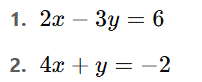
Solve the following system of equations graphically, and verify the solution algebraically:
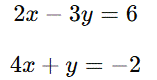
Also, classify the system as consistent independent, inconsistent, or dependent.
Solution: –
- First Equation:
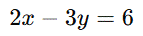
Move 2x to the other side:

Now divide by −3:
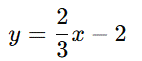
Second Equation:
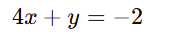
Move 4x to the other side:
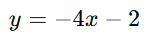
Analyse both lines for graphing:
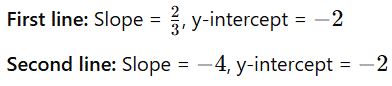
Graph both lines (conceptually describe):
First line rises moderately (since slope is positive and less than 1).
- Second line falls steeply (since slope is negative and large in magnitude).
- Both cross the y-axis at −2-2−2.
Where the two lines intersect is the solution.
Find Intersection Point Algebraically (Exact Solution):
We now solve the two equations algebraically (to get the exact point).
Start with the two original equations:
Conclusion:
- Graphically, both lines cross at (0,−2).
- Algebraically, substitution confirms the same result.
- Type of system: Consistent and Independent (unique solution).
Here are five conclusive points for "Linear Functions in a Coordinate Plane":
- Graphical Representation Provides Visual Understanding:
Solving a system of linear equations by graphing allows students to visually interpret the relationship between two or more linear equations and clearly see where and how solutions exist.
- Nature of Solutions is Easily Identified by the Graph:
By observing how the lines behave on the graph, one can quickly classify the system as having a single solution (lines intersect once), no solution (parallel lines), or infinitely many solutions (coinciding lines).
- Graphing Method Highlights Real-World Applications:
Graphing systems is particularly useful when dealing with real-world problems like comparing rates, solving budget constraints, or analysing resource limits, where visual comparison between variables matters.
- Limitations of Precision Exist in the Graphing Method:
Although graphing is a powerful conceptual tool, it can lack accuracy, especially for solutions involving non-integer or fractional coordinates, making algebraic methods necessary for exact answers.
- Understanding Slope and Intercept is Crucial for Interpretation:
A strong grasp of slope and intercept concepts is essential for accurately graphing equations and predicting the type of solution a system may have before plotting.