Unit: Graphing: Types of Graphs
Chapter: Radical Functions and Piecewise function
Reference: – Definition of Radical Functions, Domain of Radical Functions, Range of Radical Functions, Graphing Basic Square Root Functions, Graphing Cube Root and Higher Radical Functions, Transformations of Radical Functions, Solving Radical Equations Graphically, Real-world Applications of Radical Functions, Definition of Piecewise Functions, Graphing Piecewise Functions, Domain and Range of Piecewise Functions, Discontinuities in Piecewise Functions, Evaluating Piecewise Functions
After studying this chapter, you should be able to understand:
- Definition of Radical Functions
- Domain of Radical & Piecewise Functions & Range of Radical & piecewise Functions
- Solving Radical Equations Graphically & Real-world Applications of Radical Functions
- Discontinuities in Piecewise Functions & Evaluating Piecewise Functions
- Definition of Radical Functions
Radical functions are mathematical functions that contain a variable expression under a radical sign, such as a square root, cube root, or other nth roots. These functions involve the process of taking roots of numbers or expressions.
- Domain of Radical Functions
The domain of a radical function refers to all the possible input values (x-values) for which the function is defined. For even roots (like square roots), the domain is restricted to values that keep the expression inside the radical non-negative to avoid undefined results.
- Range of Radical Functions
The range of a radical function is the set of all possible output values (y-values) that the function can produce. This is determined by analysing how the values inside the radical affect the output.
- Graphing Basic Square Root Functions
This involves understanding the general shape and behavior of the simplest form of a square root function. The graph usually starts at a specific point and extends in one direction, reflecting the constraints imposed by the square root.
- Graphing Cube Root and Higher Radical Functions
Cube root and higher root functions produce graphs that are defined for all real numbers. Their graphs typically extend in both directions and are symmetric in specific ways, depending on the root.
- Transformations of Radical Functions
Transformations refer to changes in the position, orientation, and size of the graph of a radical function. These include vertical and horizontal shifts, reflections over axes, and vertical or horizontal stretching and compressing.
- Solving Radical Equations Graphically
This involves finding the point(s) where the graph of a radical function intersects a given horizontal line or another function. These points represent solutions to the radical equation.
- Real-world Applications of Radical Functions
Radical functions model many real-life situations where a relationship involves a root function, such as physics, engineering, biology, and geometry, like area-length or speed-time relations.
- Definition of Piecewise Functions
Piecewise functions are functions that are defined by different expressions for different intervals of the input variable. Each piece of the function has its own domain restriction.
- Graphing Piecewise Functions
Graphing a piecewise function involves plotting each individual piece on the coordinate plane, making sure to apply the correct domain restriction for each part.
- Domain and Range of Piecewise Functions
The domain of a piecewise function is the combined set of input values where each piece is defined. The range is the set of all output values that result from the union of all pieces of the function.
- Discontinuities in Piecewise Functions
Discontinuities occur in piecewise functions where there are jumps, gaps, or abrupt changes in the graph between different pieces. These are points where the function is not continuous.
- Writing Piecewise Functions from Graphs
This is the process of observing a given graph and expressing it in piecewise form by determining the algebraic rule for each section and its corresponding domain interval.
- Evaluating Piecewise Functions
To evaluate a piecewise function for a given input, one must first identify which piece of the function applies to that input value based on the domain restrictions, and then substitute the input into that piece.
- Real-life Applications of Piecewise Functions
Piecewise functions are used to model situations where a rule or condition changes at certain thresholds. Common examples include billing systems, tax brackets, and speed limits that vary with time or distance.
Example: –
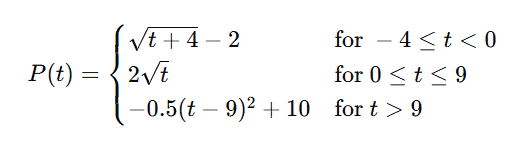
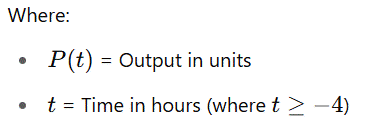
- A factory's production output (in units) over time (in hours) is modelled by the following piecewise-defined radical function:
- Sketch the graph conceptually, marking key features (turning points, endpoints, etc.).
- Identify any discontinuities in the function.
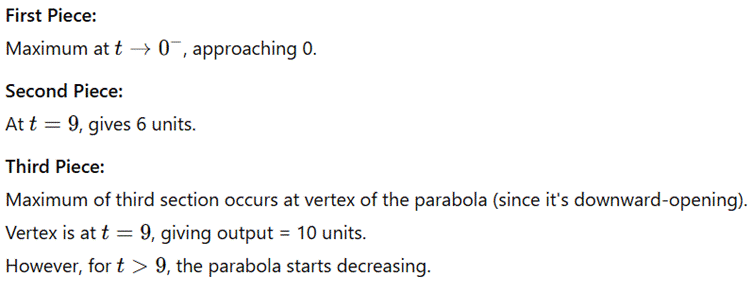
- Find the time at which the production output is at its maximum within t=−4 to t=12.
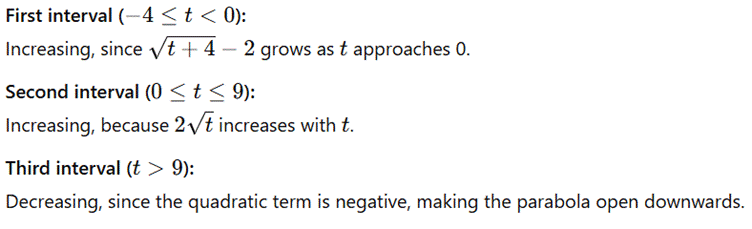
- Check if the function is increasing or decreasing in each interval.
Solution: –
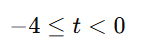
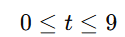
Domain of the Function:
- For first piece:
For second piece:
For third piece:

Overall domain:
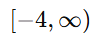
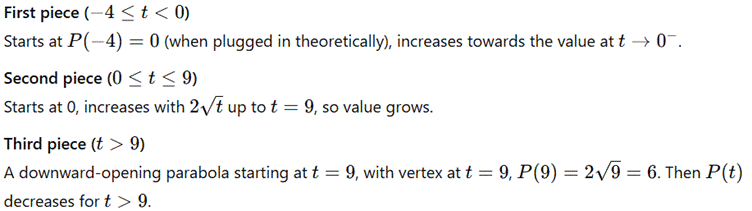
Range of the Function:
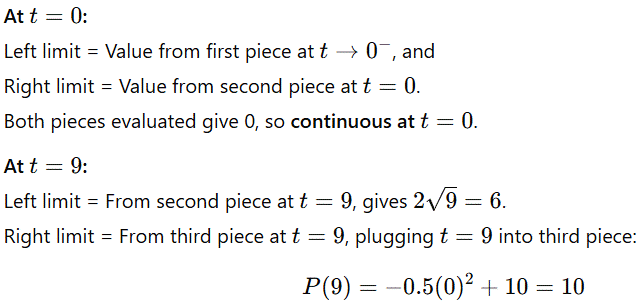
Discontinuities:
We compare the maximum output from each section:
Increasing or Decreasing Behavior in Each Interval:
Here are five conclusive points for "Linear Functions in a Coordinate Plane":
- Understanding Domain Restrictions is Crucial for Both Radical and Piecewise Functions
For radical functions, the domain is often limited by the need to avoid taking even roots of negative numbers. For piecewise functions, the domain is split into intervals, and each part of the function applies only within its specific interval.
- Graph Behavior of Radical and Piecewise Functions Shows Unique Features
Radical functions typically produce curved graphs with slow growth initially, while piecewise functions can show sudden jumps, breaks, or changes in slope and direction. Recognizing these behaviours helps in interpreting and graphing them accurately.
- Function Notation and Proper Interpretation Ensure Correct Evaluation
Both radical and piecewise functions require careful reading of function definitions and conditions. Correct evaluation depends on choosing the right expression based on input values.
- Continuity and Discontinuity Play Key Roles in Graph Analysis
While many radical functions are continuous over their domain, piecewise functions often introduce discontinuities. Identifying whether a function is continuous or has jumps is essential for graph sketching and problem-solving.
- Real-World Problems Often Require Using Both Radical and Piecewise Functions
Many real-life situations, such as distance-time relationships (radicals) or pricing models with stepwise rates (piecewise), rely on these functions. Mastering their graphing and interpretation is essential for applying algebra to practical scenarios.