Unit: Functions
Chapter: Exponential & Factorization Rearrangement
Reference: – Definition and Types of Functions, Representations of Functions, Rate of Change and Slope, Domain and Range, Intercepts and Key Features, Transformations of Functions, Comparing Linear and Nonlinear Functions, Function Composition and Inverses, Real-World Applications
After studying this chapter, you should be able to understand:
- Definition and Types of Functions & Representations of Functions
- Rate of Change and Slope & Domain and Range
- Transformations of Functions
- Real-World Applications
Here is a theoretical elaboration of each topic related to Comparing Functions in Algebra:
- Definition and Types of Functions
Functions represent relationships where each input is associated with exactly one output. Different types of functions exist, such as linear, quadratic, and exponential, each with distinct properties that determine their behavior in mathematical models and real-world applications. - Representations of Functions
Functions can be expressed in multiple ways, including algebraic equations, graphical models, numerical tables, and verbal descriptions. These representations help in analysing and comparing their characteristics and identifying patterns in data. - Rate of Change and Slope
The rate of change describes how one quantity changes in relation to another. In linear functions, this is constant and represented by the slope, while in nonlinear functions, the rate of change varies, impacting how the function behaves over different intervals. - Domain and Range
The domain refers to the set of possible input values, while the range represents the set of output values a function can produce. Comparing functions based on domain and range helps determine their limitations and practical applications. - Intercepts and Key Features
The x- and y-intercepts indicate where a function crosses the axes, providing crucial points for understanding function behavior. Other key features, such as maximum and minimum values, asymptotes, and end behavior, help in comparing different functions. - Transformations of Functions
Functions can undergo transformations, including translations, reflections, stretching, and compressing. These modifications allow functions to be compared based on their changes in position and shape while maintaining their fundamental properties. - Comparing Linear and Nonlinear Functions
Linear functions exhibit a constant rate of change, forming straight-line graphs, whereas nonlinear functions have variable rates of change, resulting in curved graphs. Understanding these differences helps in choosing appropriate function models for different scenarios. - Function Composition and Inverses
Function composition involves combining two functions to create a new one, analysing how inputs transform through multiple operations. The inverse of a function reverses its process, helping in comparisons and problem-solving in algebraic contexts. - Real-World Applications
Functions are used in diverse fields such as economics, physics, biology, and engineering. Comparing functions allows for better decision-making and prediction in practical situations, such as growth trends, financial forecasting, and scientific modeling.
Example: –
A company is analysing two different pricing models for its subscription service:
- Model A: A one-time setup fee of $50 plus a monthly fee of $10.
- Model B: A different plan that charges $20 per month with no setup fee.
Tasks:
- Write the function equations for each pricing model, where C(x) represents the total cost in dollars, and x is the number of months.
- Find the point at which both plans cost the same.
- Determine which plan is more cost-effective for short-term and long-term usage.
- Compare the rate of change for both functions.
- Analyse and compare their domain, range, and key graphical features.
Solution: –
Step 1: Writing the Equations
Let x represent the number of months of subscription.
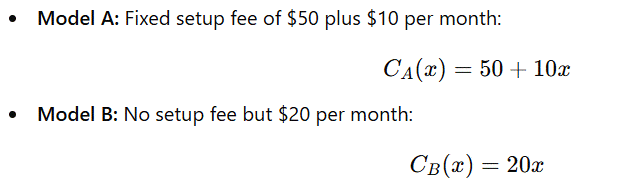
Step 2: Finding the Break-Even Point
To find when both plans cost the same, set the equations equal to each other:
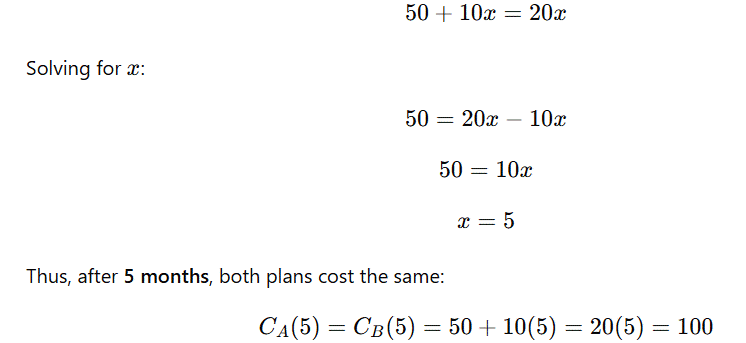
Step 3: Determining the Cheaper Plan
- If x months, Model A is more expensive because of the $50 setup fee.
- If x>5 months, Model A is cheaper as its monthly cost is lower.
Step 4: Comparing Rate of Change
- Model A's rate of change (slope) = 10 (cost increases by $10 per month).
- Model B's rate of change (slope) = 20 (cost increases by $20 per month).
Since Model B has a steeper slope, it becomes more expensive over time compared to Model A.
Step 5: Domain, Range, and Graphical Features
- Domain: x≥0 (months cannot be negative).
- Range: C(x)≥50 for Model A, C(x)≥0 for Model B.
- Intercepts: Model A has a y-intercept of 50, while Model B starts at 0.
- Graph Comparison: Both graphs are linear, but Model B has a steeper incline.
Here are five conclusive points for the topic Comparing Functions:
- Understanding Differences in Function Behavior
Functions can be compared by analysing their structure, rate of change, and graphical representation. This helps in distinguishing between linear, quadratic, exponential, and other types of functions based on their unique properties. - Importance of Multiple Representations
Functions can be expressed in various forms, including equations, tables, and graphs. Comparing different representations allows for deeper insights into their characteristics and real-world applications. - Analysing Growth Patterns
The rate at which a function increases or decreases determines its long-term behavior. Understanding whether a function exhibits constant, increasing, or decreasing rates of change is crucial in making predictions. - Application in Problem-Solving
Comparing functions is essential in fields such as economics, engineering, and science. It helps in selecting the most appropriate function model to describe real-life situations and make informed decisions. - Enhancing Critical Thinking in Algebra
By comparing functions, students develop problem-solving skills and analytical thinking. This strengthens their ability to interpret data, recognize patterns, and apply algebraic concepts effectively in diverse scenarios.