Unit: Inverse Functions
Chapter: Defining Inverse Functions
Reference: – Definition of an Inverse Function, Notation of Inverse Functions, Existence of Inverse Functions, One-to-One Functions, Horizontal Line Test, Finding Inverse Functions Algebraically, Verification of Inverses, Graphical Representation of Inverse Functions, Domain and Range Relationships Between Functions and Their Inverses, Restricting the Domain to Make a Function Invertible, Inverse of Linear Functions, Inverse Functions in Real-Life Applications
After studying this chapter, you should be able to understand:
- Definition of an Inverse Function & Notation of Inverse Functions
- Existence of Inverse Functions & One-to-One Functions
- Graphical Representation of Inverse Functions & Domain and Range
- Inverse Functions in Real-Life Applications
1. Definition of an Inverse Function:
An inverse function reverses the input-output process of the original function. If a function takes an input and produces an output, its inverse takes that output and returns the original input.
2. Notation of Inverse Functions:
Inverse functions are denoted with a superscript negative one, written as which indicates the inverse of the function f(x), not a reciprocal.
3. Existence of Inverse Functions:
A function has an inverse if and only if it is one-to-one, meaning each output value corresponds to exactly one input value.
4. One-to-One Functions:
A function is called one-to-one if different input values always produce different output values. No two distinct inputs share the same output.
5. Horizontal Line Test:
A graphical method used to determine if a function is one-to-one. If every horizontal line intersects the graph of the function at most once, the function is one-to-one and has an inverse.
6. Finding Inverse Functions Algebraically:
The process involves switching the roles of the dependent and independent variables (usually x and y) and then solving for the new dependent variable.
7. Verification of Inverses:
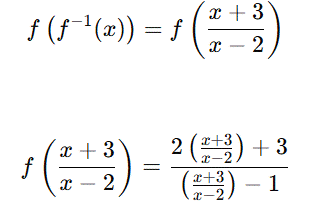
Two functions are inverses of each other if their composition (in both orders) returns the identity function. This means applying one function after the other results in the original input.
8. Graphical Representation of Inverse Functions:
The graph of an inverse function is a reflection of the graph of the original function across the line y=x.
9. Domain and Range Relationships Between Functions and Their Inverses:
The domain of a function becomes the range of its inverse, and the range of the original function becomes the domain of the inverse function.
10. Restricting the Domain to Make a Function Invertible:
For functions that are not one-to-one over their entire domain (like quadratics), limiting the domain to a section where the function is one-to-one makes it possible to define an inverse.
11. Inverse of Linear Functions:
Linear functions are typically invertible as long as their slope is non-zero, meaning they pass both the vertical and horizontal line tests.
12. Inverse of Quadratic and Non-linear Functions (With Domain Restrictions):
Quadratic and other non-linear functions generally do not have inverses over their full domain but can be made invertible by restricting the domain appropriately.
13. Inverse Functions in Real-Life Applications:
Inverse functions are used in real-world scenarios where reversing a calculation is necessary, such as converting between temperature scales, currency exchange, or distance-time relationships.
14. Composition of Functions and Identity Property:
When a function and its inverse are composed (applied one after another), the result is the original input value, a property known as the identity function.
15. Piecewise Functions and Their Inverses:
Finding inverses of piecewise functions involves dealing with each piece separately while respecting domain and range constraints for each section.
Example: –
Given the function:
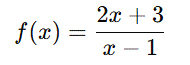
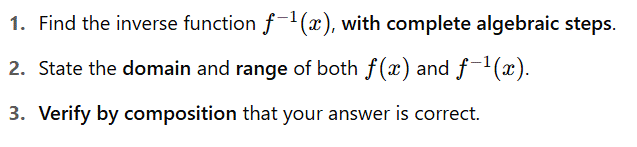
Solution: –
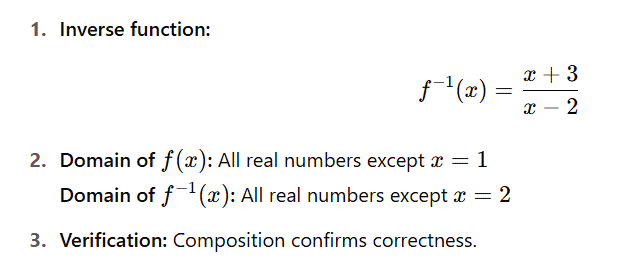
Step 1: Find the Inverse Algebraically
Given:
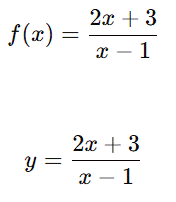
Now, swap x and y:
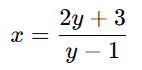
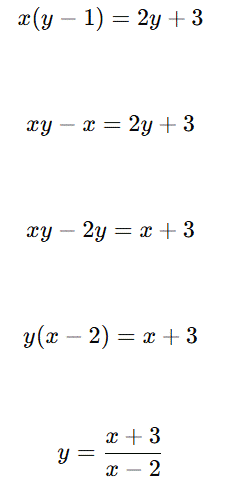
So, the inverse function is:
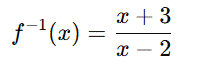
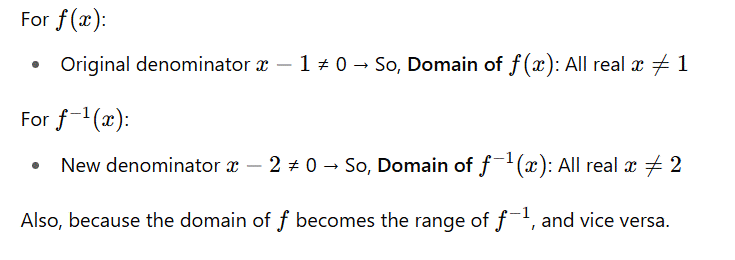
Verification by Composition:
Here are five conclusive points: –
- A Function Must Be One-to-One to Have an Inverse:
For a function to have an inverse, it must pass the horizontal line test, ensuring that each output corresponds to exactly one input.
- Inverse Functions Reverse Input and Output Roles:
An inverse function "undoes" the action of the original function by swapping the domain and range and reflecting the graph across the line y=x.
- The Algebraic Method Involves Switching Variables:
To find the inverse of a function algebraically, you interchange x and y in the original function's equation and then solve for the new dependent variable.
- Verifying Inverses Requires Composition:
Two functions are true inverses if their compositions (in both possible orders) result in the original input, confirming the identity property.
- Domain Restrictions Are Sometimes Necessary:
For non-one-to-one functions (like quadratics or other non-linear functions), restricting the domain is essential before an inverse can be defined, ensuring the inverse remains a function.