Unit: Inverse Functions
Chapter: Invertible Functions
Reference: – Definition of Invertible Functions, One-to-One Functions (Injective Functions), Onto Functions (Surjective Functions), Horizontal Line Test, Conditions for Invertibility, Algebraic Process for Checking Invertibility, Inverse Function Notation, Graphical Relationship Between a Function and Its Inverse, Domain and Range Swap, Inverse of Linear Functions, Inverse of Non-Linear Functions
After studying this chapter, you should be able to understand:
- Definition of Invertible Functions, One-to-One Functions (Injective Functions)
- Onto Functions (Surjective Functions) & Horizontal Line Test
- Inverse Function Notation & Graphical Relationship Between a Function and Its Inverse
- Inverse of Non-Linear Functions
- Definition of Invertible Functions:
An invertible function is a function for which there exists another function (called its inverse) that reverses the effect of the original function. Applying both functions in succession returns the original input.
- One-to-One Functions (Injective Functions):
A function is one-to-one (injective) if every element of the range is mapped from exactly one unique element of the domain. No two different inputs produce the same output.
- Onto Functions (Surjective Functions):
A function is onto (surjective) if every element in the target codomain is covered by at least one element from the domain. This means the range of the function is equal to its codomain.
- Horizontal Line Test:
A graphical method used to determine if a function is one-to-one. If no horizontal line intersects the graph of the function at more than one point, the function passes the test and is invertible.
- Conditions for Invertibility:
A function is invertible if it is both injective (one-to-one) and, in some cases, surjective (onto), ensuring each input corresponds to a unique output and every output comes from some input.
- Algebraic Process for Checking Invertibility:
This involves checking if two distinct inputs ever produce the same output.
- Inverse Function Notation:
The inverse of a function f & This notation indicates the inverse function and should not be confused with a reciprocal.
- Graphical Relationship Between a Function and Its Inverse:
Graphically, the function and its inverse are reflections of each other across the line y=x, meaning their points are symmetric about this line.
- Domain and Range Swap:
For any invertible function, the domain of the original function becomes the range of the inverse function, and the range of the original becomes the domain of the inverse.
- Inverse of Linear Functions:
Linear functions with a non-zero slope are always invertible because they are always one-to-one and pass the horizontal line test.
- Inverse of Non-Linear Functions:
Non-linear functions, such as quadratic or cubic functions, may or may not be invertible over their entire domain. Their invertibility depends on whether they are one-to-one.
- Restricting Domains to Achieve Invertibility:
If a function is not one-to-one over its full domain, the domain can be limited to a region where it becomes one-to-one, thus making it invertible over that restricted domain.
- Piecewise Defined Invertible Functions:
Some functions are defined in pieces over different intervals. Each piece may have to be checked separately for invertibility, often requiring domain restrictions for each piece.
- Inverse Verification Using Composition:
A function and its inverse satisfy the composition property, meaning applying the function and then its inverse (or vice versa) will result in the original input variable, confirming they are true inverses.
- Real-World Applications of Invertible Functions:
Invertible functions are used in real-life situations where processes must be reversed or "undone", such as converting between units, reversing formulas in physics, solving for time, distance, or rates, and decoding encryption algorithms.
Example: –
Let the function be:
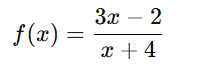

Solution: –
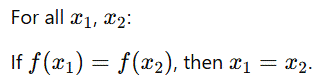
Step 1: Check for Invertibility
For a rational function like this, it’s one-to-one if it passes the horizontal line test or algebraically if it satisfies:
Step 2: Find the Inverse Function
We want to solve for x in terms of y, then swap variables.
Let:
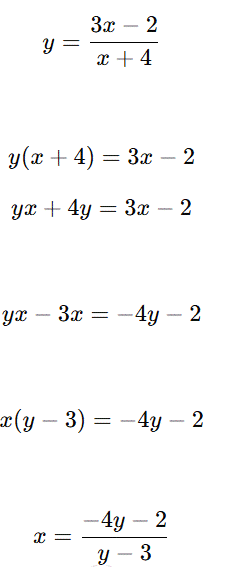
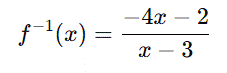
Finally, swap x and y to write the inverse function:
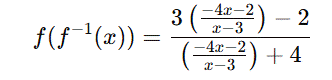
Step 3: Verification (Composition Check)
We check if:
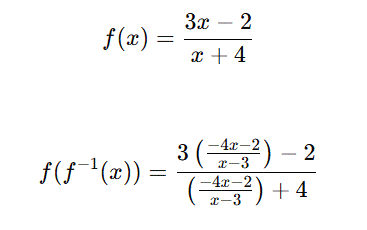
So, plugging in:
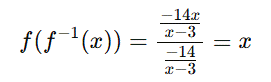
Final Answer : –
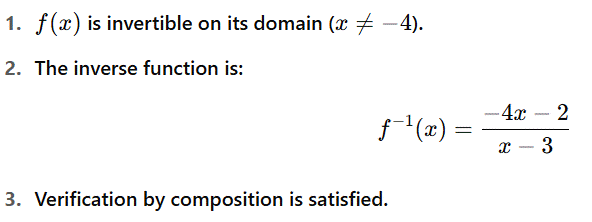
Here are five conclusive points: –
- Invertibility Requires One-to-One Behavior:
A function must be one-to-one (injective) to ensure that each output corresponds to exactly one unique input, making it reversible.
- Graphical Invertibility is Tested with the Horizontal Line Test:
The horizontal line test provides a quick and visual method to confirm whether a function is invertible by checking if any horizontal line crosses the graph more than once.
- Domain and Range Swap in Inverses:
The domain and range of a function and its inverse always switch roles. This reflects both algebraically and graphically when the original and inverse functions are compared.
- Verification of an Inverse Uses Composition:
To confirm that two functions are true inverses of each other, you can use function composition.
- Real-World Utility of Invertible Functions:
Invertible functions are essential in solving real-world problems that require reversing a process, such as converting measurements, decoding information, or solving algebraic formulas for different variables.