Unit: Sequences in Functions
Chapter: Arithmetic Sequences
Reference: – Definition of an Arithmetic Sequence, Common Difference, General Form of an Arithmetic Sequence, First Term Identification, Recursive Formula for Arithmetic Sequences, Explicit Formula for Arithmetic Sequences, Graphing Arithmetic Sequences, Arithmetic Sequences as Linear Functions, Finding Missing Terms, Sum of Finite Arithmetic Series, Applications of Arithmetic Sequences, Finding the Number of Terms
After studying this chapter, you should be able to understand:
- Definition of an Arithmetic Sequence & Common Difference
- General Form of an Arithmetic Sequence & First Term Identification
- Graphing Arithmetic Sequences & Arithmetic Sequences as Linear Functions
- Applications of Arithmetic Sequences
- Definition of an Arithmetic Sequence:
An arithmetic sequence is a list of numbers where each term after the first is generated by adding a constant value (called the common difference) to the previous term.
- Common Difference:
The common difference is the fixed value added repeatedly to generate each term from the previous term in an arithmetic sequence.
- General Form of an Arithmetic Sequence:
This is a formula that expresses any term of the sequence in relation to its position in the sequence, the first term, and the common difference.
- First Term Identification:
The first term is the starting value of the sequence from which all other terms are derived by repeatedly applying the common difference.
- Recursive Formula for Arithmetic Sequences:
A recursive formula defines each term of the sequence in terms of the preceding term and the common difference. It specifies how each term relates to the one before it.
- Explicit Formula for Arithmetic Sequences:
An explicit formula directly defines the nth term of the sequence as a function of its position and the sequence parameters, without referencing previous terms.
- Graphing Arithmetic Sequences:
Graphing involves plotting each term’s position (as the independent variable) against its value (as the dependent variable), resulting in a set of points that typically form a straight line.
- Arithmetic Sequences as Linear Functions:
An arithmetic sequence can be interpreted as a discrete form of a linear function where each input value corresponds to a sequence term, showing a constant rate of change.
- Finding Missing Terms:
This involves determining unknown values in the sequence using known positions and the common difference, based on the sequence’s defining properties.
- Sum of Finite Arithmetic Series:
This refers to calculating the total when a specified number of terms in the arithmetic sequence are added together, producing a finite sum.
- Applications of Arithmetic Sequences:
Arithmetic sequences are used in real-world contexts to model situations involving constant change, such as payment plans, savings growth, or patterns in physical arrangements.
- Finding the Number of Terms:
Given information about certain terms and the common difference, this involves calculating how many terms exist in the sequence up to a specific value or between two values.
- Using Graphs to Solve Sequence Problems:
By examining a graphical representation of a sequence, one can analyse trends, predict future terms, or identify missing data points based on linear patterns.
- Domain of Arithmetic Sequences:
The domain refers to the set of allowable input values (positions in the sequence), which for arithmetic sequences is typically restricted to positive integers.
- Function Notation for Arithmetic Sequences:
Arithmetic sequences can be expressed using function notation, where each term is represented as the output of a function, given its position as the input.
Example: –
A theatre has 40 rows of seats.
- The first row has x seats.
- Each subsequent row has 3 more seats than the previous row.
By the time the 40th row is reached, the total number of seats in the theatre is 4,700 seats.
Tasks:
- Find the number of seats in the first row (find x).
- Find the number of seats in the last (40th) row.
Solution: –
Step 1: Identify the Sequence Type
This is a finite arithmetic sequence, because:
- First term = x
- Common difference = 3 (since each row has 3 more seats than the previous row)
- Number of terms = 40 (since there are 40 rows)
Step 2: Use Formula for the Sum of a Finite Arithmetic Sequence
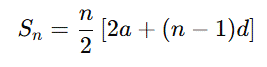
The formula for the sum of first n terms of an arithmetic sequence:
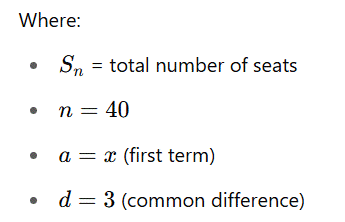
Given:
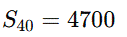
So:

Step 3: Simplify the Equation
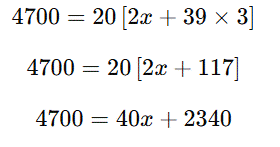
Step 4: Solve for x
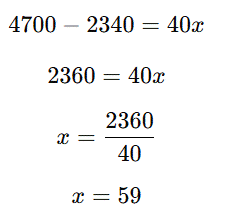
So, the first row has 59 seats.
Step 5: Find the Number of Seats in the Last (40th) Row
The formula for the nth term of an arithmetic sequence:

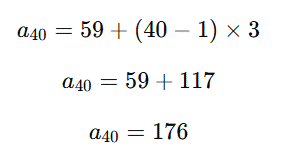
So, the 40th row has 176 seats.
Here are five conclusive points for "Linear Functions in a Coordinate Plane":
1. Arithmetic Sequences Represent Constant Change:
Every arithmetic sequence shows a consistent, linear change from one term to the next, characterized by a fixed common difference.
2. Explicit and Recursive Forms Provide Flexibility:
Arithmetic sequences can be represented both explicitly (for direct calculation of any term) and recursively (to relate each term to its predecessor), offering multiple problem-solving strategies.
3. Graphical Representation Reinforces Linear Nature:
When plotted, arithmetic sequences produce points that lie on a straight line, visually reinforcing their connection to linear functions.
4. Real-World Modeling with Arithmetic Sequences Is Common:
Arithmetic sequences effectively model real-life situations involving steady increases or decreases over time, such as salaries, distances, or production rates.
5. Understanding Term Position and Sequence Behavior Builds Function Skills:
Mastering arithmetic sequences helps students develop a deeper understanding of functions, domain restrictions (to whole number inputs), and algebraic thinking, which is foundational for more advanced math topics.