Unit: Functions
Chapter: Function Operations & Constructions
Reference: – Definition of Domain, Definition of Range, Identifying Domain from an Equation, Identifying Range from an Equation, Domain and Range from Ordered Pairs, Domain and Range from a Graph, Interval Notation for Domain and Range, Set Notation for Domain and Range, Domain Restrictions, Range Limitations Based on Function Type, Effect of Transformations on Domain and Range, Discrete vs. Continuous Domain and Range
After studying this chapter, you should be able to understand:
- Definition of Domain & Definition of Range
- Identifying Range from an Equation & Domain and Range from Ordered Pairs
- Set Notation for Domain and Range & Domain Restrictions
- Discrete vs. Continuous Domain and Range
- Definition of Domain
The domain of a function is the complete set of all input values (usually represented by the variable x) for which the function is defined and produces a valid output.
- Definition of Range
The range of a function is the set of all output values (usually represented by y or f(x) that result from applying the function rule to elements in the domain.
- Identifying Domain from an Equation
Determining the domain from an equation involves analysing the function rule to identify which values of the input variable do not violate any mathematical rules, such as division by zero or taking square roots of negative numbers.
- Identifying Range from an Equation
The range is identified by determining all possible values that the output can take based on how the function rule transforms the input values from the domain.
- Domain and Range from Ordered Pairs
When a function is given as a set of input-output pairs, the domain consists of all the input values, and the range consists of all corresponding output values.
- Domain and Range from a Graph
By examining the horizontal and vertical extent of a graph, one can determine the domain (set of all x-values) and range (set of all y-values) visually.
- Interval Notation for Domain and Range
This is a mathematical way of representing the continuous or discrete nature of domain and range using open and closed intervals to indicate whether endpoints are included or excluded.
- Set Notation for Domain and Range
An alternative to interval notation, set notation uses logical expressions to describe all values that belong to the domain or range, often using inequality symbols or set-builder form.
- Domain Restrictions
Some input values must be excluded from the domain because they result in undefined mathematical operations (e.g., dividing by zero or square roots of negative values).
- Range Limitations Based on Function Type
The type of function (e.g., linear, quadratic, absolute value, exponential) determines the nature of its outputs, which places constraints on the possible values in the range.
- Effect of Transformations on Domain and Range
Shifts (horizontal or vertical), stretches, reflections, or compressions of functions alter the domain and/or range while preserving the underlying structure of the function.
- Discrete vs. Continuous Domain and Range
A discrete domain or range consists of isolated points, while a continuous domain or range includes all values within an interval, with no breaks.
- Vertical Line Test and Functions
The vertical line test is a graphical method for verifying whether a relation is a function by checking that no vertical line intersects the graph in more than one point, confirming each input has only one output.
- Piecewise Functions and Domain Segments
Piecewise functions are defined using different expressions over specific intervals. Each segment may have its own restricted domain, and the total domain is the union of those intervals.
- Function Composition and Domain Implications
When one function is nested inside another, the domain of the composite function depends on the domain of the inner function and the ability of the outer function to accept those outputs as valid inputs.
Example: –
Let,
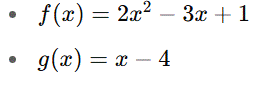
Find and simplify the expression:

Solution: –

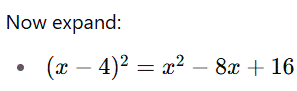
So,

Now distribute:

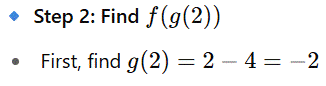



Simplify: –

✅ Five Conclusive Points
- Every Function Has a Well-Defined Domain and Range
A function is only valid when each input corresponds to exactly one output. The domain defines the allowable inputs, and the range defines the outputs resulting from those inputs.
- Function Rules Dictate the Domain and Range
The algebraic form of a function determines what input values are permissible (domain) and what outputs are possible (range), depending on operations like division, square roots, or exponents.
- Graphical and Symbolic Representations Are Both Essential
Domain and range can be determined by analysing graphs or using algebraic expressions, giving multiple ways to understand and interpret function behavior.
- Notation Matters: Interval and Set Notation Improve Clarity
Using interval notation or set-builder notation allows for precise and efficient communication of domain and range, especially for functions with restricted or complex input/output sets.
- Understanding Domain and Range is Foundational to Function Analysis
Domain and range are the basis for more advanced concepts in algebra, such as transformations, compositions, inverses, and piecewise definitions, making them essential to mastering functions.