Unit: Functions
Chapter: Construction of Composite Functions
Reference: – Definition of Composite Functions, Notation for Composite Functions, Order of Composition, Evaluating Composite Functions Numerically, Evaluating Composite Functions Algebraically, Domain Considerations in Composite Functions, Range Considerations in Composite Functions, Graphical Representation of Composite Functions, Inverse Functions and Composite Functions, Restrictions in Composition Due to Domains, Piecewise Function Composition
After studying this chapter, you should be able to understand:
- Definition of Composite Functions & Notation for Composite Functions
- Evaluating Composite Functions Algebraically
- Graphical Representation of Composite Functions
- Restrictions in Composition Due to Domains & Piecewise Function Compositio
- Definition of Composite Functions
A composite function is a function formed by applying one function to the results of another function. It involves combining two functions so that the output of one becomes the input of the other.
- Notation for Composite Functions
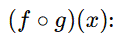
The notation for a composite function is typically written as (f∘ g) (x), which means "f composed with g" or "f of g of x." This signifies that you first apply g(x) and then apply f to the result.
- Order of Composition
In a composition of functions, the order in which functions are applied matters.
- Evaluating Composite Functions Numerically
This process involves substituting a specific numerical value into the inner function first, obtaining its output, and then substituting that result into the outer function.
- Evaluating Composite Functions Algebraically
This involves substituting an entire algebraic expression, rather than a number, from one function into another. The result is a new algebraic expression representing the composite function.
- Domain Considerations in Composite Functions
The domain of a composite function consists of all input values that are within the domain of the inner function and that also produce outputs which lie within the domain of the outer function.
- Range Considerations in Composite Functions
The range of a composite function depends on the range of the inner function and how that range fits into the domain and output behavior of the outer function.
- Graphical Representation of Composite Functions
This refers to representing a composite function visually on a graph. The graph reflects how applying two functions in sequence transforms the input values.
- Inverse Functions and Composite Functions
Inverse functions are functions that "undo" each other. When composing a function with its inverse (in appropriate domains), the composition ideally results in the identity function, where the output equals the original input.
- Restrictions in Composition Due to Domains
This concept emphasizes that composition may not be possible for all input values. Inputs that fall outside the domain of the inner function or cause invalid outputs for the outer function must be excluded.
- Piecewise Function Composition
When one or both functions in a composition are piecewise-defined (having different rules for different parts of the domain), care must be taken to evaluate the composition separately for each piece.
- Application of Composite Functions in Word Problems
In real-world contexts, composite functions represent processes where one action or measurement depends on the result of a previous one, such as converting units then calculating cost.
- Decomposing Functions into Simpler Parts
This refers to expressing a complex function as the composition of two or more simpler functions. This technique is useful in analysis and simplification.
- Nested Functions Concept
Nested functions describe the layered structure where the output of one function is directly used as the input of another, like layers inside layers.
- Multiple-Level Composition
Involves composing more than two functions, such as f(g(h(x))), requiring stepwise evaluation starting from the innermost function outward.
Example: –
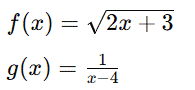
Let the two functions be defined as:

Solution: –
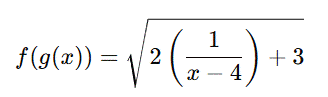
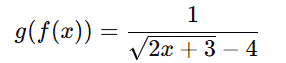
By definition:


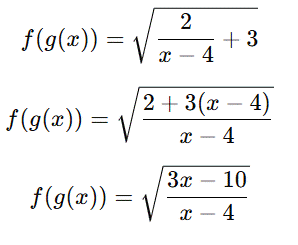
Simplify inside the square root:
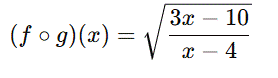
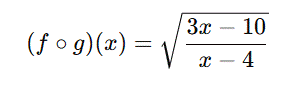
So:
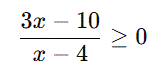
The domain must satisfy two conditions:





✅ Five Conclusive Points
- Order Matters in Composition
The sequence in which functions are applied in a composite function is crucial. Changing the order typically results in a completely different function, highlighting that composition of functions is not generally commutative.
- Domain Restrictions Are Critical
The domain of a composite function is governed by both the inner and outer functions. The input must be acceptable for the inner function, and the output of the inner function must fall within the domain of the outer function.
- Algebraic and Graphical Understanding Go Hand-in-Hand
Successfully working with composite functions requires the ability to evaluate them both algebraically (symbolically) and graphically (visually), reinforcing deep conceptual understanding.
- Real-World Problems Often Involve Function Composition
Many real-life scenarios require sequential processes that can be modelled using composite functions, making this concept highly applicable in various fields such as physics, economics, and engineering.
- Breaking Down Complex Functions Enhances Problem Solving
Decomposing complicated functions into simpler components or building complex functions from basic ones allows for better manipulation, analysis, and interpretation of mathematical models.