Unit: Quadratic Equations
Chapter: Solving Quadratic Equation by completing the square
Reference: – Understanding the standard form of a quadratic equation, Derivation of the quadratic formula, identifying coefficients from standard form, Applying the quadratic formula to solve equations, Discriminant and nature of roots, solving equations with real and complex solutions, Simplifying square roots in the formula, avoiding common mistakes in substitution, Interpreting solutions graphically, Using the formula in word problems, Connections with factoring and completing the square
After studying this chapter, you should be able to understand:
- Understanding the standard form of a quadratic equation
- Understanding Perfect Square Trinomials & Applying the Principle of Square Roots
- Derivation of the quadratic formula, identifying coefficients from standard form
- Connections with factoring and completing the square
Here is a theoretical elaboration for each topic
- Understanding the standard form of a quadratic equation
A quadratic equation is typically written in the form where the highest exponent of the variable is two. Recognizing this structure helps in applying various solving techniques, including the quadratic formula. - Derivation of the quadratic formula
The quadratic formula is derived through a process called completing the square. This process transforms a general quadratic into a solvable expression, revealing the universal formula for all such equations. - Identifying coefficients from standard form
To use the formula, one must correctly identify the numerical values representing the quadratic, linear, and constant terms. These coefficients are essential in placing correct values into the formula for accurate results. - Applying the quadratic formula to solve equations
The quadratic formula provides a direct and systematic approach to solving any quadratic equation, regardless of whether the roots are rational, irrational, or complex. - Discriminant and nature of roots
The expression under the square root in the formula—called the discriminant—determines the type of solutions: whether the equation has two distinct real roots, one repeated root, or complex conjugate roots. - Solving equations with real and complex solutions
Based on the value of the discriminant, the quadratic formula allows one to handle both real and non-real roots by operating within the realms of real numbers and complex numbers. - Simplifying square roots in the formula
When applying the formula, simplifying the square root component is often necessary to express the solution in its simplest form. This also includes rationalizing denominators when required. - Avoiding common mistakes in substitution
Substituting negative numbers and signs accurately is crucial in preventing calculation errors. Misplacement of signs or incorrect grouping can lead to incorrect results. - Interpreting solutions graphically
The roots found through the formula correspond to the points where the graph of the quadratic function intersects the x-axis. Understanding this connection helps link algebraic and geometric representations. - Using the formula in word problems
Many real-world scenarios model quadratic behavior, such as projectile motion or area problems. The quadratic formula is a key tool in finding solutions to such contextual problems. - Connections with factoring and completing the square
The quadratic formula can often be an alternative to other methods like factoring or completing the square. Understanding when and why to use each method supports mathematical fluency. - Comparing methods: factoring vs. quadratic formula
While factoring may be quicker for simple equations, the quadratic formula is more universally applicable. Comparing both approaches enhances strategic problem-solving skills.
Example: –
Solve using the quadratic formula:
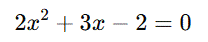
Solution: –
Identify coefficients:
a=2, b=3, c=−2
Use the quadratic formula:
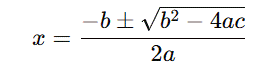
Substitute values:
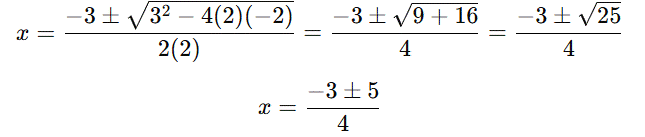
Two solutions:
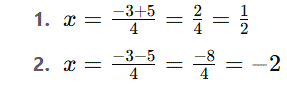
Here are five conclusive points for the topic Quadratic Formulas:
- The quadratic formula is a universal method that can solve any quadratic equation regardless of its factorability.
- The discriminant within the formula plays a key role in determining the type and number of solutions.
- Mastery of this formula enhances algebraic fluency and accuracy in both theoretical and application-based problems.
- It connects symbolic algebra with graphical interpretations by identifying x-intercepts of parabolas.
- The formula complements other methods like factoring and completing the square, offering students strategic choice in solving quadratics.