Unit: Quadratic Equations
Chapter: Quadratic Formula and Nature Of Roots
Reference: – Concept of completing the square, rewriting quadratic expressions in perfect square form, using algebra tiles or geometric visualization, solving quadratic equations by completing the square, converting standard form to vertex form, Application in finding vertex of a parabola, Role of square completion in deriving the quadratic formula, Recognizing perfect square trinomials, Dealing with coefficients not equal to one, Application in real-world and word problems
After studying this chapter, you should be able to understand:
- Concept of completing the square
- rewriting quadratic expressions in perfect square form & using algebra tiles or geometric visualization
- Role of square completion in deriving the quadratic formula
- Application in real-world and word problems
Here is the theoretical elaboration for each point under “Completing the Square” in the context of Quadratic Equations:
- Concept of completing the square
This technique involves transforming a quadratic expression into a perfect square trinomial by adding or subtracting a constant. The goal is to express the quadratic in the form of a squared binomial, which simplifies solving equations or analysing graphs. - Rewriting quadratic expressions in perfect square form
A quadratic can be expressed as a square of a binomial by identifying a suitable constant that completes the square, allowing the expression to be factored and written in a compact squared form. - Using algebra tiles or geometric visualization
Visual tools like tiles or area models help illustrate how a square can be completed by showing missing pieces in a geometric square, making the algebraic process intuitive and concrete. - Solving quadratic equations by completing the square
By rewriting a quadratic expression as a perfect square, one can isolate the variable through square roots, providing an effective method to find the roots of any solvable quadratic equation. - Converting standard form to vertex form
Completing the square enables the transformation of a quadratic from its standard form into vertex form, which reveals the vertex and symmetry of the corresponding parabola, aiding in graphing and analysis. - Application in finding vertex of a parabola
Once in vertex form, the completed square format clearly shows the coordinates of the parabola’s vertex, providing insight into the maximum or minimum values of the function. - Role of square completion in deriving the quadratic formula
The process of completing the square on the general form of a quadratic equation leads directly to the derivation of the quadratic formula, showcasing its foundational role in algebra. - Recognizing perfect square trinomials
Identifying when a trinomial is already a perfect square helps in factoring quickly and solving equations without additional manipulation. - Dealing with coefficients not equal to one
When the leading coefficient is not one, the first step is factoring it out before completing the square, ensuring the squared term forms correctly for further simplification. - Application in real-world and word problems
This method is particularly useful in problems involving motion, area, and optimization where quadratic models arise, helping interpret and solve scenarios algebraically. - Graphical interpretation of transformations
Completing the square reveals how changes in a quadratic’s equation affect the graph’s shape and position, including vertical shifts and horizontal translations. - Comparing solving strategies for quadratics
Understanding this method allows students to evaluate when completing the square is more effective compared to factoring or using the quadratic formula based on the problem structure.
Example: –
Solve by completing the square:
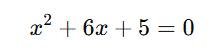
Solution: –
Step 1: Move the constant to the right:
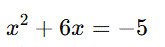
Step 2: Complete the square:
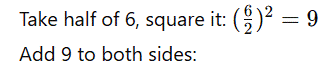

Step 3: Take square root on both sides:
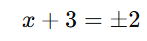
So, x = -1 & x = -5
Here are five conclusive points for the topic “Completing the Square” under Quadratic Equations:
- Completing the square is a powerful algebraic technique that rewrites any quadratic expression in a perfect square form, enhancing both solvability and graph interpretation.
- It is particularly helpful in solving quadratic equations that are not easily factorable, allowing solutions through square roots.
- This method plays a crucial role in converting standard form equations to vertex form, revealing the vertex of a parabola.
- The process underpins the derivation of the quadratic formula, reinforcing its foundational value in algebra.
- It supports better understanding of transformations and helps model real-world scenarios where optimization is required.