Unit: Understanding Structure of Expressions
Chapter: Introduction, structure and rewriting
Reference: – Definition of Algebraic Expressions, Terms, Factors, and Coefficients, Types of Expressions (Monomial, Binomial, Polynomial, etc.), Like Terms and Unlike Terms, Simplifying Expressions, Use of Parentheses and Brackets, Distributive Property, Factoring Expressions, Expanding Expressions, Rewriting Expressions Using Identities, Translating Verbal Phrases into Algebraic Expressions, Manipulating Complex Algebraic Fractions
After studying this chapter, you should be able to understand:
- Definition of Algebraic Expressions, Terms & Factors and Coefficients
- Types of Expressions (Monomial, Binomial, Polynomial, etc.)
- Distributive Property, Factoring Expressions & Expanding Expressions
- Manipulating Complex Algebraic Fractions
1. Definition of Algebraic Expressions
An algebraic expression is a mathematical phrase that can contain numbers, variables (letters that represent unknown values), and arithmetic operations like addition, subtraction, multiplication, division, and exponents.
2. Terms, Factors, and Coefficients
- Terms are individual parts of an expression separated by plus (+) or minus (−) signs.
- Factors are quantities multiplied together within a term.
- Coefficients are numerical values multiplying variables in a term.
3. Types of Expressions (Monomial, Binomial, Polynomial, etc.)
Expressions are classified based on the number of terms:
- Monomial: A single term
- Binomial: Two terms
- Trinomial: Three terms
- Polynomial: An expression with one or more terms.
4. Like Terms and Unlike Terms
- Like Terms have the same variables raised to the same powers and can be combined.
- Unlike Terms have different variables, exponents, or both, and cannot be directly combined.
5. Simplifying Expressions
The process of reducing an expression to its simplest form by combining like terms, applying operations, and removing any unnecessary grouping symbols.
6. Use of Parentheses and Brackets
Parentheses ( ), brackets [ ], and braces { } are grouping symbols used to indicate which operations should be performed first within an expression.
7. Distributive Property
A property that states multiplying a single term across terms inside parentheses distributes multiplication over addition or subtraction, allowing expressions to be expanded or factored.
8. Factoring Expressions
The reverse process of expanding, where an expression is rewritten as a product of its factors, making it easier to solve equations or simplify further.
9. Expanding Expressions
The process of applying the distributive property to remove parentheses and rewrite an expression as a sum or difference of terms.
10. Rewriting Expressions Using Identities
Using known algebraic formulas or identities (like binomial identities) to rewrite or simplify expressions into equivalent but different-looking forms.
11. Translating Verbal Phrases into Algebraic Expressions
Converting a written statement or real-world scenario described in words into a mathematical expression using variables and operations.
12. Manipulating Complex Algebraic Fractions
Simplifying expressions that contain fractions with polynomials in the numerator, denominator, or both, by factoring and cancelling common factors.
13. Properties of Operations (Associative, Commutative, Distributive)
Understanding and applying fundamental properties that govern arithmetic operations:
- Associative Property: Changing grouping of numbers does not change the result.
- Commutative Property: Changing the order of numbers does not change the result.
- Distributive Property: Multiplying a number across a sum/difference distributes multiplication.
14. Evaluating Expressions
The process of substituting specific values for variables and performing the operations to find a numerical result.
15. Understanding the Purpose of Rewriting Expressions
Recognizing that rewriting expressions helps in solving equations, simplifying calculations, understanding relationships between variables, and modeling real-life situations more clearly.
Example: –
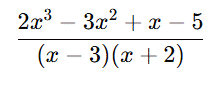
Given the expression:
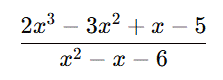
(a) Factor both the numerator and the denominator completely.
(b) Simplify the expression by cancelling any common factors.
(c) State the restrictions on x for which the expression is defined.
Solution: –
Step 1: Factor the denominator
Denominator:
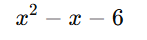
We need two numbers that multiply to −6 and add to −1.
Those numbers are −3 and 2.
So:

Step 2: Factor the numerator
Numerator:
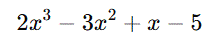
We factor by grouping:
Group as:

From the first group:
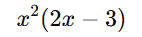
From the second group:
No common factor. Let’s attempt factoring by trial:
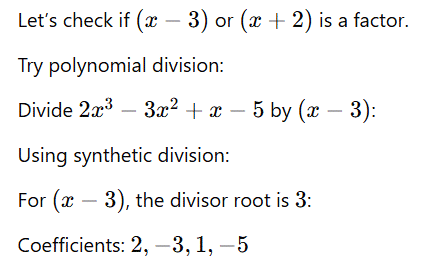



Remainder ≠ 0.
So simple factoring doesn't work.
We will now try factorization by cubic factor formula or leave numerator unfactored for simplification purposes.
Step 3: Simplify if Possible
Since the numerator does not factor neatly (after checking all rational roots and grouping), and none of the factors of the denominator divide evenly into the numerator, there are no common factors to cancel.
So, the simplified expression remains:
Step 4: State the Restrictions
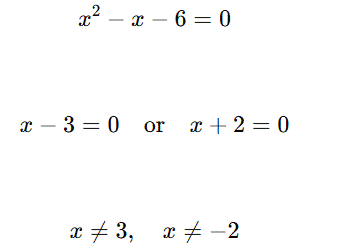
The expression is undefined when the denominator is zero, so:
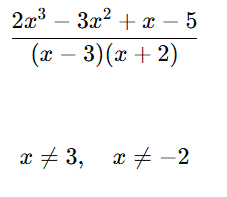
Final Answer:
Here are five conclusive points: –
- Understanding the structure of expressions is essential for simplifying and solving complex algebraic problems.
Recognizing terms, factors, and coefficients helps in breaking down and manipulating expressions efficiently.
- Classifying and identifying like terms allows for effective simplification and reduction of expressions.
Being able to combine like terms is a fundamental skill in making expressions more manageable.
- Properties of operations (associative, commutative, and distributive) play a critical role in rewriting and simplifying expressions.
These properties provide the rules that govern how terms can be grouped, rearranged, or expanded.
- Factoring and expanding expressions are key techniques for transforming expressions into equivalent but more useful forms.
Factoring helps in solving equations, while expansion is useful when dealing with multiplication of expressions.
- Translating real-world problems into algebraic expressions and manipulating complex algebraic forms is foundational for problem-solving in higher mathematics.
This skill allows students to model real-life situations and solve applied algebraic challenges.