Unit: Trigonometric & Polar Functions
Chapter: Core Trigonometric Functions: Sine, Cosine & Tangent
Reference: – Definition of Core Trigonometric Functions, Graphical Representation of Sine, Cosine & Tangent, Domain and Range, Periodicity & Symmetry, Amplitude, Frequency, and Phase Shift, Special Angles and Exact Values, Pythagorean Identities, Reciprocal Relationships, Applications of Core Functions, Connection to Polar Representation
After studying this chapter, you should be able to:
- Core Trigonometric Functions & Graphical Representation
- Domain, Range, Periodicity & Symmetry
- Pythagorean Identities & Reciprocal Relationships
- Application, properties & Polar functions
1. Definition of Core Trigonometric Functions
Explanation:
Trigonometric functions relate angles of a triangle to ratios of its sides. They are foundational in both geometry and calculus.
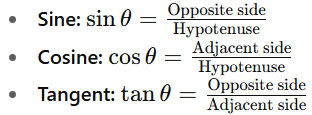
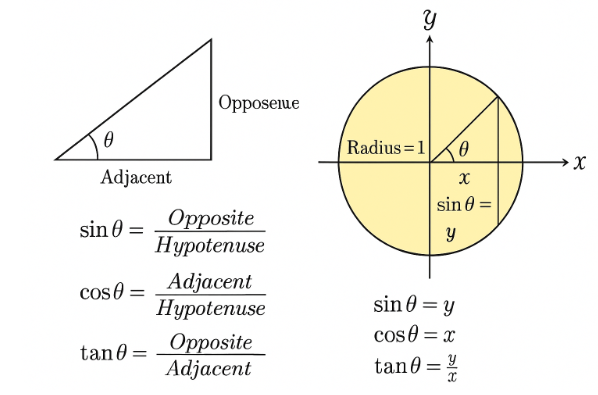
- Right Triangle Definition: For a right triangle with angle θ:
- Unit Circle Definition: Place the triangle inside a unit circle (radius = 1):
- Any point on the circle is (x, y)
- cos θ=x, sin θ=y, tan θ=y/x
Example:
For a right triangle with sides 3, 4, 5 and θ opposite side 3: 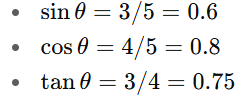
2. Graphical Representation of Sine, Cosine & Tangent
Explanation:
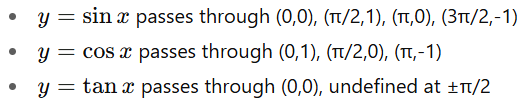
- Sine: Wave starting at 0, goes up to 1, down to -1, repeats every 2π
- Cosine: Wave starting at 1, goes down to -1, back to 1, repeats every 2π
- Tangent: Repeats every πππ, vertical asymptotes at θ=π/2+nπθ
Example Graph Observations:
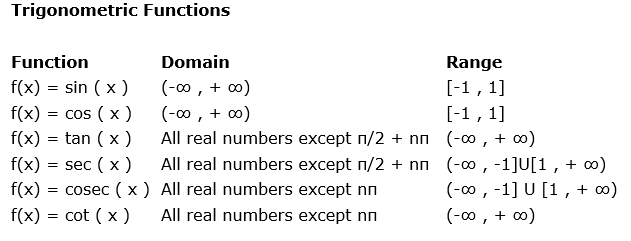
3. Domain and Range
Explanation:
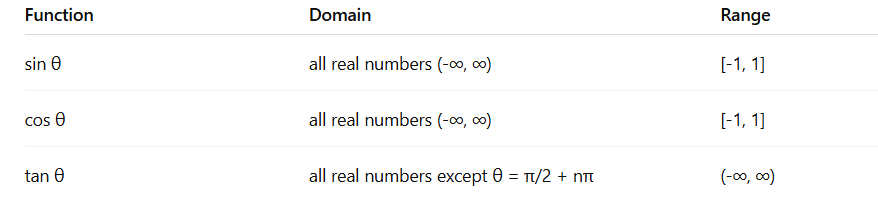
- Domain: Set of all valid input angles
- Range: Set of all possible function values
Example:
- Sin θ=1.5 → Impossible, as range is [-1,1]
- Tan π/2 → Undefined (vertical asymptote)
4. Periodicity & Symmetry
Explanation:
- Periodicity: Functions repeat after a certain interval
- sin θ, cos θ → 2π
- tan θ → π
- Symmetry:
- Sine: Odd function → sin(-θ) = -sin θ
- Cosine: Even function → cos(-θ) = cos θ
- Tangent: Odd function → tan(-θ) = -tan θ
Example:

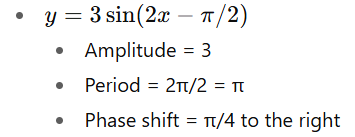
5. Amplitude, Frequency, and Phase Shift
Explanation:
- Amplitude: Height from midline → A in y = A sin x
- Frequency: Number of cycles in 2π → affects period
- Phase Shift: Horizontal shift → y = sin (x – φ)
Example:
6. Special Angles and Exact Values
Explanation:
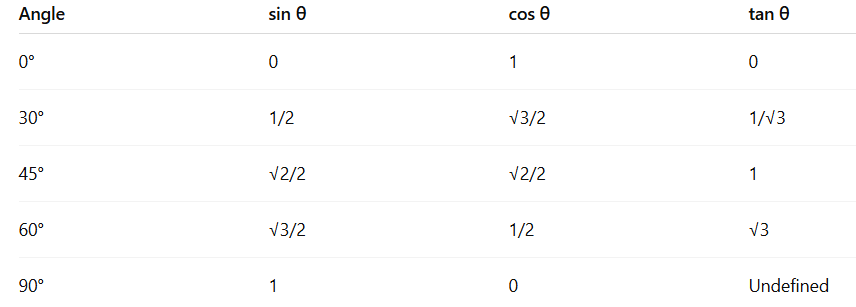
Angles with exact trigonometric values that simplify calculations.
- Common angles: 0°, 30°, 45°, 60°, 90°
- Key values:
Example:

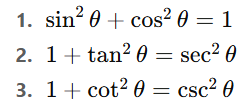
7. Pythagorean Identities
Explanation:
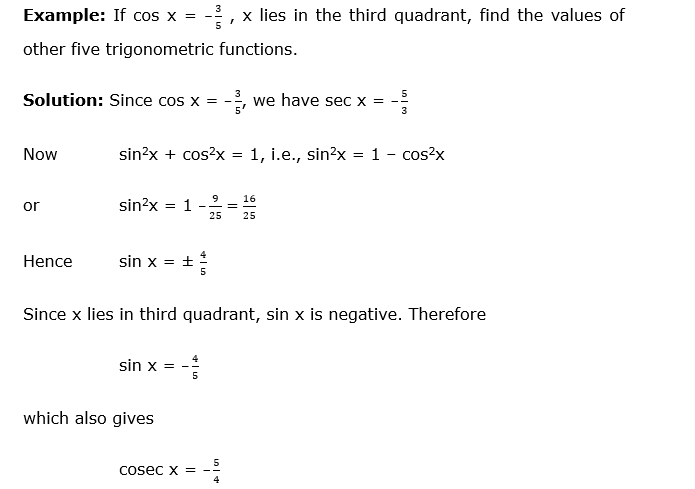
Relate sine, cosine, and tangent algebraically:
Example:

8. Reciprocal Relationships
Explanation:
Other trigonometric functions are reciprocals:
- csc θ = 1/sin θ
- sec θ = 1/cos θ
- cot θ = 1/tan θ
Example:
- θ = 30° → csc30° = 1/(1/2) = 2
- cot45° = 1/1 = 1
9. Applications of Core Functions
Explanation:
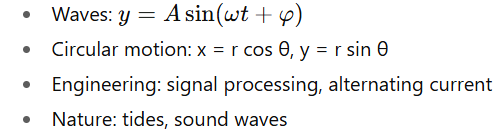
Trigonometric functions model periodic behavior in real life:
Example:
- A wave of amplitude 2 units: y = 2 sin(πt) → oscillates between -2 and 2
10. Connection to Polar Representation
Explanation:
- Polar coordinates (r, θ): Point represented as distance from origin (r) and angle θ
- Conversion to Cartesian:
- x = r cos θ
- y = r sin θ
- Unit circle links polar and trigonometry
Example:
- Point at θ = 60°, r = 2 → x = 2 cos60° = 1, y = 2 sin60° = √3
Example: Find the value of sin 31π3 .
.
Solution: – We know that values of sin x repeats after an interval of 2p. Therefore, sin31π3=sin10π+π3=sinπ3=32.
Key Points
- Sine (sin), cosine (cos), and tangent (tan) are fundamental trigonometric functions used to model relationships between angles and sides of right triangles.
- The sine function (sin) represents the ratio of the length of the side opposite an angle to the length of the hypotenuse.
- The cosine function (cos) represents the ratio of the length of the adjacent side to the length of the hypotenuse.
- The tangent function (tan) represents the ratio of the length of the side opposite an angle to the length of the adjacent side.
- The sine and cosine functions have a periodicity of 2π (or 360 degrees), meaning they repeat their values after every full revolution around the unit circle.
- The tangent function has a periodicity of π (or 180 degrees), repeating its values after every half revolution.
- The sine and cosine functions are bounded between -1 and 1, while the tangent function can take any real value.