Unit: Functions involves Parameters, Vectors & Matrices
Chapter: Graphing Conic sections & Parametric Functions
Reference: – Circle, Ellipse, Parabola, Hyperbola, Parametric equation, Parametric curve, Parametric function, Concavity, Integrating functions, Symmetry, Algebra Techniques, Cartesian Coordinates, Vector Valued function, Application & Property
After studying this chapter, you should be able to:
- Introduction to Parametric Equations & Conic section.
- Types of conic sections & their Properties.
- Concavity, Integrating functions & Symmetry.
- Cartesian Coordinates, Applications & Properties.
Introduction to Conic Sections
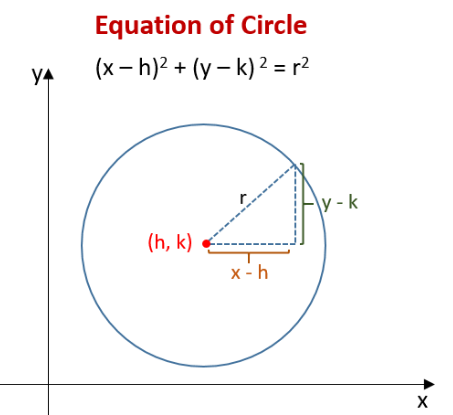
Definition: Circle is defined as the locus of a point which moves in a plane such that its distance from a fixed point in that plane is constant.
For example: If a point P moves on a plane in such a manner that its distance from a fixed point C (say) on the plane is always the same then the locus of the moving point P is called a Circle. The fixed point C is called the Centre of the circle and the constant distance CP is called the Radius of the circle.
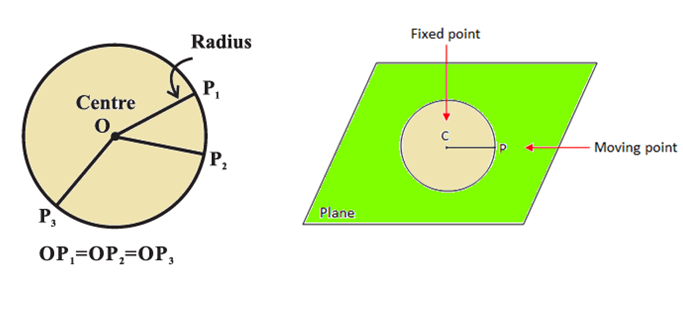
The equation of the circle is simplest if the centre of the circle is at the origin. However, we derive below the equation of the circle with a given centre and radius.
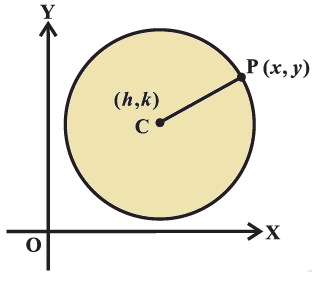
Given C (h, k) be the centre and r the radius of circle. Let P(x, y) be any point on the circle. Then, by the definition, |CP| = r. By the distance formula, we have
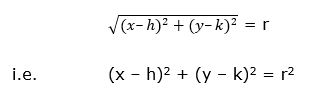
This is the required equation of the circle with centre at (h, k) and
radius r.
Standard Forms of a Circle
- Equation of circle having centre (h, k) and radius ‘a’ is
(x — h)2 + (y —k)2 = a2
If centre is (0, 0), then equation of circle is x2 + y2 = a2.
- When the circle passes through the origin, then equation of the circle is x2 + y2 — 2hx — 2ky = 0
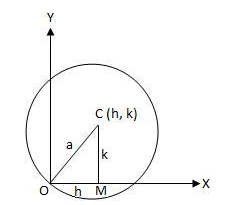
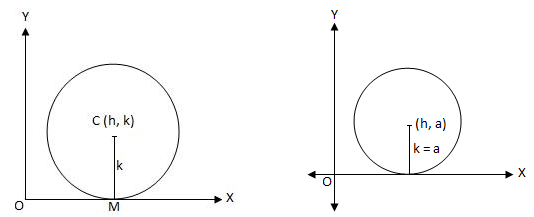
- When the circle touches the X-axis, the equation is x2 + y2 — 2hx — 2ay + h2 = 0.
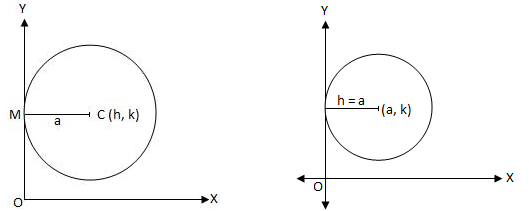
- Equation of the circle, touching the Y-axis is x2 + y2 — 2ax — 2ky + k2 = 0.
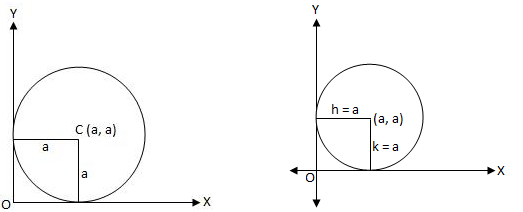
- Equation of the circle, touching both axes is x2 + y2 — 2ax — 2ay + a2 = 0.
- Equation of the circle passing through the origin and centre lying on the X-axis is x2 + y2 — 2ax = 0.
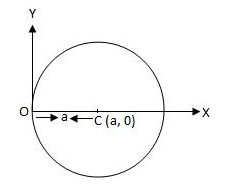
- Equation of the circle, when the coordinates of end points of a diameter are (x1, y1) and (x2, y2) is
(x — x1) (x — x2) + (y – y1) (y — y2) = 0.
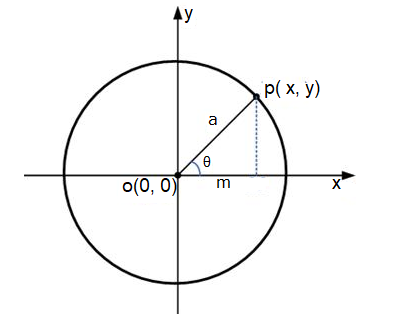
- Parametric equation of a circle
(x – h)2 + (y – k)2 = a2 is
x = h + a cosθ, y = k + a sinθ,
0 ≤ θ ≤ 2π
For circle x2 + y2 = a2, parametric equation is
x = a cos θ, y = a sin θ
General Equation of a Circle
The general equation of a circle is given by x2 + y2 + 2gx + 2fy + c = 0, where centre of the circle = (- g, – f)
Radius of the circle = g2+f2-c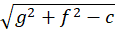
- If g2 + f2 – c > 0, then the radius of the circle is real and hence the circle is also real.
- If g2 + f2 – c = 0, then the radius of the circle is 0 and the circle is known as point circle.
- If g2 + f2 – c < 0, then the radius of the circle is imaginary. Such a circle is imaginary, which is not possible to draw.
Position of a Point with Respect to a Circle
A point (x1, y1) lies outside, on or inside a circle
S ≡ x2 + y2 + 2gx + 2fy + c = 0, according as S1 >, = or < 0
where, S1 = x12 + y12 + 2gx1, + 2fy1+ c
Intercepts on the Axes
The length of the intercepts made by the circle x2 + y2 + 2gx + 2fy + c = 0 with X and Y-axes are  and
and  .
.
- If g2 > c, then the roots of the equation x2 + 2gx + c = 0 are real and distinct, so the circle x2 + y2 + 2gx + 2fy + c = 0 meets the X-axis in two real and distinct points.
- If g2 = c, then the roots of the equation x2 + 2gx + c = 0 are real and equal, so the circle touches X-axis, then intercept on X-axis is O.
- If g2 < c, then the roots of the equation x2 + 2gx + c = 0 are imaginary, so the given circle does not meet X-axis in real point. Similarly, the circle x2 + y2 + 2gx + 2fy + c = 0 cuts the Y-axis in real and distinct points touches or does not meet in real point according to f2 >, = or < c.
Equation of Tangent
A line which touch only one point of a circle.
1. Point Form
- The equation of the tangent at the point P(x1, y1) to a circle x2 + y2 + 2gx + 2fy + c= 0 is xx1 + yy1 + g(x + x1) + f(y + y1) + c = 0.
- The equation of the tangent at the point P(x1, y1) to a circle x2 + y2 is xx1 + yy1 = r2
2. Slope Form
- The equation of the tangent of slope m to the circle x2 + y2 + 2gx + 2fy + c = 0 are y + f = m(x + g) ± √(g2 + f2 — c)(1 + m2).
- The equation of the tangents of slope m to the circle (x – a)2 (y – b)2 = r2 are y – b = m(x – a) ± r√(1 + m2) and the coordinates of the points of contact are
a 
 ,
, 

- The equation of tangents of slope m to the circle x2 + y2 = r2 are y = mx ± r√(1 + m2) and the coordinates of the point of contact are
 ,
, 

3. Parametric Form
The equation of the tangent to the circle (x – a)2 + (y – b)2 = r2 at the point (a + r cos θ, b + r sinθ) is (x – a) cos θ + (y – b) sin θ = r.
Equation of Normal
A line which is perpendicular to the tangent.
1. Point Form
- The equation of normal at the point (x1, y1) to the circle x2 + y2 + 2gx + 2fy + c = 0 is
y – y1 = [(y1 + f)(x – x1)]/(x1 + g)
(y1 + f)x – (x1 + g)y + (gy1 – fx1) = 0 - The equation of normal at the point (x1, y1) to the circle
x2 + y2 = r2 is x/x1 = y/y1
2. Parametric Form
The equation of normal to the circle x2 + y2 = r2 at the point (r cos θ, r sin θ) is
(x/r cos θ) = (y/r sin θ)
or y = x tan θ.
Pair of Tangents
- The combined equation of the pair of tangents drawn from a point P(x1, y1) to the circle x2 + y2 = r2 is
(x2 + y2 – r2) (x12+ y12 – r12) = (xx1 + yy1 – r2)2
or SS1 = T2
where, S = x2 + y2 – r2, S1 = x12+ y12 – r12
and T = xx1 + yy1 – r2
- Chord of contact TT’ of two tangents, drawn from P(x1, y1) to the circle x2 + y2 = r2 or T = 0.
Similarly, for the circlex2 + y2 + 2gx + 2fy + c = 0 is
xx1 + yy1 + g(x + x1) + f(y + y1) + c = 0
- Equation of Chord Bisected at a Given Point The equation of chord of the circle S ≡ x2 + y2 + 2gx + 2fy + c = 0 bisected at the point (x1, y1) is given by T = S1.
i.e., xx1 + yy1 + g (x + x1) + f (y + y1) + c
= x12 + y12 + 2gx1 + fy1 + c - Director Circle: The locus of the point of intersection of two perpendicular tangents to a given circle is called a director circle. For circle x2 + y2 = r2, the equation of director circle is x2 + y2 = 2r2.
Common Chord
The chord joining the points of intersection of two given circles is called common chord.
If S1 = 0 and S1 = 0 be two circles, such that
S1 ≡ x2 + y2 + 2g1x + 2f1y + c1 = 0
and S2 ≡ x2 + y2 + 2g2x + 2f2y + c2 = 0
then their common chord is given by S1 — S2 = 0
Angle of Intersection of Two Circles
The angle of intersection of two circles is defined as the angle between the tangents to the two circles at their point of intersection is given by
cos θ = (r12+r22–d2)2r1r2
Orthogonal Circles
Two circles are said to be intersect orthogonally, if their angle of intersection is a right angle.
If two circles
S1 ≡ x2 + y2 + 2g1x + 2f1y + C1 = 0 and
S2 ≡ x2 + y2 + 2g2x + 2f2y + C2 = 0 are orthogonal, then 2g1g2 + 2f1f2 = c1 + c2
Family of Circles
- The equation of a family of circles passing through the intersection of a circle x2 + y2 + 2gx + 2fy + c = 0 and line
L = lx + my + n = 0 is S + λL = 0
where, X, is any real number.
- The equation of the family of circles passing through the point A(x1, y1) and B (x1, y1) is
- The equation of the family of circles touching the circle
S ≡ x2 + y2 + 2gx + 2fy + c = 0 at point P(x1, Y1) is
xx2 + y2 + 2gx + 2fy + c + λ, [xx1 + yy1 + g(x + x1) + f(Y+ Y1) + c] = 0 or S + λL = 0, where L = 0 is the equation of the tangent to
S = 0 at (x1, y1) and X ∈ R
- Any circle passing through the point of intersection of two circles S1 and S2 is S1 +λ(S1 — S2) = 0.
Radical Axis
The radical axis of two circles is the locus of a point which moves in such a way that the length of the tangents drawn from it to the two circles are equal.
A system of circles in which every pair has the same radical axis is called a coaxial system of circles.
The radical axis of two circles S1 = 0 and S2 = 0 is given by S1 — S2 = 0.
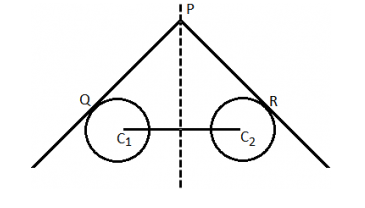
- The radical axis of two circles is always perpendicular to the line joining the centres of the circles.
- The radical axis of three vertices, whose centres are non-collinear taken in pairs of concurrent.
- The centre of the circle cutting two given circles orthogonally, lies on their radical axis.
- Radical Centre The point of intersection of radical axis of three circles whose centre are non-collinear, taken in pairs, is called their radical centre.
- Ellipse
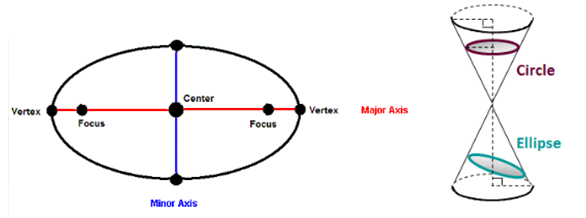
- Definition: An ellipse is the locus of a point P moves on this plane in such a way that its distance from the fixed point S always bears a constant ratio to its perpendicular distance from the fixed line L and if this ratio is less than unity.
- An ellipse is the locus of a point in a plane which moves in the plane in such a way that the ratio of its distance from a fixed point (called focus) in the same plane to its distance from a fixed straight line (called directrix) is always constant which is always less than unity.
- The two fixed points are called the foci (plural of ‘focus’) of the ellipse.
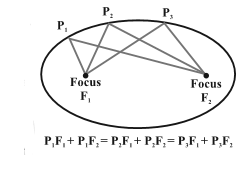
- Note: The constant which is the sum of the distances of a point on the ellipse from the two fixed points is always greater than the distance between the two fixed points.
- The mid-point of the line segment joining the foci is called the centre of the ellipse. The line segment through the foci of the ellipse is called the major axis and the line segment through the centre and perpendicular to the major axis is called the minoraxis. The end points of the major axis are called the vertices of the ellipse.
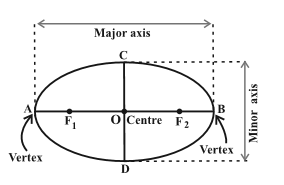
- We denote the length of the major axis by 2a, the length of the minor axis by 2b and the distance between the foci by 2c. Thus, the length of the semi major axis is a and semi-minor axis is b.
Example: Find the coordinates of the foci, the vertices, the length of major axis, the minor axis, the eccentricity and the latus rectum of the ellipse x225+y29=1.
Solution: Since denominator of x225 is larger than the denominator of y29 ,
the major axis is along the x-axis. Comparing the given equation with x2a2+y2b2=1 , we get a = 5 and b = 3. Also

Therefore, the coordinates of the foci are (–4, 0) and (4, 0), vertices
are (–5, 0) and (5, 0). Length of the major axis is 10 units length of
the minor axis 2b is 6 units and the eccentricity is45 and latus rectum
is 2b2a=185 .
Key Points
- Writing parametric equations for curves by defining x and y as separate functions of the parameter.
- Evaluating parametric equations for different values of the parameter to obtain coordinate pairs.
- Graphing parametric curves by plotting points obtained from the parameter values.
- Identifying symmetry properties of parametric curves with respect to the x-axis, y-axis, or origin.
- Calculating derivatives of parametric equations using the chain rule and finding slopes of tangent lines.
- Determining concavity and points of inflection by examining the second derivative of parametric equations.
- Analyzing motion and particle movement described by parametric equations, including velocity, acceleration, and arc length.
- Conic sections include circles, ellipses, parabolas, and hyperbolas, each with unique properties and equations.
- Understanding the standard forms of conic section equations and how to convert between different forms.
- Identifying key parameters such as center, radius, foci, vertices, asymptotes, and directrix.
- Graphing conic sections by plotting key points, determining the shape, and sketching the curve.
- Analyzing conic sections using algebraic techniques like completing the square or factoring.
- Recognizing translations, stretches, and rotations in conic section equations.
- Determining special cases such as degenerate conics or circles that intersect at one point.