Unit: Algebra
Chapter: Solving Quadratic Equations
Reference: – Introduction to Quadratic Equations, Standard Form, Solutions and Roots, Solving by Factorization, Solving by Completing the Square, Solving using the Quadratic Formula, Nature of Roots based on Discriminant, Applications and Word Problems
After studying this chapter, you should be able to understand:
- The standard form of a quadratic equation and its components.
- Various methods for solving quadratic equations: factorization, completing the square, and the quadratic formula.
- How to determine the nature of the roots using the discriminant.
- How to apply quadratic equations to solve real-world problems.
Introduction to Quadratic Equations
Definition
A quadratic equation is a polynomial equation of degree 2 in one variable. The general form is:

where a, b, and c are real numbers, and a≠0. The highest exponent of the variable x is 2, which defines it as a quadratic equation.
[Importance of Quadratic Equations]
- They appear frequently in various fields such as physics, engineering, economics, and biology.
- Essential for understanding parabolic graphs and their properties.
- Form the basis for more complex mathematical concepts in calculus and algebra.
- Used to model problems involving area, projectile motion, and optimization.
Example
Equation: 
Here, a=2, b=-4, c=1.
[Subtopics]
1. Components of a Quadratic Equation
- Coefficient a: The quadratic coefficient (must be non-zero).
- Coefficient b: The linear coefficient.
- Coefficient c: The constant term.
Key Points:
- If a=0
 , the equation becomes linear, not quadratic.
 - The solutions of a quadratic equation are also called its "roots" or "zeros."
2. Standard Form
The equation must be set equal to zero for proper identification and solution.
Solutions and Roots
[Definition]
The roots of a quadratic equation  are the values of x that satisfy the equation. A quadratic equation can have zero, one, or two real roots.
[Importance of Roots]
- Finding the roots is equivalent to solving the equation.
- The roots represent the x-intercepts of the quadratic function's graph (a parabola).
- Understanding roots helps in factoring the quadratic expression.
Examples
 , the roots are x=2 and x=3.
[Subtopics]
1. Number of Roots
A quadratic equation can have:
- Two distinct real roots
- One real repeated root (also called a double root)
- No real roots (two complex roots)
2. Relationship with Factors
If α and β are the roots, then the quadratic can be written as  .
.
Solving by Factorization
[Definition]
This method involves factoring the quadratic expression 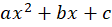 into a product of two linear expressions. The equation is then solved using the zero-product property: if the product of two factors is zero, then at least one of the factors must be zero.
Importance of Factorization
- A quick and intuitive method when the factors are obvious.
- Reinforces understanding of algebraic identities and factors.
- Useful for simplifying expressions and solving inequalities.
Examples
- Solve
 by factorization.
[Subtopics]
1. Method
- Write the equation in standard form.
- Factor the quadratic expression.
- Set each factor equal to zero.
- Solve the resulting linear equations.
2. Example Solution
 Find two numbers that multiply to 6 and add to -5: -2 and -3.
So, (x-2)(x-3)=0
Thus, x-2=0 or x-3=0
Roots: x=2, x=3
Solving by Completing the Square
[Definition]
This method involves manipulating the equation to form a perfect square trinomial on one side, which can then be solved by taking the square root of both sides. This technique is also used to derive the quadratic formula.
Importance of Completing the Square
- Works for any quadratic equation, even when factorization is difficult.
- Essential for understanding the derivation of the quadratic formula.
- Useful in calculus and for finding the vertex form of a quadratic function.
Examples
- Solve
 by completing the square.
[Subtopics]
1. Steps
- Ensure the coefficient of
 is 1. If not, divide the entire equation by a.
 - Move the constant term to the right side.
- Take half of the coefficient of x, square it, and add it to both sides.
- Write the left side as a perfect square.
- Take the square root of both sides (remembering the ± sign).
- Solve for x.
2. Example Solution

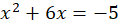 Half of 6 is 3, square it to get 9.

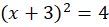

 So, x=-1 or x=-5
Solving using the Quadratic Formula
[Definition]
The quadratic formula provides a direct method to find the roots of any quadratic equation. The roots of  are given by:
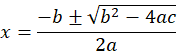
[Importance of the Quadratic Formula]{.underline}
- A universal method that works for all quadratic equations.
- Provides both real and complex roots.
- The expression under the square root,
 , determines the nature of the roots.
Examples
- Solve
 using the quadratic formula.
[Subtopics]
1. Application
- Identify a, b, and c.
- Compute the discriminant
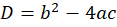 .
. - Substitute a, b, and D into the formula.
- Simplify to find the roots.
2. Example Solution
For  , a=2, b=-4, c=-6

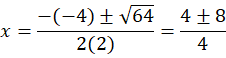
 or
or 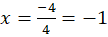
Roots: x=3, x=-1
Nature of Roots based on Discriminant
[Definition]
The discriminant, 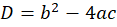 , determines the nature of the roots of the quadratic equation without actually solving it.
[Importance of the Discriminant]
- Quickly tells us whether the roots are real or complex, distinct or equal.
- Helps in understanding the graph's intersection with the x-axis.
- Used in optimization problems and curve sketching.
Examples
- For
 , D=0
, D=0 , so the roots are real and equal.
[Subtopics]
1. Cases of the Discriminant
- D > 0: Two distinct real roots.
- D = 0: One real repeated root (a perfect square).
- D < 0: No real roots (two complex conjugate roots).
Applications and Word Problems
[Definition]
Quadratic equations are used to solve a variety of real-life problems, such as those involving area, profit, projectile motion, and geometry.
Importance of Word Problems
- Demonstrates the practical application of quadratic equations.
- Develops problem-solving and modeling skills.
- Common in academic and competitive exams.
Examples
- "The product of two consecutive positive integers is 132. Find the integers."
[Subtopics]
1. Problem-Solving Steps
- Read the problem carefully and identify the unknown.
- Represent the unknown with a variable.
- Form a quadratic equation based on the given conditions.
- Solve the equation.
- Interpret the solution in the context of the problem, rejecting any extraneous solutions.
[Example: -]
Problem Statement:
Solve the quadratic equation  using three different methods: (i) Factorization, (ii) Completing the Square, and (iii) Quadratic Formula. Also, determine the nature of its roots using the discriminant.
Because these three proofs are independent (using different algebraic techniques), the solution is rigorously confirmed. The positive discriminant further validates that the roots are real and distinct.