Unit: Trigonometry
Chapter: Trigonometric Ratios, Application, & Identities
Reference: – Introduction to Trigonometry, Right-Angled Triangle and Ratios, Trigonometric Ratios of Specific Angles, Trigonometric Identities, Applications of Trigonometry, Complementary Angles, Trigonometric Equations
After studying this chapter, you should be able to understand:
- The fundamental trigonometric ratios in a right-angled triangle.
- How to find trigonometric ratios for standard angles (0°, 30°, 45°, 60°, 90°).
- The important trigonometric identities and their proofs.
- Applications of trigonometry in real-life problems.
Introduction to Trigonometry
Definition
Trigonometry is the branch of mathematics that deals with the relationships between the sides and angles of triangles, particularly right-angled triangles. The word "trigonometry" comes from the Greek words "trigonon" (triangle) and "metron" (measure).
The core concept involves ratios of the sides of a right-angled triangle with respect to its acute angles, known as trigonometric ratios.
[Importance of Trigonometry]
- Essential for fields like astronomy, navigation, surveying, architecture, and engineering.
- Forms the basis for calculus and wave theory.
- Used in computer graphics, physics, and geography.
- Helps in solving problems involving heights and distances.
Example
Scenario: Finding the height of a tree using the angle of elevation and the distance from the tree.
[Subtopics]
1. Historical Background
Trigonometry was developed for astronomical calculations. Ancient Greek, Indian, and Arab mathematicians made significant contributions.
Key Points:
- Trigonometry is based on the similarity of triangles.
- The ratios depend only on the angle, not the size of the triangle.
Right-Angled Triangle and Ratios
[Definition]
In a right-angled triangle, for an acute angle θ, we define six trigonometric ratios. Consider a right triangle ABC, right-angled at B, with respect to angle A (θ).
- Opposite Side (Perpendicular): The side opposite to the angle θ.
- Adjacent Side (Base): The side adjacent to the angle θ (excluding the hypotenuse).
- Hypotenuse: The side opposite the right angle (the longest side).
[Importance of Trigonometric Ratios]
- They are the foundation of all trigonometric concepts.
- Allow us to relate angles to side lengths.
- Used to define trigonometric functions for all angles.
Examples
- For angle A in triangle ABC (right-angled at B):
- sin A = Opposite/Hypotenuse = BC/AC
- cos A = Adjacent/Hypotenuse = AB/AC
- tan A = Opposite/Adjacent = BC/AB
[Subtopics]
1. The Six Trigonometric Ratios
- Sine (sin): Opposite / Hypotenuse
- Cosine (cos): Adjacent / Hypotenuse
- Tangent (tan): Opposite / Adjacent
- Cosecant (cosec): 1 / sin = Hypotenuse / Opposite
- Secant (sec): 1 / cos = Hypotenuse / Adjacent
- Cotangent (cot): 1 / tan = Adjacent / Opposite
2. Mnemonic for Remembering
SOH CAH TOA:
- Sine = Opposite / Hypotenuse
- Cosine = Adjacent / Hypotenuse
- Tangent = Opposite / Adjacent
Trigonometric Ratios of Specific Angles
[Definition]
The trigonometric ratios for the angles 0°, 30°, 45°, 60°, and 90° have standard values that are derived using geometric constructions. Knowing these values is crucial for solving problems quickly.
[Importance of Standard Angles]
- Frequently used in calculations.
- Form the basis for solving trigonometric equations.
- Essential for understanding the behavior of trigonometric functions.
Examples
- sin 30° = 1/2
- cos 45° = 1/√2
- tan 60° = √3
[Subtopics]
1. Derivation using Geometry
- 45°: Consider an isosceles right-angled triangle with equal sides of 1 unit. Hypotenuse = √2.
- 30° and 60°: Consider an equilateral triangle of side 2 units. Dropping a perpendicular creates two 30°-60°-90° triangles.
2. Standard Value Table
|
Angle (θ) |
0° |
30° |
45° |
60° |
90° |
|
sin θ |
0 |
1/2 |
1/√2 |
√3/2 |
1 |
|
cos θ |
1 |
√3/2 |
1/√2 |
1/2 |
0 |
|
tan θ |
0 |
1/√3 |
1 |
√3 |
∞ |
|
cosec θ |
∞ |
2 |
√2 |
2/√3 |
1 |
|
sec θ |
1 |
2/√3 |
√2 |
2 |
∞ |
|
cot θ |
∞ |
√3 |
1 |
1/√3 |
0 |
Trigonometric Identities
[Definition]
Trigonometric identities are equations involving trigonometric functions that are true for all values of the variables for which both sides of the equation are defined. They are derived from the definitions and the Pythagorean Theorem.
[Importance of Identities]
- Used to simplify complex trigonometric expressions.
- Essential for solving trigonometric equations.
- Help in proving other mathematical results.
Examples
- sin²θ + cos²θ = 1
- 1 + tan²θ = sec²θ
- 1 + cot²θ = cosec²θ
[Subtopics]
1. Pythagorean Identities
In a right triangle with hypotenuse 1 (unit circle concept):
- sin²θ + cos²θ = 1
Dividing this by cos²θ and sin²θ gives: - 1 + tan²θ = sec²θ
- 1 + cot²θ = cosec²θ
2. Proofs
These identities can be proved using the definitions in a right-angled triangle and the Pythagorean Theorem (Opposite² + Adjacent² = Hypotenuse²).
Applications of Trigonometry
[Definition]
Trigonometry is used to solve problems involving finding unknown sides or angles in right-angled triangles. Common applications include finding heights of objects, distances between points, and angles of elevation and depression.
[Importance of Applications]
- Bridges the gap between abstract math and the real world.
- Develops problem-solving and modeling skills.
- A common component of examinations.
Examples
- Angle of Elevation: The angle formed by the line of sight with the horizontal when the point being viewed is above the horizontal level.
- Angle of Depression: The angle formed by the line of sight with the horizontal when the point being viewed is below the horizontal level.
[Subtopics]
1. Steps for Solving Application Problems
- Draw a clear diagram representing the situation.
- Identify the right-angled triangle(s).
- Mark the known sides and angles.
- Choose the appropriate trigonometric ratio.
- Set up the equation and solve for the unknown.
- Interpret the result.
Complementary Angles
[Definition]
Two angles are complementary if their sum is 90°. In a right-angled triangle, the two acute angles are complementary. The trigonometric ratios of complementary angles are related.
[Importance of Complementary Angles]
- Provides relationships between sine and cosine, tangent and cotangent, etc.
- Useful for simplifying expressions and solving equations.
- Helps in understanding the co-function identities.
Examples
- sin(90° – θ) = cos θ
- cos(90° – θ) = sin θ
- tan(90° – θ) = cot θ
[Subtopics]
1. Co-function Identities
- sin(90° – A) = cos A
- cos(90° – A) = sin A
- tan(90° – A) = cot A
- cosec(90° – A) = sec A
- sec(90° – A) = cosec A
- cot(90° – A) = tan A
Trigonometric Equations
[Definition]
A trigonometric equation is an equation involving one or more trigonometric functions of unknown angles. Solving them means finding all angles that satisfy the equation.
[Importance of Trigonometric Equations]
- Used in physics and engineering to model periodic phenomena.
- Tests understanding of trigonometric ratios and identities.
- Requires logical reasoning to find general solutions.
Examples
- Solve sin θ = 1/2.
[Subtopics]
1. Basic Approach
- Use identities to simplify the equation to a basic form (e.g., sin θ = k).
- Find the principal value (the value in the principal range, usually 0° to 360° or 0 to 2π).
- Use the periodic nature of trigonometric functions to write the general solution.
[Example: -]
Problem Statement:
In a right-angled triangle ABC, right-angled at B, if AB = 6 cm and BC = 8 cm, find:
a) sin A, cos A, tan A
b) sin C, cos C, tan C
c) Show that sin²A + cos²A = 1 for angle A.
Question: Calculate the trigonometric ratios and verify the identity. Prove your answer by providing a step-by-step solution and giving three independent reasons supporting your conclusion for part (c) from these domains: (A) Direct Calculation from Triangle, (B) Using the Pythagorean Theorem, (C) Using the Definitions of sin and cos.
[Solution: -]
Given: Right-angled triangle ABC, right-angled at B.
AB = 6 cm (Base relative to angle A, Adjacent to A)
BC = 8 cm (Perpendicular relative to angle A, Opposite to A)
First, find the hypotenuse AC using the Pythagorean Theorem:
 ,
, 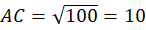 cm
cm
a) Trigonometric Ratios for angle A:
- Opposite side to A = BC = 8 cm
- Adjacent side to A = AB = 6 cm
- Hypotenuse = AC = 10 cm


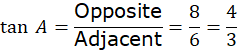
b) Trigonometric Ratios for angle C:
- Opposite side to C = AB = 6 cm
- Adjacent side to C = BC = 8 cm
- Hypotenuse = AC = 10 cm


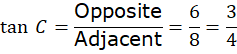
c) Verify that sin²A + cos²A = 1
(A) Direct Calculation from Triangle
We have calculated:
 , so
, so 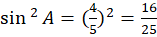
 , so
, so 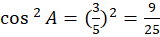
Now, 
This direct arithmetic calculation confirms the identity.
(B) Using the Pythagorean Theorem
The Pythagorean Theorem states: 
For angle A: Opposite = BC = 8, Adjacent = AB = 6, Hypotenuse = AC = 10.
So, 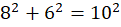 →
→ 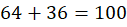 , which is true.
Now, divide the entire equation by  :
:
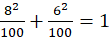 →
→ 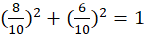 →
→ 
This shows the identity is a direct consequence of the Pythagorean Theorem.
(C) Using the Definitions of sin and cos
By definition:
 ,
, 
So, 
But from the Pythagorean Theorem, .
.
Therefore, 
This proof using the fundamental definitions and the Pythagorean Theorem is the most general and rigorous.
Final Conclusion:
a) 
b) 
c) The identity  is verified by direct calculation, by the Pythagorean Theorem, and by the definitions of sine and cosine.
Because these three proofs are independent (numerical, geometric, and definitional), the verification is rigorously confirmed.