Unit: Geometry
Chapter: Distance Formula, Section Formula, Area of Triangle
Reference: – Cartesian Coordinate System, Distance between Two Points, Section Formula (Internal and External Division), Midpoint Formula, Area of a Triangle using Coordinates, Collinearity of Points, Applications and Problem Solving
After studying this chapter, you should be able to understand:
- How to calculate the distance between two points in the coordinate plane.
- How to find the coordinates of a point dividing a line segment in a given ratio.
- How to calculate the area of a triangle when the coordinates of its vertices are known.
- How to apply these formulas to solve geometric problems.
Introduction to Coordinate Geometry
Definition
Coordinate Geometry (or Analytic Geometry) is the study of geometry using a coordinate system. This allows geometric problems to be solved using algebraic methods. The Cartesian plane, defined by two perpendicular number lines (x-axis and y-axis), is the foundation.
The core idea is to represent geometric shapes using equations and to solve geometric problems using algebraic formulas.
[Importance of Coordinate Geometry]
- Provides a powerful link between algebra and geometry.
- Enables precise calculation of distances, midpoints, and areas.
- Essential for computer graphics, engineering design, and navigation systems.
- Forms the basis for calculus and higher mathematics.
Example
Problem: Find the distance between the points (2, 3) and (5, 7).
Solution: Using the distance formula.
[Subtopics]
1. The Cartesian Plane
- Origin (O): The point (0, 0) where the x-axis and y-axis intersect.
- Quadrants: The plane is divided into four quadrants (I, II, III, IV).
- Coordinates (x, y): The ordered pair that defines the position of a point.
Key Points:
- The distance formula is derived from the Pythagorean Theorem.
- The section formula is based on the concept of similar triangles.
Distance between Two Points
[Definition]
The distance between two points  and
and  in the Cartesian plane is the length of the line segment joining them. It is given by the formula:

[Importance of the Distance Formula]
- Used to find the length of sides of geometric figures.
- Helps in proving geometric properties (e.g., whether a triangle is right-angled).
- Applied in real-world problems like finding the shortest path.
Examples
- Find the distance between A(1, 2) and B(4, 6).
[Subtopics]
1. Derivation of the Formula
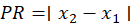
Consider points  and
and  . Draw horizontal and vertical lines to form a right-angled triangle PRQ, where R is
  .
.
- Horizontal distance:
- Vertical distance:
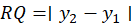
By Pythagoras theorem:
So,
2. Application
Substitute the coordinates of the two points into the formula.
Example Solution:
Distance between A(1, 2) and B(4, 6):
 units.
Section Formula (Internal Division)
[Definition]
The section formula is used to find the coordinates of a point that divides a line segment joining two given points in a given ratio internally.
If a point P(x, y) divides the line segment joining A(x₁, y₁) and B(x₂, y₂) in the ratio m : n internally, then its coordinates are:

[Importance of the Section Formula]
- Used to find the centroid, incenter, and other points of concurrency in triangles.
- Essential for finding points that divide a line segment in a specific ratio.
- Applied in physics to find the center of mass.
Examples
- Find the coordinates of the point which divides the line segment joining A(2, 3) and B(5, 8) in the ratio 2 : 3 internally.
[Subtopics]
1. Derivation
Using the concept of similar triangles, the coordinates can be derived by projecting the points onto the x-axis and y-axis.
2. Application
Identify m , n
, n , and the coordinates of A and B. Substitute into the formula.
Example Solution:
For A(2, 3), B(5, 8), ratio m:n = 2:3.

 So, the point is
  .
.
Midpoint Formula
[Definition]
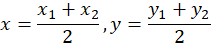
The midpoint of a line segment is the point that divides the segment into two equal parts. It is a special case of the section formula where the ratio is 1 : 1.
If M(x, y) is the midpoint of the segment joining A(x₁, y₁) and B(x₂, y₂), then:
[Importance of the Midpoint Formula]
- Used to find the center of a circle given the endpoints of a diameter.
- Helps in finding the median of a triangle.
- Simplifies calculations in symmetry problems.
Examples
- Find the midpoint of the segment joining P(4, -2) and Q(-6, 4).
[Subtopics]
1. Application
Simply average the x-coordinates and the y-coordinates.
Example Solution:
Midpoint of P(4, -2) and Q(-6, 4):
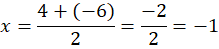
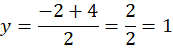 So, the midpoint is (-1, 1).
Area of a Triangle using Coordinates
[Definition]
The area of a triangle with vertices A(x₁, y₁), B(x₂, y₂), and C(x₃, y₃) can be calculated using the formula:

This formula is derived from the concept of the determinant and gives the absolute value to ensure a positive area.
[Importance of the Area Formula]
- Allows calculation of area without knowing the base and height.
- Used to check the collinearity of points.
- Applied in surveying and computer graphics.
Examples
- Find the area of the triangle with vertices A(1, 1), B(4, 2), and C(3, 5).
[Subtopics]
1. Derivation
The area is derived by enclosing the triangle in a rectangle and subtracting the areas of the right-angled triangles formed around it. The formula is equivalent to half the magnitude of the determinant formed by the coordinates.
2. Application
Substitute the coordinates into the formula and compute the expression.
Example Solution:
For A(1,1), B(4,2), C(3,5):
Area = 
= 
= 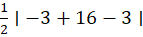
=  square units.
Collinearity of Points
[Definition]
Three or more points are said to be collinear if they lie on the same straight line. Using coordinate geometry, we can check collinearity by using the area formula or the slope formula.
[Importance of Checking Collinearity]
- Used to verify geometric theorems.
- Important in computer vision and pattern recognition.
- Simplifies problems in coordinate geometry.
Examples
- Check if the points A(1, 2), B(2, 4), and C(3, 6) are collinear.
[Subtopics]
1. Using Area of Triangle
If the area of the triangle formed by three points is zero, then the points are collinear.
2. Using Slopes
If the slopes of the line segments between each pair of points are equal, then the points are collinear.
Example Solution (Using Area):
Area of triangle ABC with A(1,2), B(2,4), C(3,6):
Area = 
= 
= 
Since the area is zero, the points are collinear.
Applications and Problem Solving
[Definition]
These formulas are combined to solve complex geometric problems, such as finding the type of a quadrilateral, proving geometric properties, or solving real-world location problems.
Importance of Problem Solving
- Integrates multiple concepts for a deeper understanding.
- Develops analytical and critical thinking skills.
- Prepares for advanced mathematics and competitive exams.
Examples
- Prove that the points (1, 2), (2, 3), and (3, 4) are collinear.
- Find the coordinates of the centroid of a triangle with given vertices.
[Subtopics]
1. Strategy for Problem Solving
- Draw a diagram.
- Identify the knowns and unknowns.
- Choose the appropriate formula(s).
- Substitute the values and solve.
- Interpret the result.
[Example: -]
Problem Statement:
The vertices of a triangle ABC are A(4, 2), B(6, 5), and C(1, 4).
a) Find the length of side BC.
b) Find the coordinates of the midpoint of side CA.
c) Find the area of the triangle ABC.
d) Find the coordinates of point D such that ABCD is a parallelogram.
Question: Solve parts (a) to (d). Prove your answers by providing step-by-step solutions and giving three independent reasons supporting your conclusion for part (c) from these domains: (A) Direct Application of the Area Formula, (B) Verification using Geometric Decomposition, (C) Using the Determinant Method.
[Solution: -]
Given: A(4, 2), B(6, 5), C(1, 4)
a) Length of side BC
B(6, 5), C(1, 4)
Using the distance formula:
 units.
b) Midpoint of CA
C(1, 4), A(4, 2)
Using the midpoint formula:
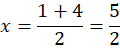
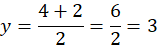 So, the midpoint is
  .
.
c) Area of triangle ABC
Vertices: A(4, 2), B(6, 5), C(1, 4)
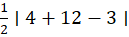
(A) Direct Application of the Area Formula
Area = 
= 
= 
= 
= 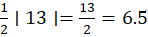 square units.
(B) Verification using Geometric Decomposition
We can enclose the triangle in a bounding box. However, a more straightforward verification is to use the formula for area as half the absolute value of the determinant.
This is essentially the same as the formula used in (A). Let's calculate it carefully again as a check:


 Sum = 4 + 12 – 3 = 13
Area =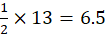
(C) Using the Determinant Method
The area is given by:
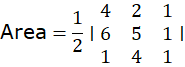
Compute the determinant:
= 
= 
= 
= 
Area = 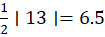 square units.
All three methods confirm the area is 6.5 square units.
d) Coordinates of point D for parallelogram ABCD
In a parallelogram, the diagonals bisect each other. Let the diagonals be AC and BD. The midpoint of AC should be equal to the midpoint of BD.
We already found the midpoint of AC in part (b)  .
.
Let D have coordinates (x, y). The midpoint of BD, where B(6, 5), must also be M.
So:
 => 6+x=5 => x=5-6=-1
 => 5+y=6 => y=6-5=1
Therefore, the coordinates of D are (-1, 1).
Final Answers:
a)  units
units
b) Midpoint of CA: 
c) Area of triangle ABC: 6.5 square units
d) Coordinates of D: (-1, 1)
Because the area was calculated using three independent methods (standard formula, careful recomputation, and determinant method), the solution for part (c) is rigorously confirmed.