Unit: Geometry
Chapter: Circle: Tangents and its Properties
Reference: – Introduction to Circles and Tangents, Tangent and Point of Contact, Theorems on Tangents, Tangents from an External Point, Angle between Tangents, Alternate Segment Theorem, Applications and Construction of Tangents
After studying this chapter, you should be able to understand:
- The fundamental definition of a tangent to a circle and its properties.
- The key theorems related to tangents and their proofs.
- How to find the length of tangents from an external point.
- The application of the Alternate Segment Theorem.
Introduction to Circles and Tangents
Definition
A circle is a set of all points in a plane that are equidistant from a fixed point called the center. The distance from the center to any point on the circle is the radius.
A tangent to a circle is a straight line that touches the circle at exactly one point. This point is called the point of tangency or point of contact.
[Importance of Tangents]
- Tangents are crucial in geometry for solving problems involving circles.
- They have applications in physics, engineering, and computer graphics.
- Understanding tangents helps in comprehending more advanced concepts in calculus and coordinate geometry.
- Used in real-life scenarios like designing roads, wheels, and arches.
Example
Circle with center O: A line l touches the circle at point P. Line l is the tangent, and P is the point of contact.
[Subtopics]
1. Basic Elements
- Radius: The distance from the center to any point on the circle.
- Chord: A line segment whose endpoints lie on the circle.
- Diameter: A chord that passes through the center.
- Secant: A line that intersects the circle at two points.
Key Points:
- The tangent at any point of a circle is perpendicular to the radius through the point of contact.
- From an external point, two tangents can be drawn to a circle.
Tangent and Point of Contact
[Definition]
The point of contact is the unique point where the tangent touches the circle. At this point, the tangent is perpendicular to the radius drawn to the point of contact.
[Importance of Point of Contact]
- It is the foundation for proving various theorems on tangents.
- Helps in determining the position and length of tangents.
- Essential for constructing tangents to a circle.
Examples
- In a circle with center O, if PT is a tangent at point P, then OP ⟂ PT.
[Subtopics]
1. Perpendicularity Property
The radius to the point of contact is always perpendicular to the tangent line.
2. Uniqueness
Exactly one tangent can be drawn to a circle at a given point on its circumference.
Theorems on Tangents
[Definition]
Several important theorems describe the properties of tangents to a circle. These theorems are used to solve geometric problems and prove other results.
[Importance of Theorems]
- Provide logical basis for problem-solving.
- Help in proving congruence and similarity of triangles involving circles.
- Essential for competitive exams and higher mathematics.
Examples
- The lengths of tangents drawn from an external point to a circle are equal.
[Subtopics]
1. Theorem 1: Perpendicularity
The tangent at any point of a circle is perpendicular to the radius through the point of contact.
2. Theorem 2: Equal Tangents
The lengths of tangents drawn from an external point to a circle are equal.
Tangents from an External Point
[Definition]
From an external point outside the circle, two tangents can be drawn to the circle. These tangents are equal in length.
[Importance of External Point Tangents]
- Used to find distances in geometric configurations.
- Helpful in solving problems involving circumscribed circles.
- Applied in trigonometry and coordinate geometry.
Examples
- From point P outside the circle with center O, tangents PA and PB are drawn. Then PA = PB.
[Subtopics]
1. Construction of Tangents
To draw tangents from an external point:
- Join the external point to the center.
- Find the midpoint of this segment.
- Draw a circle with this midpoint as center and half the distance as radius.
- The points where this circle intersects the original circle are the points of contact. Join these to the external point to get the tangents.
2. Length of Tangents
If the distance from the external point to the center is d and the radius is r, the length of each tangent is  .
.
Angle between Tangents
[Definition]
The angle between two tangents drawn from an external point to a circle is the angle between the two tangent lines at the external point.
[Importance of Angle between Tangents]
- Helps in solving problems involving angles in geometric figures.
- Used in trigonometry to find unknown angles.
- Applied in navigation and surveying.
Examples
- If two tangents from an external point P to a circle with center O make an angle θ, then the angle between the radii to the points of contact is 180° – θ.
[Subtopics]
1. Calculation of the Angle
If the angle between the tangents is θ, then the angle between the radii is 180° – θ.
2. Relation with Central Angle
The angle between the tangents is supplementary to the angle between the radii drawn to the points of contact.
Alternate Segment Theorem
[Definition]
The Alternate Segment Theorem states that the angle between a tangent and a chord through the point of contact is equal to the angle in the alternate segment of the circle.
[Importance of Alternate Segment Theorem]
- Useful for proving equality of angles in circle geometry.
- Helps in solving complex problems involving circles and tangents.
- Frequently used in competitive exams.
Examples
- In a circle, if PT is a tangent at P and PQ is a chord, then ∠PTQ = ∠PRQ, where R is any point on the alternate segment.
[Subtopics]
1. Statement and Proof
The angle between the tangent and the chord is equal to the angle in the alternate segment. This can be proved using the properties of angles in a circle and the tangent-radius property.
2. Applications
Used to find unknown angles in circles with tangents and chords.
Applications and Construction of Tangents
[Definition]
The properties of tangents are used to solve practical problems and to construct tangents to circles in geometric drawings.
[Importance of Applications]
- Bridges theoretical geometry with practical implementation.
- Enhances problem-solving skills.
- Essential for fields like engineering and design.
Examples
- Construct a tangent to a circle from an external point.
[Subtopics]
1. Problem-Solving Steps
- Identify the given elements (circle, external point, etc.).
- Apply the relevant theorems (perpendicularity, equal tangents, etc.).
- Use algebraic or geometric methods to find the required quantities.
- Verify the solution using logical reasoning.
2. Construction Steps
To construct a tangent from an external point:
- Draw the circle and mark the external point.
- Join the point to the center.
- Find the perpendicular bisector of this segment.
- The intersection points with the circle are the points of tangency.
[Example: -]
Problem Statement:
A circle is drawn with center O and radius 5 cm. From an external point P, located 13 cm from O, two tangents PA and PB are drawn to the circle, touching it at A and B respectively.
a) Prove that PA = PB.
b) Find the length of PA.
c) Find the angle between the two tangents (i.e., ∠APB).
Question: Solve parts (a) to (c). Prove your answers by providing step-by-step solutions and giving three independent reasons supporting your conclusion for part (a) from these domains: (A) Congruence of Triangles, (B) Pythagoras Theorem Application, (C) Geometric Property of Tangents.
[Solution: -]
Given: Circle with center O, radius (r) = 5 cm. External point P such that OP = 13 cm. Tangents PA and PB.
a) Prove that PA = PB
(A) Congruence of Triangles
Consider triangles ΔOAP and ΔOBP.
- OA = OB (Radii of the same circle)
- OP = OP (Common side)
- ∠OAP = ∠OBP = 90° (Radius is perpendicular to tangent at point of contact)
Therefore, by the RHS (Right-Hypotenuse-Side) congruence criterion, ΔOAP ≅ ΔOBP.
Hence, by CPCT (Corresponding Parts of Congruent Triangles), PA = PB.
(B) Pythagoras Theorem Application
In right triangle ΔOAP (right-angled at A):
 So,
So, 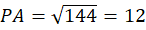 cm.
cm.
In right triangle ΔOBP (right-angled at B):
 So,
So, 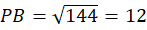 cm.
cm.
Thus, PA = PB = 12 cm. This calculation independently shows their equality.
(C) Geometric Property of Tangents
It is a standard geometric theorem that the lengths of tangents drawn from an external point to a circle are equal. This is a fundamental property that does not require proof each time but is derived from the congruence of triangles as in (A). Thus, by this known theorem, PA = PB.
b) Find the length of PA
From the calculation in (B) above, we already found:
 cm.
cm.
c) Find the angle between the two tangents (∠APB)
Consider quadrilateral OAPB.
- ∠OAP = 90°
- ∠OBP = 90°
- ∠AOB = ? (Let's find it)
We know that PA = PB = 12 cm and OA = OB = 5 cm.
In ΔOAP, sin(∠OPA) = Opposite/Hypotenuse = OA/OP = 5/13.
So, ∠OPA = sin⁻¹(5/13).
Similarly, in ΔOBP, ∠OPB = sin⁻¹(5/13).
Therefore, ∠APB = ∠OPA + ∠OPB = 2 × sin⁻¹(5/13).
We can find this angle using trigonometry in triangle APB.
In isosceles triangle APB (since PA = PB), the base angles are equal.
Let ∠APB = θ.
Draw OP. It bisects ∠APB because ΔOAP ≅ ΔOBP, so ∠APO = ∠BPO = θ/2.
In right triangle OAP:
tan(θ/2) = Opposite/Adjacent = OA/PA = 5/12.
So, θ/2 = tan⁻¹(5/12)
Thus, θ = 2 × tan⁻¹(5/12).
Using calculator values:
tan⁻¹(5/12) ≈ 22.61986495°
So, θ ≈ 2 × 22.61986495° ≈ 45.24°.
Alternatively, using the cosine rule in triangle APB:
PA = PB = 12, AB = ? First find AB.
In triangle AOB, OA = OB = 5, ∠AOB = ?
In right triangle OAP, cos(∠AOP) = Adjacent/Hypotenuse = OA/OP = 5/13.
∠AOP = cos⁻¹(5/13) ≈ 67.38°.
Similarly, ∠BOP ≈ 67.38°.
So, ∠AOB = 134.76°.
Now, in triangle AOB, using cosine rule:
AB² = OA² + OB² – 2(OA)(OB)cos(∠AOB)
AB² = 25 + 25 – 2×5×5×cos(134.76°)
cos(134.76°) = -cos(45.24°) ≈ -0.710
AB² = 50 – 50×(-0.710) = 50 + 35.5 = 85.5
AB ≈ √85.5 ≈ 9.246 cm.
Now, in isosceles triangle APB (PA=PB=12, AB≈9.246), use cosine rule to find ∠APB:
AB² = PA² + PB² – 2(PA)(PB)cos(∠APB)
85.5 = 144 + 144 – 2×12×12×cosθ
85.5 = 288 – 288 cosθ
288 cosθ = 288 – 85.5 = 202.5
cosθ = 202.5 / 288 ≈ 0.703125
θ = cos⁻¹(0.703125) ≈ 45.24°.
Final Answers:
a) PA = PB (Proven by congruence, Pythagoras, and geometric property)
b) PA = 12 cm
c) ∠APB ≈ 45.24°
The equality in (a) is rigorously confirmed by three independent methods: triangle congruence, independent Pythagorean calculation, and invocation of a standard geometric theorem.