Unit: Statistics and Probability
Chapter: Experimental & Theoretical Approach to Probability
Reference: – Introduction to Probability, Basic Terminology, Theoretical Probability, Experimental Probability, Law of Large Numbers, Difference between Experimental and Theoretical Probability, Calculation of Probability, Applications in Real Life
After studying this chapter, you should be able to understand:
- The fundamental concepts of probability.
- The difference between theoretical and experimental probability.
- How to calculate probability using both approaches.
- The Law of Large Numbers and its significance.
Introduction to Probability
Definition
Probability is the branch of mathematics that deals with calculating the likelihood of a given event's occurrence, which is expressed as a number between 0 and 1. A probability of 0 means the event is impossible, while a probability of 1 means the event is certain.
Probability helps us quantify uncertainty and make predictions about the outcomes of random experiments.
[Importance of Probability]
- Used in various fields such as statistics, finance, science, and artificial intelligence.
- Helps in risk assessment and decision-making.
- Forms the basis for inferential statistics.
- Essential for understanding games of chance, weather forecasting, and insurance.
Example
Event: Tossing a fair coin.
Outcome: Getting a Head.
Probability: The chance of getting a Head is 1/2.
[Subtopics]
1. Basic Terminology
- Experiment: A process that leads to well-defined outcomes (e.g., tossing a coin).
- Random Experiment: An experiment where all possible outcomes are known, but the exact outcome is unpredictable (e.g., rolling a die).
- Sample Space (S): The set of all possible outcomes of an experiment.
- Event (E): A subset of the sample space (e.g., getting an even number when rolling a die).
Key Points:
- The probability of an event E is denoted by P(E).
- For any event E, 0 ≤ P(E) ≤ 1.
- The sum of probabilities of all elementary events in a sample space is 1.
Theoretical Probability
[Definition]
Theoretical Probability is the probability that is calculated based on reasoning and theoretical principles, without actually performing the experiment. It assumes that all outcomes in the sample space are equally likely.
The theoretical probability of an event E is given by:

[Importance of Theoretical Probability]
- Provides a precise mathematical value for the likelihood of an event.
- Used when the sample space is known and all outcomes are equally likely.
- Forms the foundation for probability theory.
Examples
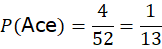
- Find the theoretical probability of drawing an Ace from a well-shuffled deck of 52 cards.
[Subtopics]
1. Calculation
Number of Aces in a deck = 4
Total number of cards = 52
2. Assumptions
- The deck is well-shuffled (each card is equally likely to be drawn).
- There are no biased outcomes.
Experimental Probability
[Definition]
Experimental Probability is the probability that is determined based on the results of an actual experiment or historical data. It is calculated by performing the experiment multiple times and recording the outcomes.
The experimental probability of an event E is given by:

[Importance of Experimental Probability]
- Reflects what actually happens in practice.
- Useful when theoretical probability is difficult to calculate.
- Helps in validating theoretical models.
Examples
- A coin is tossed 100 times, and Heads appear 47 times. The experimental probability of getting Heads is 47/100 = 0.47.
[Subtopics]
1. Calculation
Perform the experiment a large number of times and use the formula.
2. Reliability
The reliability of experimental probability increases with the number of trials.
Law of Large Numbers
[Definition]
The Law of Large Numbers states that as the number of trials in an experiment increases, the experimental probability of an event gets closer to its theoretical probability.
[Importance of the Law of Large Numbers]
- Justifies the use of large sample sizes in experiments.
- Explains why casinos always make money in the long run.
- Fundamental in statistics and insurance.
Examples
- If a fair coin is tossed 10 times, the number of Heads might be 4, 6, etc. But if tossed 1000 times, the number of Heads will be close to 500.
[Subtopics]
1. Explanation
With a small number of trials, experimental results can vary widely. As the number of trials increases, the average of the results approaches the expected value.
Difference between Experimental and Theoretical Probability
[Definition]
This section highlights the key differences between the two approaches to probability, including their definitions, calculations, and applications.
[Importance of Understanding the Difference]
- Helps in choosing the appropriate method for a given situation.
- Clarifies when to use theoretical models and when to rely on experimental data.
- Essential for critical thinking in probability.
Examples
- For a fair die, the theoretical probability of getting a 6 is 1/6. If you roll the die 60 times and get 12 sixes, the experimental probability is 12/60 = 1/5.
[Subtopics]
1. Key Differences
- Theoretical Probability: Based on reasoning and assumptions. Calculated without performing experiments.
- Experimental Probability: Based on actual experiments and observations. Calculated after performing experiments.
2. When to Use Which
- Use theoretical probability when the sample space is known and outcomes are equally likely.
- Use experimental probability when theoretical calculation is complex or when real-world data is available.
Calculation of Probability
[Definition]
This involves applying the formulas for theoretical and experimental probability to solve problems. It includes finding probabilities of simple and compound events.
[Importance of Calculation]
- Enables prediction of events.
- Useful in strategy and planning.
- Common in academic and competitive exams.
Examples
- Find the probability of drawing a red ball from a bag containing 3 red and 5 blue balls.
[Subtopics]
1. Steps for Calculation
- Identify the sample space and the event.
- For theoretical probability, use the formula,
 .
. - For experimental probability, use the formula
 .
.
Applications in Real Life
[Definition]
Probability is used in various real-life scenarios to make informed decisions, assess risks, and predict outcomes.
[Importance of Real-Life Applications]
- Demonstrates the practical utility of probability.
- Enhances understanding of uncertain events.
- Prepares for practical problem-solving.
Examples
- Weather forecasting, medical testing, game strategies, and quality control.
[Subtopics]
1. Examples of Applications
- Weather Forecasting: Predicting the chance of rain.
- Medical Testing: Determining the reliability of a diagnostic test.
- Insurance: Calculating premiums based on risk assessment.
[Example: -]
Problem Statement:
A die is thrown 50 times, and the outcomes are recorded as follows:
|
Outcome |
1 |
2 |
3 |
4 |
5 |
6 |
|
Frequency |
8 |
9 |
7 |
10 |
6 |
10 |
a) What is the theoretical probability of getting a prime number?
b) What is the experimental probability of getting a number greater than 4?
c) Compare the theoretical and experimental probability of getting an even number.
Question: Solve parts (a) to (c). Prove your answers by providing a step-by-step solution and giving three independent reasons supporting your conclusion for part (a) from these domains: (A) Definition of Theoretical Probability, (B) Sample Space Analysis, (C) Favorable Outcomes Identification.
[Solution: -]
a) Theoretical probability of getting a prime number
(A) Definition of Theoretical Probability
Theoretical probability is calculated as:
P(E)=

For a fair die, total possible outcomes = 6.
(B) Sample Space Analysis
The sample space for a die throw is S = {1, 2, 3, 4, 5, 6}.
(C) Favorable Outcomes Identification
Prime numbers between 1 and 6 are: 2, 3, 5.
So, number of favorable outcomes = 3.
Therefore, 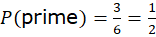 .
.
b) Experimental probability of getting a number greater than 4
Numbers greater than 4 are: 5 and 6.
From the table:
Frequency of 5 = 6
Frequency of 6 = 10
Total frequency for numbers > 4 = 6 + 10 = 16
Total number of trials = 50
Experimental probability  .
.
c) Compare theoretical and experimental probability of getting an even number
Theoretical Probability:
Even numbers on a die: 2, 4, 6 → 3 favorable outcomes.
 .
.
Experimental Probability:
From the table:
Frequency of 2 = 9
Frequency of 4 = 10
Frequency of 6 = 10
Total frequency for even numbers = 9 + 10 + 10 = 29
Total trials = 50
Experimental  .
.
Comparison:
Theoretical probability = 0.5
Experimental probability = 0.58
The experimental probability is slightly higher than the theoretical probability. This discrepancy is expected due to the relatively small number of trials (50). According to the Law of Large Numbers, if the die is thrown a very large number of times, the experimental probability should approach 0.5.
Final Answers:
a) Theoretical P(prime) = 1/2
b) Experimental P(>4) = 8/25
c) Theoretical P(even) = 0.5, Experimental P(even) = 0.58; Experimental is slightly higher.
The theoretical probability in part (a) is rigorously confirmed by its definition, sample space analysis, and correct identification of favorable outcomes.