Discover why Top 1% Students Study Smarter instead of longer. Learn the strategies, mentorship, and learning systems used by students aiming for Ivy League colleges.
Top 1% Students Study Smarter, Not Longer
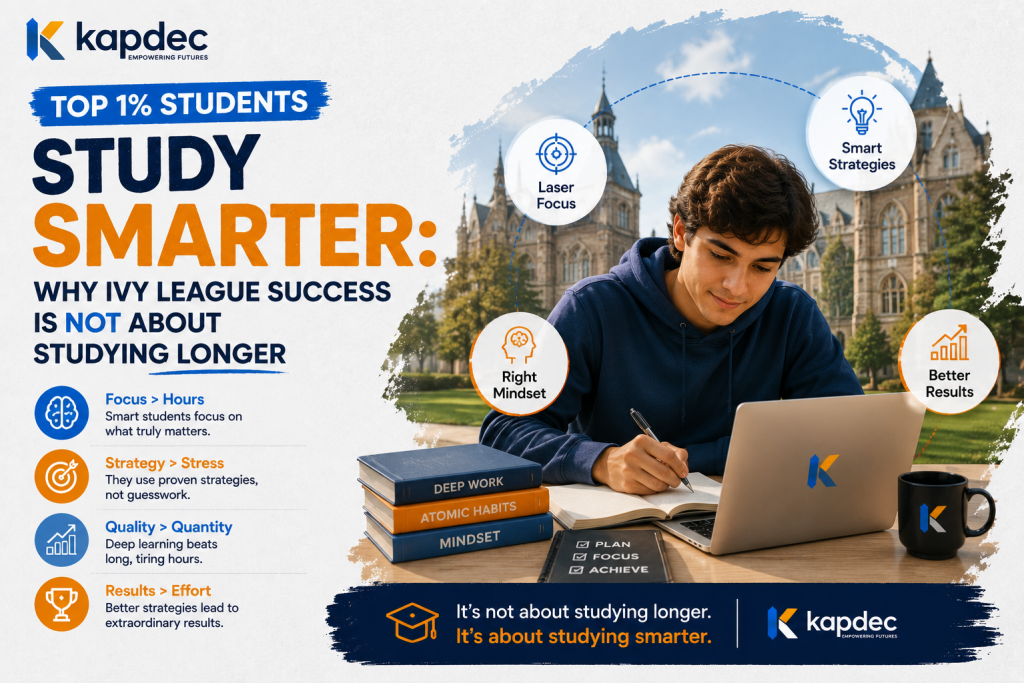
Top 1% Students Study Smarter because they understand something most students miss:
Academic success is not simply about the number of hours spent studying.
Students who reach elite universities like Harvard University, Columbia University, or Wharton School rarely succeed through endless studying alone.
They succeed because they use smarter systems.
They focus on:
- efficiency over repetition
- strategy over randomness
- depth over volume
- consistency over burnout
This is the real reason Top 1% Students Study Smarter.
Why Studying Longer Often Produces Worse Results
Many students believe success comes from studying 10–12 hours daily.
But in reality, excessive studying often leads to:
- burnout
- lower focus
- weak retention
- mental fatigue
- inconsistent performance
According to Kapdec, Students learn more effectively through active learning, focused practice, and strategic study methods rather than passive repetition.
Top-performing students understand this deeply.
That is why Top 1% Students Study Smarter instead of trying to study endlessly.
What Top 1% Students Actually Do Differently
Students aiming for Ivy League admissions focus heavily on systems and optimization.
They often prioritize:
1. Focused Learning Sessions
Instead of studying for long hours without clarity, they study in high-focus blocks with specific goals.
2. Active Recall and Practice
They test themselves constantly instead of rereading notes repeatedly.
3. Identifying Weaknesses Early
Top students spend more time fixing weak areas than repeating comfortable topics.
4. Strategic Mentorship
Many successful students work with mentors who guide them on:
- SAT and ACT preparation
- AP course strategy
- time management
- college application positioning
This is another reason why Top 1% Students Study Smarter.
They do not learn alone [1].
Why Mentorship Plays a Massive Role
Students preparing for elite universities face more than academic pressure.
They also need:
- strategic planning
- confidence
- accountability
- long-term clarity
Platforms like Kapdec, support mastery-based learning, but high-achieving students often combine self-learning with personalized mentorship.
You can also explore our internal guide on Mentorship Shapes Careers Before College to understand how early guidance influences long-term success.
Mentorship helps students avoid wasting time on ineffective study habits.
That is a major reason Top 1% Students Study Smarter.
The Ivy League Mindset: Depth Over Volume
Students targeting universities like Harvard University or Columbia University are often trained to think critically, not memorize endlessly.
They focus on:
- understanding concepts deeply
- solving unfamiliar problems
- developing communication skills
- building intellectual curiosity
This creates stronger academic performance and more impressive applications.
Elite colleges value students who can think independently—not just students who study longer.
How Kapdec Aligns with Smart Learning
Kapdec strongly supports the philosophy that Top 1% Students Study Smarter.
The platform focuses on:
- outcome-based learning plans
- premium mentors and tutors
- personalized academic strategies
- practitioner-led education
Instead of encouraging endless hours of study, Kapdec promotes:
- focused learning systems
- measurable improvement
- strategic mentorship
This helps students achieve stronger outcomes with smarter effort [2].
Why Smart Studying Creates Better Long-Term Results
Students who study smarter often develop:
- better mental health
- stronger confidence
- sustainable learning habits
- improved problem-solving skills
This creates success not only in exams but also in college and future careers.
Because the real goal is not just admission.
It is long-term excellence.
That is why Top 1% Students Study Smarter.
FAQ’s
Why do top 1% students study smarter instead of longer?
Top 1% students focus on efficiency and strategy rather than simply increasing study hours. They understand that quality of learning matters more than quantity. Instead of spending endless hours rereading material, they use focused techniques like active recall, practice testing, and structured revision to maximize results in less time.
How do Ivy League students usually manage their study time?
Students aiming for universities like Harvard University or Columbia University often follow highly structured study systems. They break learning into focused sessions, prioritize weak areas, and avoid distractions. Their schedules are designed around productivity and consistency instead of long, exhausting study hours.
What study techniques do top-performing students use most?
Top-performing students commonly use techniques such as active recall, spaced repetition, mock testing, and concept-based learning. They spend less time passively reading and more time applying knowledge through problem-solving and self-testing. These methods improve retention and understanding much more effectively.
Why is mentorship important for students targeting elite colleges?
Mentorship helps students study strategically rather than randomly. Mentors guide them on exam preparation, time management, academic planning, and avoiding common mistakes. Students preparing for Ivy League admissions often benefit greatly from personalized guidance because competition is extremely high and smart decision-making becomes critical.
Can studying longer actually reduce performance?
Yes, excessive studying can lead to burnout, mental fatigue, and lower concentration. Students who study without proper structure often become less productive over time. Smart studying focuses on maintaining energy, focus, and consistency, which usually produces better long-term academic performance.
How does smart studying help beyond academics?
Smart studying develops valuable life skills such as discipline, critical thinking, time management, and problem-solving. These skills help students succeed not only in exams but also in college, careers, and leadership roles. Learning how to study efficiently creates long-term advantages that go far beyond grades alone.
Final Thoughts
Top 1% Students Study Smarter because they understand that success comes from systems, strategy, and mentorship—not endless hours of stress.
The students who reach Ivy League universities are rarely the ones studying the longest.
They are usually the ones learning most efficiently.
They know how to focus.
They know how to think critically.
And most importantly, they know where to invest their effort.
Because in modern education, smarter learning always beats harder learning alone.