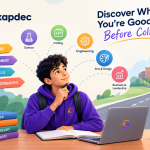
A practical High School Roadmap for making grades 9–12 count through strong fundamentals, STEM exploration, meaningful activities, college preparation, and personal growth.
The Four Years That Matter: How to Make Every High School Year Count
High School Roadmap planning is not about turning teenagers into nonstop achievers. It is about helping students understand that every year of high school can serve a different purpose.
Many students make the mistake of treating freshman year as a practice round. They assume they can become serious about academics, competitions, extracurricular activities, or college preparation later.
By junior year, however, the timeline becomes much tighter.
The strongest high school journeys are usually built gradually. Students develop academic foundations first, explore interests along the way, take on greater challenges, and eventually use their experiences to make more intentional college and career decisions.
The goal is not to make every year perfect. It is to make every year purposeful.
Why a High School Roadmap Should Begin in 9th Grade
Freshman year is often underestimated.
Students are transitioning into a more demanding academic environment while simultaneously developing new friendships, routines, and responsibilities. This makes Grade 9 the ideal time to establish habits that can compound over the next four years.
Students should focus on:
- Building strong mathematics and science fundamentals
- Developing effective study and time-management habits
- Learning how to take organized notes
- Becoming comfortable asking for academic help
- Exploring different subjects and extracurricular activities
- Understanding their strengths and areas for improvement
Freshman year does not need to be filled with impressive achievements. Its primary purpose is to build the foundation.
A student with strong fundamentals in Grade 9 has a much better opportunity to succeed when coursework becomes more advanced later.
Grade 10: Explore, Experiment, and Build Skills
By sophomore year, students generally have a better understanding of their academic abilities.
This is a good time to move beyond simply completing schoolwork and begin testing potential interests.
Students can explore:
- STEM clubs and competitions
- Coding and engineering projects
- Science fairs
- Research opportunities
- Independent courses
- Writing, debate, or leadership activities
- Different academic disciplines
This stage of a High School Roadmap should emphasize experimentation.
A student does not need to know whether they will become an engineer, doctor, scientist, programmer, or entrepreneur. They can investigate these possibilities through actual experiences.
Projects are particularly valuable because they turn abstract curiosity into evidence [1].
Grade 11: Deepen Interests and Increase Academic Challenge
Junior year is often considered the most important year for college preparation, but students who have planned effectively should not be starting from zero.
By Grade 11, students can begin going deeper into areas that genuinely interest them.
This might mean taking advanced coursework, pursuing research, entering higher-level competitions, developing substantial projects, or seeking mentorship.
Students should also begin thinking more seriously about:
- Potential college majors
- College requirements
- Standardized tests where relevant
- Research and internship opportunities
- Academic and career interests
- Building a meaningful portfolio
The key word is depth.
Instead of joining five unrelated activities simply to strengthen an application, students can invest significant effort into two or three areas that genuinely matter to them.
That depth can reveal persistence, curiosity, and developing expertise.
Grade 12: Transition From Preparation to Independence
Senior year should not be treated as the final opportunity to build an impressive profile.
Ideally, much of the groundwork has already been completed.
Grade 12 should focus on:
- Finalizing college applications and decisions
- Maintaining academic performance
- Completing meaningful projects
- Strengthening independent-learning skills
- Preparing for the transition to college
- Developing practical life skills
Students should also reflect on what they have learned about themselves.
What subjects do they enjoy?
What kinds of problems do they like solving?
Which experiences challenged them?
What skills do they want to develop next?
These questions can help students enter college with greater self-awareness rather than simply arriving with a list of accomplishments.
How Academic Decisions Compound Across Four Years
A High School Roadmap works because decisions made early can influence opportunities later.
For example, a student who develops strong algebraic foundations in Grade 9 may be better prepared for advanced mathematics in Grades 10 and 11.
That stronger mathematics background can make physics, computer science, engineering, or data-related courses more accessible.
Similarly, joining a STEM club in Grade 9 can lead to competition experience in Grade 10, a research project in Grade 11, and a substantial portfolio project in Grade 12.
The progression might look like:
Foundation → Exploration → Specialization → Independence
This is much more sustainable than trying to create an impressive profile in the final year of high school.
When Should Students Explore STEM Careers?
Earlier than many families realize—but without pressure to choose a career.
Students can begin exploring STEM careers during Grades 9 and 10 through documentaries, books, clubs, competitions, projects, online courses, and conversations with professionals.
The purpose is not immediate career selection.
It is exposure.
A student cannot make an informed decision about a field they have never experienced.
Why Students Should Not Sacrifice Their Entire High School Experience
A successful High School Roadmap should leave room for more than academics.
Students need friendships, hobbies, physical activity, creativity, family time, and opportunities to simply be teenagers.
Constant pressure can undermine the very curiosity and motivation that education is supposed to develop.
The objective is balanced ambition.
Students should challenge themselves without believing that every activity must become a résumé item.
An experience can be valuable simply because it teaches confidence, teamwork, creativity, resilience, or self-awareness.
How Kapdec Can Support a Four-Year Academic Journey
Kapdec’s mentorship-focused approach can complement a student’s long-term high school development by supporting conceptual understanding, challenging problem-solving, and academic confidence.
Instead of focusing only on immediate grades, students can work toward deeper mastery that prepares them for increasingly complex coursework.
Parents and students can also explore related Kapdec resources such as “Why Your High School Learning Habits Follow You Into College” and “What High School Students Get Wrong About Preparing for College” as part of a broader academic-planning strategy.
FAQ’s
Why should students start planning their high school journey from Grade 9?
Grade 9 is the foundation of a student’s four-year high school journey. Treating freshman year as a “practice year” can cause students to miss opportunities to develop strong academic habits and explore their interests early. Building solid fundamentals in subjects such as mathematics, science, reading, and writing during Grade 9 can make advanced coursework easier later. Students should also begin developing time-management, organization, study, and help-seeking skills that will remain valuable throughout high school and college.
What should students focus on during Grades 9, 10, 11, and 12?
Each year can have a different purpose. Grade 9 should focus on foundations and academic habits, while Grade 10 can emphasize exploration and skill development through clubs, competitions, projects, and independent learning. Grade 11 is a good time to deepen genuine interests, take challenging coursework, explore research, and begin making more serious college plans. Grade 12 should focus on maintaining academic performance, completing meaningful commitments, making college decisions, and preparing for greater independence. This gradual progression prevents students from trying to accomplish everything during their final year.
When should high school students start exploring STEM careers and competitions?
Students can begin exploring STEM careers and competitions as early as Grades 9 and 10. They do not need to decide on a specific career at that age. Instead, they can experiment through mathematics and science competitions, robotics, coding, research projects, science fairs, engineering challenges, and independent courses. These experiences help students discover whether they genuinely enjoy particular subjects and types of problems. By Grades 11 and 12, students can then pursue the areas that have demonstrated the strongest and most consistent interest.
Why is it a mistake to wait until junior or senior year to build a competitive profile?
Building a meaningful academic and extracurricular profile takes time. A student who begins a project, competition, research activity, or leadership role in Grade 11 may have limited time to develop meaningful depth before graduation. Starting earlier allows students to learn from mistakes, improve their skills, take on greater responsibility, and demonstrate sustained interest. More importantly, early exploration is valuable for the student themselves—it helps them discover what they genuinely enjoy rather than participating in activities simply because they appear impressive on a college application.
How do academic and extracurricular decisions compound throughout high school?
Small decisions made in one grade can create opportunities in later grades. For example, a student who develops strong algebra fundamentals in Grade 9 may be better prepared for advanced mathematics in Grade 10 and physics or computer science later. Similarly, joining a STEM club in Grade 9 could lead to competition participation in Grade 10, a research project in Grade 11, and an advanced independent project in Grade 12. This progression allows students to develop depth, confidence, and expertise instead of constantly starting from scratch.
How can students balance academic ambition with friendships and personal development?
A successful high school experience should not be measured only by grades, awards, or college admissions. Students also need time for friendships, hobbies, physical activity, family, creativity, and personal interests. The goal should be balanced ambition—challenging themselves academically while maintaining a healthy and sustainable lifestyle. Not every activity needs to become a résumé item. Some experiences are valuable because they build confidence, communication, resilience, teamwork, or self-awareness. A well-designed high school roadmap prepares students not only for college admission but also for life beyond the classroom.
Final Thoughts
A strong High School Roadmap does not require students to know their entire future at 14, 15, or 16.
It requires them to understand that every year presents a different opportunity.
Grade 9 builds foundations.
Grade 10 encourages exploration.
Grade 11 develops depth.
Grade 12 builds independence and prepares students for what comes next.
When students approach high school this way, academic and extracurricular decisions begin to compound naturally.
The result is not simply a stronger college application.
It is a student who enters adulthood with stronger knowledge, greater self-awareness, better problem-solving skills, and the confidence to continue learning long after high school ends.