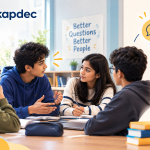
School Projects develop planning, research, collaboration, problem-solving, communication, and execution skills that traditional exams may not fully measure.
School Projects: Why They Can Teach More Than School Exams
School Projects can teach students something that traditional exams often cannot: how to use knowledge when the path to the answer is not already defined.
Exams have an important role in education. They can assess whether students understand concepts, remember information, apply formulas, solve problems, and demonstrate individual knowledge under specific conditions.
But real-world problems rarely arrive as neatly structured exam questions.
There may be incomplete information, competing solutions, unexpected obstacles, changing deadlines, and no single obvious answer.
Projects introduce students to this kind of environment.
Instead of simply answering a question, students may have to decide what question to investigate, how to approach it, what resources to use, and how to turn an idea into a finished result.
That difference can make project-based learning a powerful complement to traditional assessment.
Why School Projects Require More Than Knowing the Answer
An exam usually provides students with a defined task.
A project can begin with something much less certain.
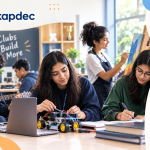
A student might be asked to design a water-filtration system, investigate local environmental conditions, create an app, build a simple robot, or research a scientific question.
The student must first determine how to approach the problem.
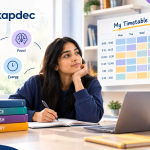
This requires planning, judgment, research, and decision-making before the actual work even begins.
The experience teaches students that knowing information is only the beginning.
The bigger challenge is knowing what to do with that information [1].
Projects Teach Students How to Manage Ambiguity
One of the biggest differences between exams and projects is the level of certainty.
Exam questions generally provide clear instructions and defined conditions.
Projects can be much more open-ended.
Students may discover that their first idea does not work. Their research may reveal information they did not expect. Their prototype may fail. Their original plan may take too long.
These experiences teach an important lesson:
Progress does not always happen in a straight line.
Students learn to adapt instead of simply waiting for the correct answer.
This kind of flexibility is particularly valuable in STEM fields, where experimentation and revision are fundamental parts of the process.
Breaking Big Problems Into Smaller Tasks
Large projects can initially feel overwhelming.
A student might know the final goal but have no idea how to get there.
Projects teach students to break that goal into manageable steps.
For example, building a simple environmental monitoring device might require students to:
- Research the environmental problem
- Identify the measurements needed
- Select appropriate components
- Design the system
- Build a prototype
- Test the device
- Analyze the results
- Improve the design
- Present the final outcome
This process develops structured problem-solving.
Students begin to understand that complicated challenges become more manageable when they are divided into smaller, connected tasks.
The Importance of Deadlines, Feedback, and Iteration
A project does not end when students submit their first attempt.
Good projects involve iteration.
Students create something, receive feedback, identify weaknesses, make changes, and try again.
That process is very different from completing an exam where an answer is generally final once the paper is submitted.
Projects can therefore teach students how to respond to criticism without treating feedback as failure.
They learn to ask:
What can I improve?
What did not work?
What should I change next time?
How Group Projects Teach Accountability
Individual assignments can demonstrate what one student knows.
Group projects introduce another layer: responsibility to other people.
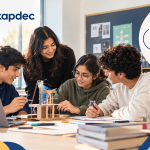
Students have to divide responsibilities, coordinate schedules, communicate expectations, resolve disagreements, and make sure their part of the work is completed.
Sometimes group members will have different opinions about how the project should develop.
That creates opportunities to practice negotiation and compromise.
These experiences connect with [Why Schools Need to Teach Students How to Handle Disagreement], because successful collaboration requires students to communicate differences without allowing disagreements to derail the entire project.
Projects Connect Different Subjects
Traditional school structures often separate subjects into individual periods.
A project can bring them together.
Consider a student designing a small solar-powered vehicle.
The project may involve:
- Physics to understand motion and energy
- Mathematics to calculate measurements and performance
- Computer science to program components
- Engineering to design and test the vehicle
- Writing to document the process
- Art and design to present the final product
Suddenly, knowledge is no longer divided into separate boxes.
Students begin to see how different disciplines interact to solve real problems.
Choice Can Reveal What Students Are Actually Interested In
One of the most valuable aspects of project-based learning is student choice.
When students can choose what they investigate or build within reasonable boundaries, their interests can become more visible.
A student who is not particularly engaged by conventional assignments might become deeply interested in designing a game.
Another might discover an unexpected interest in robotics, environmental science, coding, biomedical technology, or data analysis.
This connects with Why High School Students Should Stop Waiting for College to Discover What They’re Good At.
Projects give students a way to turn curiosity into evidence.
Instead of simply saying, “I like engineering,” a student can demonstrate that interest by designing, building, testing, and documenting something.
Measuring Knowledge and the Ability to Use It
The strongest school projects should not replace academic knowledge.
They should put academic knowledge into action.
A well-designed project can assess whether students understand the underlying concepts while also evaluating how effectively they apply them.
Teachers can assess:
- Conceptual understanding
- Research quality
- Planning
- Problem-solving
- Creativity
- Collaboration
- Execution
- Communication
- Reflection
- Ability to respond to feedback
This creates a broader picture of learning than a single test score can provide.
How Kapdec Can Support Project-Based Learning
Mentorship can make project-based learning even more meaningful through Kapdec.
Students may have strong ideas but struggle to determine where to begin. A mentor can help them define the problem, identify resources, challenge assumptions, evaluate possible approaches, and improve their work without simply doing the project for them.
This approach encourages students to become independent problem-solvers.
The mentor provides guidance.
The student does the thinking, building, testing, and learning.
FAQ’s
Why can school projects teach students skills that exams may not measure?
School Projects require students to do more than demonstrate knowledge under specific conditions. They often involve planning, research, decision-making, collaboration, problem-solving, and completing a final outcome.
An exam may show whether a student can solve a particular problem correctly. A project can reveal how that student approaches an open-ended challenge, responds when something does not work, manages time, and improves an idea. Both forms of assessment can be valuable, but they measure different aspects of learning.
How do school projects help students deal with uncertainty?
Unlike many exam questions, projects may not provide a clearly defined path to the solution. Students may have to decide what information they need, which method to use, and how to respond when their first approach fails.
This teaches students that uncertainty is a normal part of solving complex problems. Instead of immediately looking for a correct answer, they learn to investigate, test possibilities, evaluate evidence, and adjust their approach. These habits are particularly useful in STEM subjects and real-world problem-solving.
What skills do students develop by completing a large project?
Large projects teach students how to break complicated goals into smaller, manageable tasks. They may need to research a topic, create a plan, assign responsibilities, establish deadlines, test ideas, analyze results, and prepare a final presentation.
This process develops planning, organization, time management, critical thinking, communication, and problem-solving skills. Students also learn that completing a meaningful outcome often requires several stages rather than one successful attempt.
How do group projects teach students differently from individual assignments?
Group projects introduce students to responsibilities that individual assignments cannot fully reproduce. Students must communicate with teammates, divide tasks, coordinate deadlines, handle different opinions, and remain accountable for their contribution.
They may also encounter disagreements about how the project should be completed. Learning to discuss these differences respectfully and reach a practical solution helps students develop negotiation and collaboration skills that are useful in college, workplaces, and other team environments.
Why is student choice important in project-based learning?
Giving students some choice over what they investigate or create can reveal interests that traditional assignments may not always identify. A student who seems less interested in a standard lesson might become highly engaged when given the opportunity to build a robot, investigate an environmental problem, create an application, or design an experiment.
Choice can also encourage ownership. When students have a personal connection to the project, they may be more willing to research deeply, overcome setbacks, and improve their final work.
Should school projects replace exams as the main form of assessment?
Projects do not necessarily need to replace exams. They can complement traditional assessments by measuring different dimensions of learning.
Exams can help evaluate individual understanding, knowledge, and the ability to apply concepts under defined conditions. Projects can evaluate how students use that knowledge in more open-ended situations involving research, planning, collaboration, experimentation, and communication.
A balanced approach can therefore provide a broader picture of student capability. The goal is not to choose between exams and projects, but to use different forms of assessment to understand both what students know and what they can do with what they know.