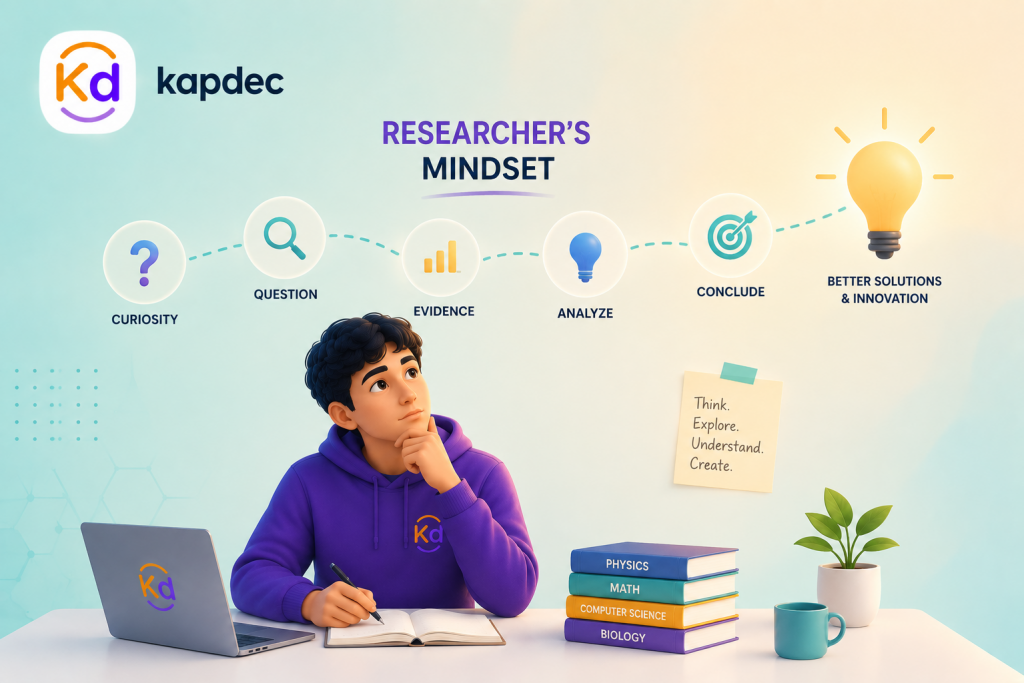
A Researcher’s Mindset in STEM teaches students to ask better questions, test hypotheses, evaluate evidence, embrace uncertainty, and investigate problems instead of simply memorizing answers.
Researcher’s Mindset in STEM: Learning to Investigate Instead of Memorize
Researcher’s Mindset in STEM is one of the most valuable habits a student can develop long before entering a university laboratory or professional research environment.
Traditional classroom learning often revolves around questions with known answers.
Students read a chapter, learn a concept, solve assigned problems, and prepare for an examination.
Research works differently.
A researcher begins with uncertainty.
They ask:
What is happening?
Why is it happening?
What evidence would support one explanation over another?
What if our current assumption is wrong?
This difference changes the role of the student—from someone who receives knowledge to someone who actively investigates how knowledge is developed.
The National Academies identifies asking questions, planning investigations, analyzing data, developing explanations, and reasoning from evidence as core science and engineering practices for K–12 learning.
What Makes a Researcher’s Mindset Different?
A conventional learner may ask:
“What is the correct answer?”
A student developing a researcher’s mindset asks:
“How do we know this is the correct answer?”
That second question requires a completely different level of thinking.
Researchers understand that evidence can be incomplete, measurements can contain uncertainty, and multiple explanations may initially appear reasonable.
Instead of becoming uncomfortable when there is no immediate answer, they become curious.
This ability to work with uncertainty is particularly important in advanced STEM fields, where many important problems do not have predetermined solutions.
Learning to Investigate Questions Instead of Searching for Answers
Search engines and AI systems make it remarkably easy to find information.
But finding information is not the same as conducting an investigation.
Suppose a student asks:
“Does temperature affect plant growth?”
A basic approach might involve searching for the answer.
A researcher-minded student might ask:
- What temperature range should we study?
- What plants should we compare?
- How will we measure growth?
- What variables should remain constant?
- How many observations do we need?
- What alternative explanations could exist?
- What evidence would change our conclusion?
The student has transformed a simple question into an investigation.
That transition is central to the Researcher’s Mindset in STEM [1].
Why Evidence Matters More Than Intuition
Research requires students to distinguish between what they believe and what the evidence actually supports.
A student may predict that increasing temperature will always increase plant growth.
An experiment might produce a different result.
Instead of defending the original prediction, a researcher asks:
“What does the evidence tell us?”
This is an important intellectual habit.
The National Academies emphasizes that students should learn to analyze data, construct explanations, and engage in arguments based on evidence.
The goal is not to prove that the original idea was correct.
The goal is to discover what the evidence can legitimately tell us.
The Importance of Hypotheses and Testable Predictions
A hypothesis gives an investigation direction.
For example:
“If the temperature increases within a specific range, then plant growth will increase.”
The student can then design an investigation to test that prediction.
Importantly, a hypothesis is not a guarantee.
It is a reasoned idea that can be supported, modified, or rejected by evidence.
Students who learn this process begin to understand that being wrong can be productive.
A failed hypothesis can reveal something important about the system being studied.
That is one reason research thinking can develop resilience alongside intellectual curiosity.
Small Experiments Can Build Big Research Skills
Students do not need access to an advanced laboratory to develop a researcher’s mindset.
Small projects can be enough.
A student might investigate:
- Which paper structure supports the greatest weight?
- How does light affect plant growth?
- Does changing an algorithm affect processing time?
- How does surface texture influence friction?
- Which variables influence battery performance?
- How does water temperature affect dissolving time?
The important part is not the complexity of the experiment.
It is the process:
Question → Hypothesis → Method → Data → Analysis → Conclusion → New Question
The National Academies recommends placing investigation and engineering design at the center of science learning because students learn through asking questions, gathering evidence, analyzing information, and revising explanations.
Why Students Should Document Failures and Unexpected Results
One of the biggest differences between ordinary schoolwork and research is how mistakes are treated.
In an examination, an incorrect answer usually means lost marks.
In research, an unexpected result can be valuable information.
Students should therefore document:
- failed experiments
- unexpected observations
- measurement problems
- incorrect predictions
- changes made during the investigation
- questions that emerged afterward
A research journal can become a record of how their thinking developed.
This teaches students that progress does not always happen through immediate success.
Sometimes the most useful discovery begins with:
“That wasn’t supposed to happen.”
How Research Thinking Builds Intellectual Independence
A researcher does not automatically accept the first explanation they encounter.
They compare evidence.
They examine alternative explanations.
They question assumptions.
They look for weaknesses in their reasoning.
They revise their conclusions when stronger evidence appears.
This intellectual independence is becoming increasingly important in an environment filled with online information and AI-generated content.
Students who develop a researcher’s mindset can ask:
Who produced this information?
What evidence supports it?
Could another explanation exist?
How reliable is the source?
Can the claim be independently verified?
These questions help students become better consumers and creators of knowledge.
The Role of Mentors in Developing a Researcher’s Mindset
Students often need guidance to move from curiosity to structured investigation.
A strong mentor does not simply provide answers.
Instead, they ask:
“What do you think is happening?”
“How could we test that?”
“What evidence would convince you?”
“What other explanation could account for the result?”
“What would you change in the next experiment?”
This type of mentorship teaches students how experienced researchers approach uncertainty.
It also helps students understand that good research is rarely a straight line.
It involves questioning, testing, revising, and trying again.
How Researcher Thinking Prepares Students for Future STEM Careers
Research skills are useful far beyond academic laboratories.
Engineers investigate design problems.
Data scientists investigate patterns.
Doctors evaluate evidence.
AI researchers test models.
Environmental scientists study complex systems.
Entrepreneurs investigate whether a proposed solution actually addresses a real problem.
In each case, professionals must work with incomplete information and make decisions based on evidence.
Students who develop research habits early therefore gain more than preparation for university.
They develop a general framework for solving unfamiliar problems.
How Kapdec Can Encourage a Researcher’s Mindset
Kapdec’s mentorship-driven approach can support students in moving beyond traditional answer-focused learning toward investigation, experimentation, questioning, and independent projects.
Students can be encouraged to turn concepts from mathematics, physics, computer science, and other STEM disciplines into questions they can investigate.
This connects naturally with the earlier article Why STEM Students Who Learn to Challenge Assumptions Become Better Problem-Solvers, which explores how questioning premises can lead students toward deeper reasoning and more independent thinking.
The objective is not simply to teach students more information.
It is to teach them how to investigate information, test ideas, and create better explanations.
FAQ’s
What is a researcher’s mindset in STEM?
A researcher’s mindset in STEM is the habit of approaching problems with curiosity, evidence, and a willingness to investigate rather than simply looking for a predetermined answer. Students with this mindset ask questions such as “How do we know this?”, “What evidence supports it?”, and “What would happen if our assumption were wrong?” They become comfortable with uncertainty and understand that mistakes, unexpected results, and failed attempts can provide useful information.
How is research-based learning different from traditional classroom learning?
Traditional classroom learning often focuses on understanding established concepts and finding correct answers. Research-based learning places greater emphasis on asking questions, forming hypotheses, collecting evidence, analyzing results, and developing explanations. For example, instead of simply learning that temperature affects plant growth, students could design an experiment to determine how temperature affects growth and investigate why the results occur. This makes students active participants in the learning process.
Do students need advanced laboratories to develop a researcher’s mindset?
No. Students can develop research skills through relatively simple investigations. They might test which paper structure holds the most weight, examine how surface texture affects friction, compare different algorithms, or investigate how light affects plant growth. What matters most is following an investigative process such as question → hypothesis → experiment → data → analysis → conclusion → new question. Even small projects can teach students how to deal with evidence, uncertainty, and unexpected outcomes.
Why should students learn to accept failed experiments and unexpected results?
In research, an unexpected result is not necessarily a failure. It may reveal that an assumption was incorrect, that another variable was involved, or that the original hypothesis needs modification. Students who document failed experiments and unexpected observations learn to treat setbacks as information rather than personal failure. This builds resilience and encourages them to ask better questions instead of simply repeating the same approach.
How can a researcher’s mindset help students in the AI era?
AI can provide information and answers very quickly, but students still need to determine whether those answers are accurate, relevant, and supported by evidence. A researcher’s mindset encourages students to ask “What evidence supports this?”, “What assumptions were made?”, and “How can I verify this independently?” These habits are especially important when using AI-generated information because students need to evaluate and investigate information rather than accepting it automatically.
How can parents, teachers, and mentors develop a researcher’s mindset in students?
Adults can encourage research thinking by asking questions instead of immediately providing solutions. Questions such as “What do you predict?”, “How could we test that?”, “What evidence would convince you?”, and “What other explanation could exist?” encourage independent investigation. Students can also maintain research journals, conduct small experiments, work on independent projects, and present their findings. With consistent guidance, they gradually learn that not knowing the answer is not a weakness—it is an invitation to investigate.
Final Thoughts
Researcher’s Mindset in STEM is not reserved for students who eventually become professional researchers.
It is a way of thinking that can benefit anyone who needs to solve difficult and unfamiliar problems.
Students who develop this mindset learn to ask better questions, form hypotheses, evaluate evidence, accept uncertainty, document failures, and revise their thinking when new information appears.
Most importantly, they learn that knowledge is not simply something to memorize.
It is something to question, investigate, test, refine, and expand.
The strongest STEM students may therefore not be the ones who can remember the most information.
They may be the ones who naturally ask:
“How can I find out?”
Because learning to investigate is ultimately more powerful than simply learning to memorize.