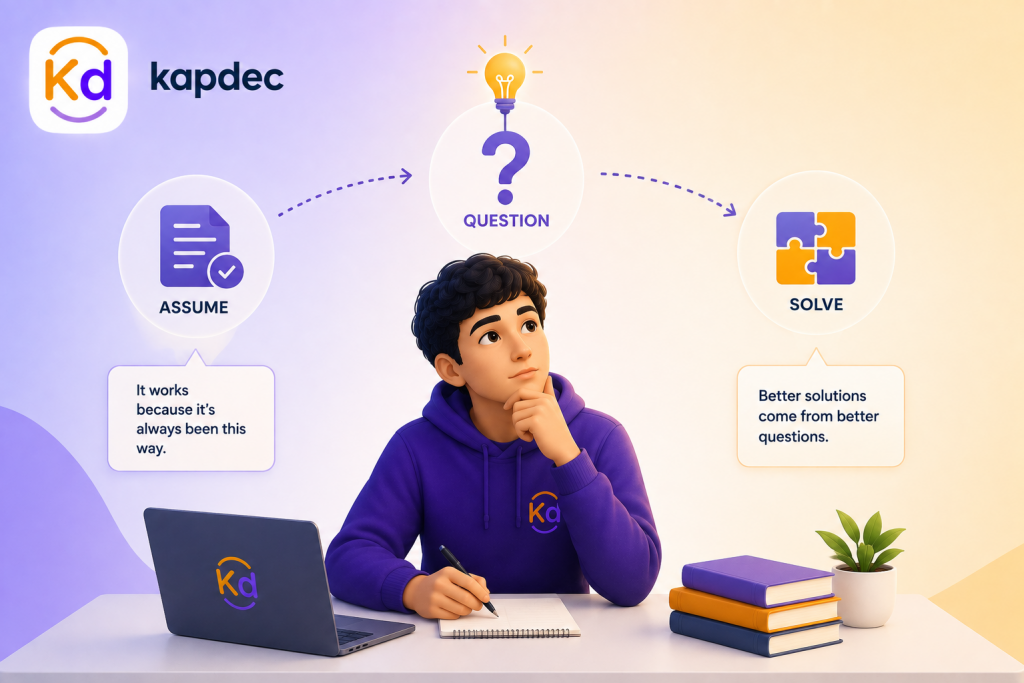
Challenging Assumptions in STEM helps students strengthen reasoning, question premises, identify hidden errors, discover simpler solutions, and develop intellectual independence in an AI-driven world.
Challenging Assumptions in STEM: The Skill Behind Better Problem-Solving
Challenging Assumptions in STEM is one of the most powerful habits students can develop if they want to become stronger problem-solvers.
Students are often taught to identify the information provided in a problem, select the appropriate formula, and calculate the answer.
But advanced STEM thinking requires another question:
“Are we sure the assumptions behind this problem are correct?”
An assumption is something we accept as true without necessarily proving it. Some assumptions are necessary. Others can limit our thinking.
Learning to identify and question them helps students move beyond following established procedures toward independent reasoning, investigation, and innovation.
Why Accepting Every Premise Can Limit Problem-Solving
Many classroom problems are carefully designed with assumptions that make them easier to solve.
A physics problem may assume there is no air resistance.
A mathematical problem may assume a function is continuous.
An engineering calculation may assume a particular material behaves predictably.
A computer science problem may assume unlimited or reliable data.
These assumptions are useful for learning.
But real-world problems are rarely so clean.
Students who automatically accept every premise may become excellent at solving defined problems but struggle when the problem itself needs to be questioned.
Strong STEM thinkers learn to ask:
What are we assuming?
Why are we assuming it?
What happens if the assumption is wrong?
How Challenging Assumptions in STEM Strengthens Reasoning
Questioning an assumption forces students to examine the structure of a problem.
Consider a simple mathematical example.
If a student is asked to find the shortest distance between two points, they may immediately apply a familiar formula.
But what if the points exist on a curved surface rather than a flat plane?
The original method may no longer be appropriate.
The student must reconsider the model itself.
This is an important distinction:
Routine problem-solving asks, “Which method should I use?”
Advanced problem-solving asks, “Is this the right way to represent the problem?”
That second question requires deeper reasoning [1].
Examples Across STEM Disciplines
Mathematics
Students can ask whether a mathematical conclusion depends on a particular condition.
What changes if that condition is removed?
This encourages students to understand why a theorem or method works rather than simply memorizing it.
Physics
Suppose students study projectile motion while ignoring air resistance.
A useful extension is:
What if air resistance were significant?
The question introduces a more realistic model and helps students understand why simplified assumptions were initially made.
Engineering
Engineers frequently work with safety factors and uncertainty.
Instead of assuming that a structure will experience exactly the expected load, engineers ask what happens under unexpected conditions.
Students can similarly ask:
What if the load is twice the expected value?
This encourages risk analysis and systems thinking.
Computer Science
A student may design an algorithm assuming a small dataset.
But what happens when the dataset becomes millions of times larger?
A solution that works efficiently at one scale may become impractical at another.
Questioning the original assumption introduces students to scalability and computational complexity.
Why Skepticism Drives Scientific Discovery
Scientific progress depends on questioning what is already believed.
Scientific skepticism does not mean automatically rejecting established knowledge.
It means asking whether claims are supported by sufficient evidence.
Students should therefore learn the difference between:
Constructive skepticism:
“What evidence supports this conclusion?”
and
Unproductive disagreement:
“I don’t believe this because I disagree.”
The first encourages investigation.
The second simply creates opposition.
Effective STEM education teaches students to question ideas with evidence and reasoning.
How Challenging an Approach Can Reveal Simpler Solutions
Questioning assumptions does not always make a problem more complicated.
Sometimes it makes the solution dramatically simpler.
Students may spend considerable time following a complicated procedure because they assume that every step is necessary.
A more experienced problem-solver may ask:
“Do we actually need to do all of this?”
That question can reveal a shortcut, a symmetry, a different mathematical representation, or an entirely different approach.
Innovation frequently comes from recognizing that a problem does not have to be solved in the way it has traditionally been solved.
How Mentors Can Teach Students to Question Constructively
Students need guidance because challenging assumptions can easily become confused with simply disagreeing.
A mentor can encourage constructive questioning by asking:
- What assumption are you challenging?
- Why do you think it may be incorrect?
- What evidence would support your position?
- What would change if the assumption were removed?
- Can you test your alternative?
- Is there another explanation?
These questions turn skepticism into a structured problem-solving process.
The objective is not to teach students to distrust everything.
It is to teach them to think before accepting.
Why Intellectual Independence Matters in the AI Era
AI systems can provide explanations, calculations, summaries, code, and recommendations within seconds.
That makes information easier to access than ever.
But greater access to information also creates a new challenge:
How do students know whether the information is correct, relevant, or based on a faulty assumption?
Students who simply accept AI-generated answers may reproduce errors without recognizing them.
Students who have developed the habit of challenging assumptions can ask:
What evidence supports this answer?
What assumptions did the system make?
Could there be another interpretation?
Can I verify the result independently?
This makes intellectual independence increasingly important.
AI can accelerate thinking, but students still need the ability to evaluate the thinking behind an answer.
How Students Can Practice Challenging Assumptions
Students can develop this skill through a simple five-step routine:
1. Identify the Premise
What is the problem assuming?
2. Question It
Why does this assumption exist?
3. Change It
What happens if the assumption is different?
4. Test It
Use mathematics, experiments, simulations, research, or evidence.
5. Compare
Which approach produces the stronger explanation or solution?
With practice, this process becomes natural.
Students begin looking beyond the information presented and examining the structure underneath it.
How Kapdec Can Encourage Independent STEM Thinking
Kapdec’s mentorship-driven approach can support students in moving beyond answer-focused learning toward conceptual understanding, questioning, experimentation, and independent problem-solving.
Mentors can encourage students to explain their assumptions, test alternative approaches, and explore what happens when established conditions change.
This connects naturally with our internal article Why the Best STEM Education Happens When Students Stop Asking “What?” and Start Asking “What If?”, which explores how hypothetical questions can transform students from information consumers into investigators.
The goal is not simply to produce students who can solve more problems.
It is to develop students who can recognize which problems, assumptions, and methods deserve to be questioned in the first place.
FAQ’s
Why is challenging assumptions important for STEM students?
Challenging assumptions in STEM helps students move beyond simply following instructions or applying familiar formulas. Many STEM problems depend on specific conditions, and those conditions may not always apply in real-world situations. By asking “Why are we assuming this?” or “What happens if this assumption is wrong?”, students learn to examine the structure of a problem before choosing a solution. This develops deeper reasoning, flexibility, and the ability to recognize problems that require a different approach.
Does challenging assumptions mean students should question everything they learn?
No. The goal is not to make students distrust established knowledge. Constructive skepticism means examining claims using logic, evidence, and context. Students should understand why an assumption exists, when it is useful, and what happens when it no longer applies. For example, ignoring air resistance may be appropriate for introducing basic projectile motion, but students should later understand how including air resistance changes the model. This teaches students to question ideas intelligently rather than simply disagree with them.
How does questioning assumptions improve mathematical problem-solving?
Mathematical problem-solving often becomes more advanced when students examine the conditions behind a method. Instead of immediately asking “Which formula should I use?”, students can ask whether the formula actually applies to the situation. They might investigate what happens if a condition is removed, a variable changes, or the problem is represented differently. This can reveal alternative methods, patterns, shortcuts, and simpler solutions that may not be obvious through routine calculation.
How can challenging assumptions help students in physics, engineering, and computer science?
The skill has applications across almost every STEM discipline. In physics, students can ask what happens when ideal conditions such as zero friction are removed. In engineering, they can consider what happens when a structure experiences loads beyond its expected design conditions. In computer science, they can examine how an algorithm behaves when the amount of data increases dramatically. These exercises help students understand limitations, uncertainty, scalability, safety, and real-world complexity rather than simply solving idealized classroom problems.
How can mentors teach students to challenge assumptions constructively?
Mentors can encourage students to explain their reasoning rather than immediately correcting them. Questions such as “What assumption are you making?”, “What evidence supports it?”, “What would happen if we removed it?”, and “How could we test your alternative?” turn disagreement into investigation. A strong mentor helps students understand that questioning an idea is valuable when it is supported by reasoning and evidence. This develops intellectual independence without encouraging unnecessary skepticism or argument.
Why is challenging assumptions especially important in an AI-driven world?
AI can produce answers, explanations, code, summaries, and recommendations extremely quickly, but speed does not guarantee correctness. AI-generated information can contain errors, misunderstand a question, or rely on assumptions that are not appropriate for the situation. Students who know how to challenge assumptions can ask: “What evidence supports this answer?”, “What assumptions were made?”, and “Can I verify this independently?” As AI becomes more integrated into education and professional work, the ability to evaluate answers rather than automatically accept them will become an increasingly valuable STEM skill.
Final Thoughts
Challenging Assumptions in STEM does not mean rejecting established knowledge.
It means understanding the conditions under which that knowledge applies.
The strongest STEM students learn to ask:
Why is this assumption necessary?
What happens if it changes?
Is there another way to represent the problem?
What evidence supports this conclusion?
These questions strengthen mathematical reasoning, scientific skepticism, engineering judgment, computational thinking, and intellectual independence.
In an AI-driven world where answers are increasingly easy to obtain, the ability to question the assumptions behind those answers may become even more valuable.
The future may belong not simply to students who can find answers quickly, but to those who know when an answer deserves another question.