Discover the hidden systems behind High-Performing STEM Students and how exceptional mentors, smarter learning systems, and higher-level thinking accelerate success.
High-Performing STEM Students Rarely Succeed by Accident
High-Performing STEM Students often appear naturally talented from the outside. People assume they are simply “gifted” in subjects like mathematics, physics, coding, engineering, or computer science.
But the reality is far more strategic.
Top STEM students usually succeed because they develop:
- smarter learning systems
- strong mentorship
- higher-level thinking habits
- disciplined problem-solving approaches
Their success is rarely random.
Behind almost every high-performing student is a system designed for accelerated growth.
Why STEM Education Rewards Systems, Not Just Intelligence
STEM subjects are different from memorization-heavy learning.
Students cannot rely only on reading theory.
Subjects like calculus, physics, programming, and data science require:
- deep conceptual understanding
- logical reasoning
- pattern recognition
- practical problem-solving
According to Kapdec, Students learn STEM subjects more effectively through active learning and problem-solving rather than passive instruction.
This is why High-Performing STEM Students focus heavily on systems and application.
They train their thinking—not just their memory.
The Role of Exceptional Mentors in STEM Success
One of the biggest accelerators for High-Performing STEM Students is mentorship.
Exceptional mentors help students:
- identify conceptual gaps quickly
- develop problem-solving frameworks
- think beyond textbook methods
- avoid ineffective learning habits
Top mentors do not simply explain answers.
They teach students how to approach difficult problems independently.
Platforms like Kapdec offer strong foundational learning resources, but mentorship adds strategy, accountability, and higher-level thinking.
That combination creates massive academic acceleration [1].
Why Smarter Learning Systems Matter More Than Study Hours
Many average students believe STEM success comes from studying longer.
Top students know something different.
They understand that effectiveness matters more than time spent.
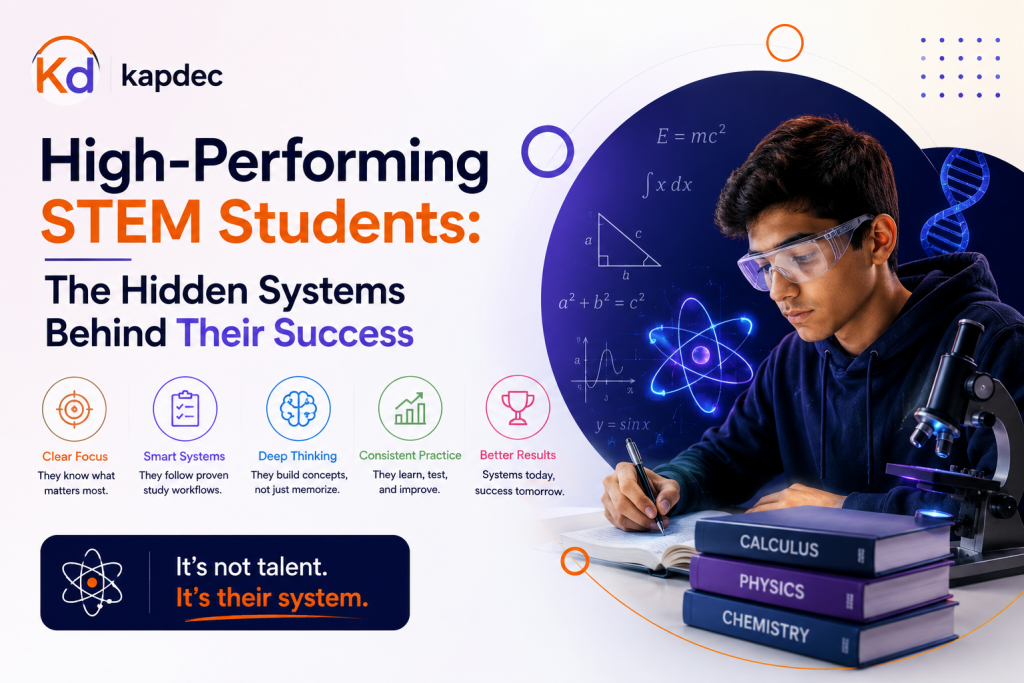
This is why High-Performing STEM Students use systems such as:
1. Active Problem Solving
Instead of rereading notes, they solve challenging problems repeatedly.
2. Weakness-Based Learning
They focus heavily on weak concepts rather than practicing comfortable topics.
3. Layered Learning
They master fundamentals deeply before moving to advanced applications.
4. Structured Revision
They review concepts strategically instead of cramming before exams.
This creates faster and more sustainable improvement.
Higher-Level Thinking Habits Separate Top STEM Students
The biggest difference between average and exceptional STEM students is often mindset.
High-Performing STEM Students develop habits like:
- curiosity-driven learning
- asking deeper questions
- connecting concepts across subjects
- learning independently
- analyzing mistakes carefully
They do not just ask:
“What is the answer?”
They ask:
“Why does this work?”
This shift creates stronger understanding and long-term mastery.
How Mentorship Builds Confidence in STEM Learning
STEM subjects can feel intimidating for many students.
Without proper guidance, students often develop:
- fear of difficult problems
- lack of confidence
- inconsistent learning habits
- dependency on memorization
You can also explore our internal guide on Building Confidence Through Mentorship to understand how mentorship improves academic performance and long-term growth.
Strong mentorship helps students build confidence by teaching them how to think systematically.
This is critical for success in STEM education [2].
How Kapdec Supports High-Performing STEM Students
Kapdec aligns strongly with the philosophy behind High-Performing STEM Students.
The platform focuses on:
- practitioner-led education
- premium mentors with real expertise
- outcome-based learning systems
- personalized STEM mentorship
Instead of promoting endless tutoring hours, Kapdec emphasizes:
- deeper understanding
- strategic learning systems
- measurable academic outcomes
This helps students achieve stronger results through smarter methods.
Why the Future Belongs to System-Based Learners
The world is becoming more technical and fast-changing.
Future STEM leaders will not simply be students who memorize formulas.
They will be students who can:
- think critically
- solve unfamiliar problems
- adapt quickly
- learn independently
That is why systems, mentorship, and thinking habits matter more than raw intelligence alone.
And that is exactly how High-Performing STEM Students continue to outperform others.
FAQ’s
What makes high-performing STEM students different from average students?
High-performing STEM students usually rely on strong learning systems rather than raw intelligence alone. They focus on understanding concepts deeply, solving problems actively, and learning strategically. They also seek mentorship, identify weak areas early, and build disciplined study habits that help them improve consistently over time.
Why are mentors important for STEM students?
Mentors help STEM students develop problem-solving frameworks and higher-level thinking skills. Instead of simply giving answers, they teach students how to approach complex problems logically and independently. This guidance helps students avoid confusion, build confidence, and accelerate their academic growth much faster.
Do top STEM students study longer hours than others?
Not necessarily. Most high-performing STEM students focus more on efficiency than on long study hours. They use focused learning sessions, structured revision, and active problem-solving methods. Their goal is to maximize understanding and retention rather than simply spending more time studying.
What learning systems do successful STEM students commonly use?
Successful STEM students often use systems like active recall, layered learning, mock testing, and weakness-focused revision. They practice solving difficult problems repeatedly and review mistakes carefully. These methods help them strengthen conceptual understanding and perform better in exams and real-world applications.
Why is critical thinking important in STEM education?
STEM fields require students to analyze situations, solve unfamiliar problems, and apply concepts logically. Memorization alone is not enough. Critical thinking allows students to understand why solutions work, connect ideas across subjects, and adapt to advanced challenges more effectively.
How does mentorship improve confidence in STEM subjects?
Many students find STEM subjects intimidating because they involve complex logic and problem-solving. Mentors help simplify difficult concepts, provide encouragement, and guide students through challenges step by step. This structured support helps students gain confidence, reduce fear of failure, and become more independent learners.
Final Thoughts
High-Performing STEM Students are not just studying harder.
They are learning differently.
Their success comes from:
- exceptional mentors
- smarter learning systems
- disciplined thinking habits
- deep conceptual understanding
The hidden advantage is not talent alone.
It is the ability to learn strategically and think at a higher level.
Because in STEM education, the students who succeed the fastest are usually the ones with the strongest systems behind them.
REFERENCES
- Frontiers | STEM career: essential factors for students to achieve success in STEM (supportive individuals, skills/abilities, motivational factors)
- Factors Influencing Student STEM Learning: Self-Efficacy and Outcome Expectancy, 21st Century Skills, and Career Awareness | Journal for STEM Education Research | Springer Nature Link