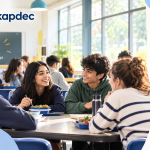
Discover why the Future Belongs to Students Who Can Think Beyond the Textbook and how mentorship, critical thinking, creativity, and problem-solving are becoming essential skills in the AI era.
Why the Future Belongs to Students Who Can Think Beyond the Textbook
Why the Future Belongs to Students Who Can Think Beyond the Textbook is becoming one of the defining questions of modern education.
For decades, academic success was largely measured by how much information students could learn, memorize, and reproduce. Textbooks served as the primary source of knowledge, and mastering content was often considered the ultimate goal.
Today, the landscape has changed dramatically.
With artificial intelligence, search engines, and digital learning platforms providing instant access to information, the value of simply knowing facts is declining. Information is becoming abundant. What remains scarce is the ability to think deeply, reason independently, and solve problems creatively.
As technology continues to automate information access, the students who thrive will not necessarily be those who memorize the most. They will be those who can apply knowledge in ways that machines cannot easily replicate.
Why Information Is No Longer the Ultimate Advantage
One reason behind Why the Future Belongs to Students Who Can Think Beyond the Textbook is that information has become widely accessible.
Students can now find explanations, formulas, tutorials, and research within seconds.
This accessibility creates tremendous opportunities for learning.
However, it also changes what matters most.
Success increasingly depends on a student’s ability to:
- analyze information
- evaluate sources
- identify patterns
- connect ideas
- solve unfamiliar problems
The challenge is no longer finding information.
The challenge is knowing what to do with it [1].
How Deep Thinking Creates Competitive Advantage
Deep thinking allows students to move beyond memorization.
Rather than simply recalling facts, students learn to understand relationships, explore implications, and generate original insights.
Deep thinkers often ask questions such as:
- Why does this work?
- What assumptions are being made?
- How can this concept be applied elsewhere?
- What happens if conditions change?
These questions lead to stronger understanding and greater intellectual flexibility.
In an environment where information is easily available, the ability to think critically becomes a significant advantage.
Why Creative Problem Solving Matters More Than Ever
Many future careers will involve solving problems that do not yet exist today.
This is particularly true in STEM fields.
Engineers, scientists, entrepreneurs, and innovators are frequently required to navigate situations without predetermined solutions.
Creative problem-solving involves:
- generating new ideas
- testing possibilities
- adapting to uncertainty
- learning from failure
- approaching challenges from multiple perspectives
Organizations such as Kapdec have repeatedly identified critical thinking and problem-solving among the most important future workforce skills.
Students who develop these capabilities early position themselves for long-term success [2].
Why Independent Thinking Is Becoming Essential
Another major reason behind Why the Future Belongs to Students Who Can Think Beyond the Textbook is the growing importance of independent judgment.
Artificial intelligence can provide answers.
However, it cannot replace human judgment entirely.
Students must still determine:
- whether information is accurate
- which solutions are appropriate
- how competing ideas should be evaluated
- what ethical considerations matter
Independent thinking enables students to make informed decisions rather than simply accepting information at face value.
This skill becomes increasingly valuable as AI-generated content becomes more common.
The Limitations of Standardized Learning Alone
Traditional education often rewards students for producing correct answers.
While foundational knowledge remains important, real-world challenges rarely present themselves in textbook format.
Complex problems often require:
- interdisciplinary thinking
- adaptability
- experimentation
- collaboration
- innovation
Students who rely exclusively on memorization may struggle when confronted with situations that require original thought.
Those who develop deeper reasoning skills are often better equipped to succeed.
How Mentorship Develops Higher-Level Thinking
Deep thinking rarely develops through information consumption alone.
It grows through discussion, challenge, feedback, and intellectual engagement.
This is where mentorship becomes particularly valuable.
Mentors help students:
- ask better questions
- analyze ideas critically
- challenge assumptions
- connect concepts across disciplines
- think strategically about learning
Rather than simply providing answers, mentors encourage students to develop the reasoning processes that support long-term intellectual growth.
This creates learning experiences that go far beyond traditional instruction.
How Kapdec Prepares Students for the Future
Kapdec’s mentorship-driven approach reflects the realities behind Why the Future Belongs to Students Who Can Think Beyond the Textbook.
Kapdec helps students build capabilities that extend beyond academic content mastery.
This includes:
- critical thinking development
- advanced problem solving
- intellectual curiosity
- strategic learning
- independent reasoning
Students receive guidance that prepares them not only for exams but also for future academic and professional challenges.
You can also explore our internal guide on The New Academic Divide: Students Who Use AI Well vs Poorly to understand how thinking quality increasingly determines success in the AI era.
Why Thinking Skills Will Define Future Success
As technology continues to evolve, many routine tasks will become increasingly automated.
Human value will increasingly come from abilities such as:
- creativity
- judgment
- reasoning
- adaptability
- innovation
Students who cultivate these skills will be better prepared to thrive in uncertain and rapidly changing environments.
FAQ’s
Why is thinking beyond the textbook becoming more important in the AI era?
As AI tools make information instantly accessible, simply memorizing facts is no longer enough to stand out. Students who can analyze information, solve unfamiliar problems, and think independently are better positioned to succeed. The future will increasingly reward those who can apply knowledge creatively rather than simply recall it.
What does it mean to “think beyond the textbook”?
Thinking beyond the textbook means going deeper than memorization and standard classroom learning. It involves questioning assumptions, connecting ideas across subjects, exploring real-world applications, and developing original solutions to complex problems. These skills help students become adaptable thinkers rather than passive learners.
How does critical thinking help students succeed academically and professionally?
Critical thinking enables students to evaluate information, identify patterns, and make informed decisions. In academics, it helps them understand concepts more deeply and tackle challenging questions. Professionally, it prepares them to solve real-world problems, adapt to change, and contribute innovative ideas in rapidly evolving industries.
Why are creativity and problem-solving becoming valuable STEM skills?
Many future STEM careers will involve challenges that do not yet have established solutions. Creativity allows students to explore new possibilities, while problem-solving helps them navigate uncertainty and develop effective answers. Together, these skills make students more capable of handling complex situations that cannot be solved through memorization alone.
Can traditional classroom learning alone develop higher-level thinking skills?
Traditional education provides an important foundation of knowledge, but higher-level thinking often requires additional experiences such as discussion, exploration, project-based learning, and mentorship. Students develop stronger reasoning skills when they are encouraged to analyze, debate, question, and apply concepts beyond standard classroom assignments.
How does mentorship help students become independent thinkers?
Mentors challenge students to think critically rather than simply providing answers. They encourage deeper questioning, expose students to new perspectives, and help them develop sound reasoning processes. Over time, mentorship builds intellectual confidence, allowing students to approach unfamiliar problems with greater creativity, judgment, and independence.
Final Thoughts
Why the Future Belongs to Students Who Can Think Beyond the Textbook reflects a profound shift in education and workforce preparation.
Information is becoming easier to access than ever before.
As a result, the most valuable skills are no longer limited to memorization and content recall.
The students who succeed in the coming decades will be those who can reason independently, solve unfamiliar problems, think creatively, and adapt continuously.
Mentorship plays a critical role in developing these capabilities by helping students move beyond passive learning toward deeper intellectual engagement.
In an AI-driven world, knowledge remains important.
But the ability to think beyond knowledge may become even more valuable.